BookBin2013: Batgirl Volume 2: Knightfall Descends

knightfalldescends

Finally back to my own collection…although, admittedly, this is a recent purchase and not one of those myriad books languishing in the literary limbo of my own devising. Still, this collection and the other two that I recently purchased are stories that I have been waiting to continue for quite a while now. I simply can’t wait to read these.

It’s been since January of this year that I paid a visit to Gotham City to see what’s new with two of my favorite members of the Order Chiroptera. I’ll be talking more about my visit with the Lady Kane soon enough, but this is about the Knightfall Descending upon the lovely Barbara Gordon.

Writer Gail Simone continues to spin quite a yarn for Gordon as she re-acclimates herself with her role as Batgirl. There’s a nice bit of back story in the beginning, a bit of “top of the world for a moment or two” as we see her fighting alongside Batman and Robin, followed by a decision to leave the darkness of fighting the criminal world to live a normal life…only to realize that, as the first issue of this collection points out on its last page, “Sometimes, the darkness finds you.

That darkness is, of course, what Gordon continues to struggle with as she tries once more to regain the full prowess of her role as Batgirl. There is other darkness as well throughout this novel, both within the fortress of Gordon’s personal life as well as throughout the expanses of her home turf. Quite a bit, actually. Gotham’s sinister underside spills into the lives of its heroes, painting every corner with blood and menace, revenge and desperation all the shades of the grimmest spectrum.

Overall, the stories within this novel were interesting enough to keep me reading. I also believe that they are putting into place some elements that will set the stage for even more interesting storytelling to come with Batgirl’s upcoming third collection, Death of the Family.

[Loba Tangent: I have already pre-ordered this collection, which apparently ties in with several other Gotham-related graphic novels that all share the same title, and am counting down the days until its October 29 release. The cover art alone makes me want to get my hands on this one!]

Speaking of art, Ardian Syaf is still doing the bulk of the penciling for Batgirl, and is still doing an admirable job. I’m not really all that fond of the cover of this particular collection (done by artist Stanley Lau). I feel like that cover is all about one thing: “Hey, look, it’s Batgirl’s crotch!” However, Syaf’s still treating Batgirl as if she’s more than crotch shots, butt shots, and boobs. I wish they drew Batwoman a little more like Syaf draws Batgirl.

Speaking of Batwoman (which I like to do quite often, thank you), she makes a crossover appearance toward the end of this collection! And answers that most important question: Who would win in a fight between Batwoman and Batgirl? (Guess you’ll just have to read the novel to learn the answer.) Even though I still think that Batwoman artist J.H. Williams III is the stronger artist, I really liked Syaf’s treatment of Batwoman. He made her a little sportier looking as well, while still giving her the rather…generous proportions that Williams bestows upon her in her own comics. Syaf might be a good choice to take over Batwoman’s world as well, now that…

…but that’s a conversation for another post.

Final Verdict: I liked this collection. I found some of the revelations to be interesting and titillating enough (especially the ones involving Gordon’s family members). I do feel that this was a bit of a “bridge” collection…stories that are not necessarily the greatest, but that are setting us up for something that might transcend greatness in the telling. For that reason alone, I’m glad I picked back up with Barbara Gordon and her Batgirl journeys.
BookBin2013: Locke & Key 2

I can’t believe that it’s been more than a year since Joe Hill welcomed me to Lovecraft. More than a year since I first encountered the Locke family as they began their long emotional journey back from the brutal home invasion in their San Francisco home that left their father murdered and their mother broken in many ways.

It’s been too long. It’s time to catch up on old times, denizens.

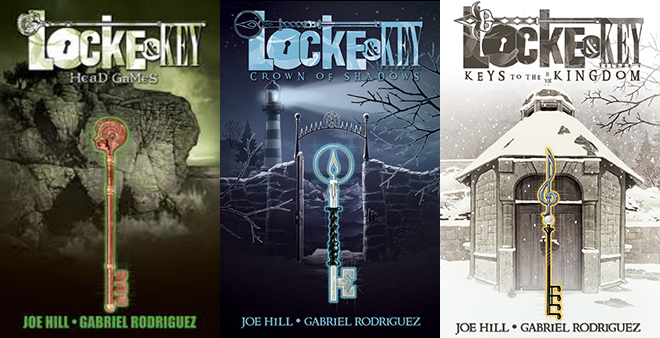
lak2-4

That’s right, I recently succumbed to my need to enter a library and binge on whatever I could find of interest…and part of what I found were the next three graphic novels from Joe Hill and Gabriel Rodriguez’s Locke & Key series: Volume 2: Head Games; Volume 3: Crown of Shadows; and Volume 4: Keys to the Kingdom.

More revelations about the truth behind Rendell Locke’s murder as well as his life in Lovecraft. More keys. More secrets. More discoveries. More darkness.

This is a seriously dark story. I would expect nothing less from Hill

BookBin2013: Lucille

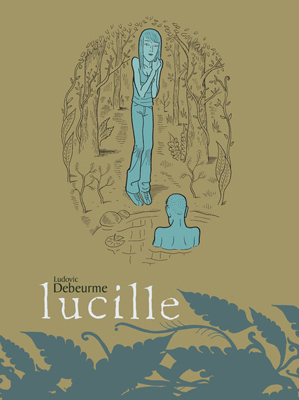
lucille

You might just want to skip this review, denizens, because I’m going to let you know right now: It’s going to be short and unsatisfying.

And, yes, that’s what she said. [ba-dum-tssh]

Ludovic Debeurme’s rather large graphic novel Lucille (I do believe it’s slightly more than 500 pages) is the story of two troubled teenagers

BookBin2013: My Friend Dahmer

mfd

I confess that I borrowed Derf Backderf’s graphic novel, My Friend Dahmer, from the library for equal parts earnest interest in and morbid curiosity about the early life of Jeffrey Dahmer. For those who don’t know who Dahmer is, he was found guilty of incredibly heinous crimes and sentenced to prison, where he was later slain by a fellow inmate. I don’t really want to go into any more detail than that, simply because I’m willing to bet you already know more than enough about what he did.

What you don’t know is why he did what he did. Neither do I, even after reading this novel. I suppose I didn’t really expect to find any concrete answers. I did expect a bit more insight than what Backderf provided. I think, though, for all his claims that he was doing this project out of a need to explore his past relationship with Dahmer and try to understand what happened that led Dahmer from who Backderf knew in high school to who he became, Backderf simply wasn’t up to the task of providing the “objective” look that he said he wanted to give readers. In fact, even though he claims at the beginning of the novel to want to give a more sympathetic look at the events of Dahmer’s youth that could have led him to commit such horrific acts, he then almost immediately calls Dahmer a monster undeserving of empathy.

For a bit of backstory, “Derf” Backderf (his real name is John) was in the same high school class as Dahmer, ran in the same circle of maligned geeks, nerds, and social misfits

BookBin2013: Batwoman Volume 1: Hydrology / Batgirl Volume 1: The Darkest Reflection

batwoman_batgirl

Please don’t think that because I have paired these two books into one review I don’t think they are worthy of their own individual posts. I can assure you, denizens, this is not the case. However, it just so happens that I purchased both of these “New 52” collections at the same time (along with my very own copy of Alan Moore’s The Killing Joke, which I have already reviewed but mention because it will play a part in the following review). I also happened to read these two collections successively, which sparked a bit of “compare-and-contrast” within my swirly brain.

First, a bit of exposition: Both are collections of the first comics for each heroine under the recent DC Comics “reboot.” I use reboot loosely, however, because it kind of was a reboot…but not really. In my mind, a reboot would have meant total tabula rasa for all the characters involved. This wasn’t exactly the case, at least for Kate Kane and Barbara Gordon.

For example, Barbara Gordon is, indeed, once more Batgirl. However, she is still the same Barbara Gordon who was shot at point-blank range by the Joker in The Killing Joke. Part of her history is still those years she spent in a wheelchair and the time she spent known as Oracle, the brains behind the Birds of Prey.

Kate Kane is still the wealthy “playgirl” of Gotham with a military history that was curtailed by “Don’t Ask, Don’t Tell.” She also still carries with her the baggage of dark truths revealed in the anthology Elegy.

So not necessarily a complete reboot in the truest sense of the word. However, it was enough of a reboot to get Gordon back into that Batgirl costume, which I definitely appreciate. Even more, it was enough to get Gail Simone in to take over telling Batgirl’s second chance at bat.

Heh. Get it? Bat. Never mind.

Simone’s name on the cover of The Darkest Reflection is ultimately what lured me into Batgirl’s story. I spoke about my thoughts on Simone’s prowess as a comic writer in my review of Wonder Woman: The Circle. She did wonders (I’m sorry; I’ll stop doing that, I swear) for Diana of Themyscira. She was also responsible for telling Gordon’s tale as Oracle for many issues as head writer for Birds of Prey, so I knew she already had a connection with and understanding of Gordon that most writers wouldn’t already have.

Similarly, it was seeing J.H. Williams, III’s name on Hydrology that lured me once more back into Batwoman’s storyline. Williams was the artistic brilliance behind Elegy, so I knew the art once again would be exemplary. However, this time, Williams was also the writer, taking over the Batwoman mythology from Greg Rucka. I honestly think this was the collection’s biggest weakness. Not only was Rucka a more captivating and comprehensive writer, I think taking on both roles caused Williams’s art to suffer a bit. But only a bit, mind you. Between the two collections, I would choose Williams as the more stunning and unconventional artist. Still, I think that writing and drawing were too taxing for Williams. His artwork was nowhere near as astonishing as it was for Elegy.

Sticking for a moment with commentary on the artwork, I will say this in favor of Ardian Syaf, the artist behind Batgirl’s return: I much preferred his rendering of Gordon as Batgirl to Williams’s rendering of Kane as Batwoman. Batgirl came across as fit, athletic, limber, and lithe. She has a sporty physique and her Batgirl costume is modestly rendered. She looks like she’s ready to do battle with villains.

Batwoman, on the other hand, at times looks like she’s ready to take a spin or two around a pole in Gotham’s redlight district. Pendulous breasts and a generous derriere, covered in latex in a way that leaves little to the imagination, Batwoman is also drawn in a far more provocative manner than Batgirl. Translation: There are lots more stereotypical comic renderings of Batwoman from utterly ridiculous but obviously “male gaze” angles than there are of Batgirl.

Syaf’s take on Batgirl is celebratory of the female form, while Williams’s take on Batwoman comes across many times as exploitative. It’s a shame, really. I want to like Batwoman more than Batgirl, but I find comics that depict women so wantonly to be insulting and, truthfully, kind of sad.

I can’t help but wonder if the moderation of Syaf’s artwork was due to Simone’s presence. Did Simone let Syaf know that she didn’t want Batgirl coming across as one step above a Playboy Playmate? Or did Syaf perhaps refrain from the more lascivious artwork out of deference to Simone? Or maybe it has less to do with Simone and more to do with the one primary difference between the two characters names: Gordon is a Bat girl, while Kane is a Bat woman. Perhaps the “girl” nom de guerre grants her a reprieve from the more pornographic postures?

Of course, this isn’t to say that Syaf didn’t ever present Batgirl in some of those predictably provocative male gaze positions. There are a couple of doozies in this collection, actually. Williams, however, is the guilty party between the two artists when it comes to objectifying artwork.

As for the storytelling itself, I’m going to have to also give my vote to Batgirl. Just as I mentioned in my review of Simone’s writing for Wonder Woman, here she again presents her primary character in a wonderfully and holistically developed fashion. Barbara Gordon is believable, replete with damage, fear, guilty, wonder, and joy. Williams simply fails to provide Kate Kane with the same level of dimensionality, presence, or realism. He gives it the old college try, but, in the end, he lacks the inherent connection with and understanding of Kate Kane that a female writer

BookBin2012: Blacksad: A Silent Hell

blacksadsilenthell

I know, I know: It’s no longer officially 2012. However, I did finish this book last year (ooh, that feels so weird to write), so it still qualifies…even if I was too lazy to get here to post the review before the calendar switched.

You might recall that a couple of years ago, I read and completely fell in love with the first Blacksad collection. Of course, the moment I learned there was a new book, I didn’t even hesitate. I hit that one-click order button on Amazon.com faster than you can say anthropomorphic animals.

This time, rather than being a collection of stories, Blacksad: A Silent Hell is only one story, plus a couple of somewhat lackluster shorts at the end. However, the main story is full of that film noir fury that made the first collection so enjoyable and memorable for me. Also, it’s another chance to enjoy the luscious artwork of Juanjo Guarnido. Honestly, denizens, he’s one of the most amazing artists working in the field today. Each panel is amazing, and honestly I believe he even bested his previous Blacksad work with some incredible artistry for A Silent Hell. Gorgeous. Simply gorgeous.

There’s not much else to say. It’s a gritty detective tale, this time set in New Orleans. I have to admit, I did enjoy the fact that it was set in the Big Easy. I enjoyed even more my own personal “Where’s Waldo” moment when I spotted a character in the foreground of one of the crowded street scenes who was obviously based on the physical characteristics of a very famous New Orleans literary figure. I’ll leave it at that. But I’ll be sure to make a note of his appearance in one of my Big Chief writing tablets. (A nice cold Dr. Nut to the first person to crack this code.)

Guarnido gave an enormous level of effort in getting details of the city and its outlying areas as close to recognizable as possible. So close that at times I could almost hear the rattle of the street cars as they lumbered through the Magazine district or the raging jazz and blues as they tumbled out of open doors and into the deepest corners of the French Quarter. If I haven’t made this point yet to you, please note: Guarnido’s artwork makes every page worth studying, absorbing, enjoying, and finally returning to over and over again.

Final Verdict: Definitely a keeper, already nestled onto my shelf, right next to its “big brother” Blacksad. And thus ends my reading efforts for 2012. I made it to 40 books in 2012, which was 11 shy of my record since I started writing reviews here at the lair and 6 shy of my reads from last year. I’m okay with this. I’m less okay with the fact that I only read 6 books from my own collection while I read 30 from the library. If I’d read 30 from my own collection, I could have almost completely obliterated at least two of the stacks of books piled up around my nightstand! So I’m going to make a concerted effort this year to again focus on my own collection. Is that my resolution? I suppose it is.

Read on, denizens. Read on…

BookBin2012: The Silence of Our Friends

soof

I actually finished Mark Long’s graphic novel The Silence of Our Friends a while ago. However, I wanted to say so much about this novel…and I could never really find the time to write down all the thoughts that I had and all the social commentary I wanted to examine. Things have been so tumultuous lately…but with every day that passed that I didn’t get the chance to write about this, the more heavily it preyed upon me. It wasn’t until this morning that I realized that it had become something so much more than just another BookBin review, and that the proportions to which it had grown mentally were now making it nearly insurmountable.

That’s not what should have happened. That’s not what I ever intended. So, let’s reel it back and start with something simple. Here is the book’s description:

As the civil rights struggle heats up in Texas, two families

BookBin2012: Buffy The Vampire Slayer: Omnibus 1-4

Some of you may already know that I have spent slightly more than a year in the idyllic little slice of hell life known as The Buffyverse. In fact, I just recently finished my sojourn with the viewing of the last episode of Angel.

Being the overachieving geek that I am, of course, I couldn’t leave it at tormenting myself with the shows only. Oh no! There are comics as well, my friends! In fact, both Buffy and Angel continue on in comics-based “seasons.” Prior to this, however, the shows had regular release comics, running concurrently with the shows…just like Star Trek or The X-Files.

Just like Star Trek or The X-Files, these early non-canonical comics are spotty in their storytelling attempts, but more often than not simply awful to behold. On all levels. The artwork is questionable in its best form. In most forms, it’s the equivalent of a hydrochloric eye wash. Seriously, if you cannot find someone able to tell your story in a visually pleasing style, you need to reconsider telling your story in graphic form. Many of the comics are illustrated in poorly chosen styles, some looking so amateurish and off-putting that the artwork distracted me completely from the story itself.

Thankfully, Cliff Richards did a lot of the artwork throughout these first four Buffy the Vampire Slayer: Omnibus volumes. His style is far more aesthetically pleasing than some of the more obtuse styles throughout these volumes, albeit more traditional as well. What can I say? I’m just an old-fashioned wolf at heart, I guess. Not even Richards, however, could meet the challenge of making the characters look like their actor counterparts. This is something that I notice in every show- or movie-based graphic novel tie-in: The comic characters very rarely look like the actors.

I’m somewhat all right with this, but it’s because I have decided that the artists do this as a means of signaling that, hey, this isn’t Sarah Michelle Gellar. This is Buffy. And she only looks like Sarah Michelle Gellar when Sarah Michelle Gellar is playing her. Elsewhere? She looks like this. Or this. Or this. The artist is ultimately true to the character, not the player. Does that make sense?

Of course, that being said, sometimes we then end up with comic characters that look like this little slice of WTF:

And believe me when I state that there were worse visual offenses than this throughout these volumes. For the most part, however, I think my biggest quibble with a lot of the artwork was the fact that more often than not, Willow was a brunette. Um…wha? That’s as irritating as a certain TNG novelist writing that Dr. Crusher has green eyes. Again, if you want to be taken seriously, you kind of have to get basics right. I know I just wrote that the artist must remain true to the character rather than the actor with comics…but when you’re not drawing your characters to look like the actors, you need some kind of universal visual to signal that this is Willow and not Cordelia, which honestly became an issue for me with some of the more non-traditional artwork.

That being said, I would like to hug the artist responsible for the cover art for the third volume of this set. Why?

Well played. So very well played.

Oh, and in case you were wondering, I chose to read the first four volumes of the Buffy Omnibus because they were readily available through our local library. Only these volumes, however. Honestly? I’m okay with that. Only getting to read the first four volumes is more than okay with me.

As for the stories, they were mostly…unmemorable. Some were short little one-shots that made absolutely no sense and held no point beyond the one being wielded by the Slayer against whatever demonic ick she was facing at the moment.

There were standouts, however. Actually, I’m going to say that the first volume in its entirety was the most enjoyable of the four, and very much worth reading. It begins with a graphic rendering of the original Joss Whedon script for the movie that started all this insanity.

Remember that movie? Yeah.

Well, apparently, it was supposed to be much darker…still possessing pop culture awareness, humor, and kitsch, but also infused with deep shades of melancholy and despair.

Kind of like what the show often tried to be.

The original movie story actually wasn’t bad. Neither was the follow-up arc “Slayer, Interrupted,” which chronicled Buffy’s brief institutionalization that was referenced a few times on the show. It also shows the tangential travails of one Rupert Giles, who wishes to earn the Council’s approval as the next assigned Watcher. The Giles storyline is fairly decent as well and plays quite nicely in conjunction with Buffy’s arc, bringing them together slowly and convincingly until they finally cross in good old Sunnydale.

Before we get the recognizable arrangement of Buffy and Giles and the Scooby Gang, however, we get Volume 2’s “A Stake to the Heart.” This was probably my favorite story arc of all four volumes. It details the end of Buffy’s parents’ marriage and Joyce’s subsequent decision to move her daughters to Sunnydale. It’s quite a dark, grim tale in which Angel accidentally releases a band of “malignancy demons” upon Buffy in an attempt to cast a spell to protect her from the miseries and pressures of life that surround her.

Oops.

Admittedly, it’s a silly sounding premise for a story. However, the artwork is the finest of the lot

BookBin2012: The Complete Strangers in Paradise, Volume 1

I’m not quite certain what to make of the first volume of Terry Moore’s Strangers in Paradise.

By no means do I believe that comics need to always be about superheroes or mutants or anything more than everyday life. I point to recent reads like Deogratias, Epileptic, or Blankets…or even further back to Fun Home or This Will All End in Tears as fine examples of how the graphic novel can be a satisfying medium through which to tell tales of normal people experiencing normal things, with beauty, compassion, depth, and sophistication.

Moore seems to be telling a similar tale of normal life in this collection…but not with the level of depth I had hoped for. In truth, his two primary characters seem more like shadows of complexity, shackled to stereotypes that perhaps Moore had originally intended to break through his telling of their tale. Katchoo often comes across as a riotous, man-hating lesbian and Francine is a codependent, overly emotional woman. And of course, Katchoo is in love with Francine, because lesbians can’t be just friends with women.

Look, it’s When Sally Met Sally!

This volume is just the beginning of their story, which apparently lasted quite a while: There are three volumes of Strangers in Paradise, and the third volume is divided into eight parts. The local library has all of those parts…but doesn’t have the second volume at all! I guess it’s a good thing that I didn’t really feel all that invested after reading the first section; I’d be a bit livid right now. Either that or I’d be on Amazon Marketplace, trying to find a cheap used copy. Now look, I can save my money.

Final Verdict: I admit, I am slightly curious about how their story plays out, and if the library did have the second volume, I would probably give it a go. Obviously, there’s something to this story if it lasted long enough to fill out 10 books. Then again, there have been five seasons of Jersey Shore…so, there you go. However, I don’t feel any great sense of loss that I won’t be continuing along with Katchoo and Francine. Back to the library they go.

BookBin2012: Marvel 1602

As anyone who has followed my literary exploits here at the lair already knows, I’m a bit of a Neil Gaiman fan. Even when I don’t particularly like one of his offerings enough to add it to or keep it in my collection, I still am able to find aspects of the story to enjoy and carry with me. And the stories are always intriguing enough that I keep returning to him as one of my favorite modern genre writers.

My latest library discovery belonging to Gaiman is his 2003 graphic novel Marvel 1602. The year is…1602, and strange events are transpiring all throughout the realm of Queen Elizabeth I. Strange meteorological events, the existence of dinosaurs in the New World, disappearing colonists, savages, demented villains…and the premature arrival of some strangely familiar characters.

That’s right: Gaiman transports a large selection of Marvel heroes and villains back in time to Elizabethan England. Part of what I enjoyed most about this novel was trying to deduce who was whom. Some are easy: Sir Nicholas Fury, Dr. Stephen Strange, Peter Parquagh, Sir Richard Reed, Carlos Javier and his “witchbreed” students.

Wait. I always enjoy saying that name out loud a few times. In a bad impression of Mr. Roarke from Fantasy Island. Carlos Javier.

Heh.

Others are a bit more difficult to suss, but they’ll come to you sooner or later. One is actually the key to the early arrival of our favorite Marvel characters into the timeline of Human existence.

Gaiman’s transition of these characters into an earlier historical period is quite well planned and executed. It definitely helps that his tale is supported by a beautiful pencil and coloring collaboration between Andy Kubert and Richard Isanove, with gorgeous “scratchboard” covers by Scott McKowen. The artwork itself has a rather unique appearance. I did a little research and learned that, rather than sending the pencil work first to an inker, Kubert sent his pencil drawings straight to Isanove for digital coloring, creating what is referred to as an “enhanced pencil” technique. It’s a beautiful and unique art style that I enjoyed immensely.

It’s also enjoyable and impressive, how well Gaiman slips his selected Marvel representatives into historical reality, nipping and tucking the timeline or simply splitting it open per his own crazy creative whims. I’m by no means an historical expert, but I’ve studied enough English history and the early history of America to be able to recognize several real events scattered through Gaiman’s story and to be able to laugh at how Gaiman tweaked them for his own purposes.

Because I’m a bit of an all-around nerd, this kind of historical/fictional commingling amused me greatly. Do I think it would be everyone’s cup of tea? Probably not. Hard-core history nerds would probably grind a molar or two flat out of frustration, and hard-core comics fans might find the historical angle more than just a little below their expected “BAM! WHAM! KAPOW! ZING!” enjoyment level.

However, if you find yourself amenable to all variety of nerdery, and especially if you have a bit of a soft spot for Gaiman and/or characters from the Marvel universe, I think this might be an enjoyable exploit.

Final Verdict: I might be tempted to add this to my library at some point, but not today. However, if you do read and enjoy this collection, you might be interested in knowing it spawned three sequels. One was even written by Peter David. Do with that knowledge what you will.