
It seems to be that I’m locked in a m
It seems to be that I’m locked in a m

Remember back when I reviewed volumes 2-4 of Joe Hill and Gabriel Rodriguez’s Locke & Key graphic novel series and stated that I loved those volumes so much that I had already added myself to the library wait list for the fifth volume, Clockworks?
Finally.
That’s right, it took almost 8 months to finally receive the fifth volume…and it subsequently took me less than a day to consume it and still be left starving for more.
I’m not going to go into details other than to say that this volume finally provides the full back story for how Rendell Locke and his friends ended up unleashing the demon that has been plaguing his children. More captivating Hill storytelling set off by beautiful Rodriguez artwork. I cannot reiterate enough that if you love well-crafted horror and stunning illustrations, then these books are a must-read for you.
I’m also going to skip the “Final Verdict” section, because I’m getting these novels. No ifs, ands, or buts. IDW has released the final volume already, so technically, I can go ahead and start stacking up now. I’m torn, though. Do I wait to see if they release a packaged set of all six books? Maybe a special edition set with bonus materials? Or do I just start buying the separate books now?
Decisions, decisions. Mayhaps it’s time to e-mail IDW directly to find out if they have anything planned. To the lair inbox, stat!

If ever you wanted to find a graphic novel to dismiss anyone’s assumption that they are “easy reads,” then this is the book for you, denizens. At more than 400 pages of tightly packed storytelling pleasure, Adam Hines’s Duncan the Wonder Dog, Show One is a visual storytelling blackout of a novel.
To be honest, I wasn’t quite prepared for this level of engagement. I only did a precursory flip-through before adding it to my pile of library books. Once I started in for my first serious session with this story, I realized that it was one of those rare beasts of a book that pulls you into a dazzlingly complicated world, where the story is not confined to the traditional spaces that “normal” tales occupy. The only other book that comes to mind as a fair frame of comparison is Mark Z. Danielewski’s House of Leaves (although his follow-up, Only Revolutions, might be similarly constructed; I’ve yet to read that one). Like Danielewski’s labyrinthine debut novel, Hines’s novel bleeds into the margins, weaves through the backgrounds, trickles down the spine, and floats outward into any space it can infiltrate. It whispers tangential tales along the outskirts of the main story, sometimes making their connections readily known…sometimes making you work to unlock the cipher.
Not only does this novel not occupy the traditional spaces of storytelling, it also does not occupy the traditional parameters of “reality.” For Hines’s characters, animals can speak, philosophize, create, destroy, love, and harm with the same pernicious zeal as humans. In some regards, I could imagine Gerry Alanguilan’s graphic novel Elmer fitting quite well into Hines’s graphic world.
As for the artwork, Hines is quite talented at manipulating a monochromatic color scheme, but his true skill lies within his mastery of shadow and light. Especially light. Natural light. Fluorescent light. Light caressing a weary face. Light piercing a stentorian darkness. Light unrestrained by a two-dimensional depiction. Hines’s rendering of light throughout this novel was a magnificent thing. His complexity of shadows against shadows was almost equally captivating, but it was the light that continued to draw me into this murky, muddled, contrasting world in which humans and animals try to coincide amidst prejudices and long-suppressed hatred that triggers terrorism, investigation, salvation, and damnation, all in pounding waves of stunning line work and shading.
Final Verdict: Even though this book is called “Show One,” and I read that Hines had planned to take the series up to nine volumes, I don’t see any new volumes out there yet. Of course, with this level of detail both in artwork and storytelling, I imagine these things will each take quite a bit of time to produce. So far, I would have to say they are worth the wait. This was well worth the read, and I will happily keep watching for the next show to start…

Publishers Weekly wrote this about Nate Powell’s graphic novel Swallow Me Whole:
Indy comic artist Powell, an Eisner-nominee, works full-time with adults with developmental disabilities, which may have been an inspiration for Swallow Me Whole, a stand-alone graphic novel about two teenage step-siblings with psychological problems. Ruth suffers from obsessive-compulsive disorder and thinks she can hear insects speak, making it difficult for her to walk across grassy lawns but landing her a sweet internship in the natural history museum. Perry sometimes sees a tiny wizard who speaks to him about his destiny, which would be cute if this were a fantasy comic; instead, it’s sadly tragic since Perry recognizes the wizard as nothing more than a troublesome hallucination. It should be obvious from the start that things will not end well. Dark inks and elongated whispering word balloons carry us into Ruth’s world of voices and missing time, while experimental paneling masterfully conveys the characters’ inner worlds and altered states. Powell’s ultimate message remains unclear: Is this a cautionary tale reminding ill teens to take their medication(s)? Or should we take a hopeful message away from Ruth’s tragic story, knowing that one need not give in completely to one’s delusions?
I place this here because I believe this is an excellent summary of a novel that in many ways defies summarizing. Even this tidy little blurb misses so much. Powell delivers a haunting and complicated attempt at viewing the world through the inescapable maze of mental illness. Ruth in particular was poignant in her alienation, tragic in her magnificence. He uses the visual aid of his chosen medium to leave us just as confused, just as lost, just as frustrated and bewildered as Ruth and Perry. His artistry, at times bleak, primitive, decorates the landscapes of Ruth’s and Perry’s world in deep shadows, ghostly gray mists, and sharp lines of light. At times, he erases all boundaries, leaving a page emblazoned with a single image, the surrounding blackness threatening to completely devour it. Sometimes, the nothingness wins…entire pages devoured, formless, empty.
Worth second mention is Powell’s ingenious use of word balloons. Conversations snake through the air in contorted streams, shrink in size and trail away…made pointless by some mental disturbance that steals meaning from spoken words and focuses our attention on the slow disentanglement of our protagonists from reality.
Even though the plots are quite different, Powell’s novel reminded me in many ways of David Beauchard’s graphic novel Epileptic. Both deliver stories involving extremely difficult mental/medical conditions as experienced through younger perspectives. Again, I believe this dismisses the author from having to provide a convoluted (and possibly overwhelming) level of medical explanation, instead allowing us to experience the transpiring events on the same level as the main characters.
Final Verdict: While I don’t know if I would like to add this book to my own library, I’d be interested to see if Powell is able to provide the same level of power and control. Perhaps reading some of his other works would inspire me to want to bring several of his works into my graphic novel collection.

First graphic novel of the new year! Alex Robinson’s Tricked initially caught my eye because of its cover. It’s quite appealing to a child of the 80s (it also made me want a companion book emblazoned with a pencil on its cover; awkward cassette tape humor, FTW).
If I were to boil down this novel into one sentence, it would be that this is one of those “strangers suddenly linked by a common experience” stories. We’ve seen quite a few of these types of stories recently; if it works once, it will work hundreds more times, right? I could even argue that Rowling’s The Casual Vacancy could qualify as this type of story, since many of the residents of Pagford really didn’t know each other at all (most especially the ones who were related or married).
The question is, was Robinson’s take on this storyline successful? To qualify, he would need to create characters who are not necessarily likeable but complex enough to pique reader interest, as well as story arcs that join together in believable ways and lead to a captivating conclusion. As to the latter part of these requirements, I feel ambivalent. In some ways, I felt that the ending, while not what one might expect, was more satisfying. Conversely, the failure of meeting fully the expectations of the former requirement meant that the ending lacked the punch that it might have carried, had all the characters been interesting.
I will say, however, that two characters in particular shine: a paranoid schizophrenic who decides to stop taking his medications, and a waitress struggling to overcome body issues ingrained upon her by a string of abusive relationships. Both characters are believable in discomfiting ways. Both characters, for primarily subjective reasons, caused me to engage in a great deal of internal debate regarding their behavior, their choices, and at times their insufferable behavior. It’s a shame that the other characters couldn’t incite this level of response from me, but I applaud Robinson for taking the time to craft these characters so well.
Lest we forget that this is a graphic novel, I should acknowledge that Robinson’s illustrations are somewhat tame but clean and controlled, with the occasional inspired use of space and his monotone palette. Overall, his artwork is enjoyable while in the midst of the novel but not memorable enough to remain with me.
Final Verdict: I like Robinson both as a storyteller and an illustrator, and since my new favorite thing is to search the county library catalog and put holds on books, I’ll have to see if they have anything else of his that I can give a go.

Yes, that’s right…one more BookBin review for the late, great 2013. I didn’t completely finish this one last year, but I finished the bulk of it…so it counts, dammit.
To be honest, I felt mostly lost the entire time that I was reading Batman R.I.P., written by Grant Morrison and illustrated by Tony S. Daniel (with cover art by the impeccable Alex Ross…who likes Batman’s eyes to be brown while the book artist makes them blue). I don’t really follow Batman in the comics. I know enough about him through comic book osmosis, the 1960s show, and the Tim Burton movies (well, at least the first one was awesome). The only thing the Christopher Nolan movies taught me was that I could really hate Batman under the right circumstances.
Nolan’s movies also taught me that I really don’t like The Joker being played as totally psychopathic and cruel. He needs to have some kind of softening humor to him. Some kind of Cesar Romero or Jack Nicholson joie de vivre. Without that whimsy, he’s just…like any other psychotic killer. Even Alan Moore’s Joker was more interesting than the way the character comes across now. And having him split his tongue with a straight razor (SPOILERZ) so that it looked like a serpent’s tongue? That was around the point when I kind of shut down on that character. I can’t help it. I grew up with Romero’s kooky, loveable Joker and “This town needs an enema!” Nicholson Joker. Besides, why does everything have to be so sick and twisted and dark anymore? Tongue-splitting Joker. Neck-breaking Superman. Spoilerz. What happened to having fun with these stories?
I get that Batman’s had a rough life. As rough as a life can be for a multimillionaire who never has to work an honest day in his entire life. I guess we should be thankful that he wants to do good and fight evil rather than jet off to Bora Bora every weekend with his latest fling. Still, lighten up, Brucie. Dark Knight is Dark. And mopey. Then again, this is called “Batman R.I.P.” Moping is allowed, I suppose, when everyone is always trying to kill you.
All in all, it was an entertaining read with some really fine artwork, even if: A) I felt like I was missing key information while reading parts of it; and B) It does go a bit off the rails here and there (although maybe those moments would have made more sense if I’d had all the pieces to the puzzle). Also, no one is ever going to believe that any of these characters is ever going to really die. People who don’t really die: Star Trek characters and comic book heroes. Whether they come back as half-Romulan hybrids or they’re rebooted back into existence, they’re always going to be around. Not even having a bridge dropped on him could stop Captain Kirk, in the books at least. SpoilerZ. So at no point did I ever believe that Batman was really going to die. Also, I have the pleasure of being in the now and knowing that Batman does, indeed, still live.
I also don’t really get the back story for all the different Robins. Yeah, I know that one of them is now Nightwing. And I think one of them is dead (okay, so some characters do die…but only the replaceable ones). Not that I really care all that much. Still…it feels like there’s something questionable going on in Gotham that they keep remanding all these boys over to Bruce Wayne’s care but not investigating when they “go missing.” Maybe that’s just me. I had to laugh at the appearance of original Batwoman, in her yellow onesie and her Bat lust for Bruce Wayne. Oh, Katy Kane. You so cray.
And now excuse me while I wash my brain out with peroxide for actually using the word “cray.”
Final Verdict: Even though I found the novel enjoyable enough to finish it, I guess it’s safe to say that I’m not much of a Batman comic fan. I still love the original series and I still love the Tim Burton movie. I also like the concept of the character, for the most part. However, I think I find others from the Bat Family more interesting than the Dark Knight. Still, I’ve got a “classic” Batman graphic novel in my collection that I need to finally read. I’ll let you know how that goes…
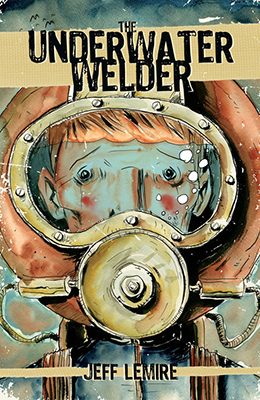
I nearly put Jeff Lemire’s graphic novel The Underwater Welder back before even giving the story a proper go. Why? Because the Introduction’s author likened the story to “the most spectacular episode of The Twilight Zone that was never produced.” That’s not what set me off; I actually love The Twilight Zone. What set me off was the author himself: Damon Lindelof. Otherwise known as “The Butcher of GallitepStar Trek Movie Scripts.”
My honest initial reaction was, if Lindelof knows as much about The Twilight Zone as he does about Trek, then no thank you. However, I resisted the temptation to judge the book based solely on the questionable choice of Lindelof as the one responsible for introducing this novel. And I’m very glad that I did.
Lemire’s story of Jack Joseph, he of the titular profession, is equal parts eerie, surreal, mysterious, and moving. Jack is facing the life change of a newborn son
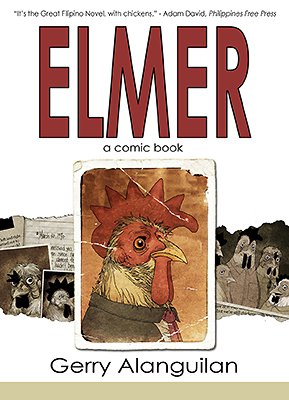
Another graphic novel posing another allegorical examination of another human flaw. This time, rather than examining our obsession with war by putting animals in the path of bullets instead of humans, we examine humanity’s intolerance of those who are different…through racism toward sentient chickens.
I know, denizens. I know.
Actually, though, sometimes the best way to get someone to think differently about a topic or to look at it with fresh eyes is to pull it out of familiar settings and turn it on its head a bit. Why do you think Star Trek has been so popular for so many years? When we remove these topics from the realm of the familiar and put them in unexpected settings, we’re forced to view them in new ways. Perhaps even view them in ways opposite from how we would typically view them.
Such is the case with Gerry Alanguilan’s graphic novel Elmer. Part social commentary, part family drama, the novel tells the story of the strange and sudden evolution of chickens into creatures capable of intelligent communication and interaction with humans, and what this means for a global society forced to accept that what was once part of the dinner menu at McDonald’s now demands the same rights and freedoms as any other sentient being.
Where my previous BookBin review left me feeling quite depressed, Elmer left me feeling amused as well as enamored of the fact that Alanguilan succeeded, for even the briefest of moments, in encouraging me to re-examine my rather carnivorous eating habits. What would I do if, tomorrow, chickens actually did start speaking? Or, even worse, cows? How would we deal with no longer being able to depend upon these creatures for sustenance?
Insert parallel comparison with slavery and emancipation. Minus the consumption. Again, always interesting when someone can force us to view old arguments through new lenses.
Sadly, I’m still just a carnivore at heart. I’ve greatly reduced my meat consumption in recent years, particularly my red meat consumption. But sometimes…sometimes. Sorry, Bessy, but sometimes I just need a steak.
Final Verdict: I might be tempted to add this to my wish list, just to keep an eye out for a cheap copy through Amazon Market Place. It was an interesting enough concept executed in a captivating enough way that I wouldn’t be averse to revisiting it later on (could I sound any more non-committal?).

Obviously, I’ve been hitting up the library quite a bit in this last half of 2013. This past trip, I spent even more time than usual in the graphic novel section. Seems they got a new shipment of books in recently, and I couldn’t help myself. That’s the only way I can explain how I ended up with this strange three-comic collection, We3, written by Grant Morrison and illustrated by Frank Quitely (Scotland Tag Team, woot!).
“We3” stands for “Animal Weapon 3,” a government experiment to turn common house pets into lethal weapons. This particular group of weaponized animals, the third in a series of tests, consists of three pets stolen from the streets: a brown Labrador mix named Bandit, a tabby cat named Tinker, and a black and white rabbit named Pirate (yeah, I’m not really sure why the rabbit was hopping out on the streets either). They are reclassified (rather originally) as “1,” “2,” and “3” and outfitted with body armor that contains missiles, razor-sharp claws, machine guns, and mines. Scientists also somehow soup up their brains to a point where they can speak in rather rudimentary ways.
Yes, before you even say it, the basic story does sound a bit silly. Then again, with a culture as obsessed with war and destruction as we are, sometimes I wonder if we even have limits to what we would be willing to do in the name of defending ourselves.
Beyond finding the concept both silly and disturbing, I just felt depressed after reading this book (even with the questionably “happy” ending). Still, kudos to Morrison for writing a compelling story and to Quitely for beautiful artwork.
Final Verdict: This series posed an interesting (and definitely unsettling) question about our limits when it comes to war, but I don’t feel as if it’s a question that I want to revisit exploring. Perhaps that’s my own unwillingness to face this particular darkness that surges through humanity and that could actually cause us to consider doing something like this…or worse. We send children to die “for [insert deity of choice here] and country” all the time. Sometimes, even someone as jaded and dark as I can be prefers to put some things out of mind.

I told you I’d be speaking of the Lady Kane very soon. I bought all three of these graphic novels at the same time, and while I enjoyed Batgirl’s collection immensely, it was really all about Batwoman for me. These two graphic novels, To Drown the World and World’s Finest, barely made it into the house before I was flipping through them, devouring the visuals, squeeing at the snippets that my brain was able to process on a first-blush review, and then champing at the bit in anticipation of the story that awaited me.
Admittedly, I might have enjoyed the second Batgirl collection a bit more if I wasn’t so looking forward to these two novels. Sorry, Batgirl.
Truthfully, though, I was a little bit…not necessarily disappointed by the second Batwoman collection…but definitely not as enamored of it as I was of her first go in the New 52 universe. One of the primary reasons is a pretty obvious one. J.H. Williams III didn’t do most of the artwork for this collection. He and W.H. Blackman were busy writing the story, so a lot of the interior art was done by Amy Reeder, Trevor McCarthy, and Pere Perez, with Guy Major doing the coloring. Not that this made the artwork terrible…but Williams is such a masterful artist that not seeing his work makes you painfully aware of how unlike Williams most other artists are.
Plus, there are a lot more “male gaze/crotch/butt/boob” illustrations of Batwoman in this novel than previously, which I found very distracting. These particular poses die down after a while, but the fact that they’re in there at all really annoys me. Batwoman isn’t here to titillate you with pendulous breasts and a latex-clad badonka-donk. She’s here either to save or kick your ass, depending on which side of the law you choose. Also, if you’re turning to comic books for that kind of titillation? Here’s a little bit of advice: Women, even the comic book variety, are on this planet for more than your ogling. Also? Batwoman is not interested in you.
Williams and colorist Dave Stewart return to the drawing table for the comics that make up the third volume, giving even more credence to the collection’s title, World’s Finest. Not to mention the fact that the third volume’s writing is that much stronger…and there’s the fact that another DC Comics heroine makes a guest appearance throughout this collection, making it that much more amazing.
But first, the second volume. Just as I stated in my review of Batgirl’s Knightfall Descends, I feel like this second collection is a bridge collection, with story arcs designed to get us from the amazing work in Hydrology to World’s Finest. It’s still a solid offering (probably more so that Knightfall Descends) and carries the plot forward in strong ways.
The payoff, however, is the third volume, which is brilliant from start to finish. Plus? Wonder Woman. Yeah, that’s right. Wonder Woman plays a major part in this collection as she agrees to team with Batwoman to help defeat the latest menace to threaten the residents of Gotham City.
[Loba Tangent: Why are there even still people who live in Gotham City? I’m sorry, but not even knowing that Batwoman had my back would make me want to…okay, never mind. I would totally stay in Gotham if Batwoman was there to protect me. Carry on.]
Seriously, denizens, the third volume of the Batwoman story is ace all the way. Williams and Blackman are so on-point throughout, and Williams’s artwork shines as always. He makes the graphic novel experience such an immense joy, even when depicting some of the darkest, most gruesome moments. And believe me when I say that Batwoman’s world is incredibly dark and incredibly gruesome.
To be honest, this third volume made me believe that Batwoman could totally convey to a movie experience. This is definitely in part to Williams being such a masterful artist…his vision of Batwoman’s world is absolutely cinematic. Plus, the fantastical villains and epic battles would look amazing on a big screen. It definitely helps that the writing is so great as well. I know I said before that I didn’t think Williams was as strong a writer as he is an artist, but I do believe that the combo team of Williams and Blackman nail this story in such amazing ways. They both have hit such a stride, not only with the large-scale story arcs but also with the smaller, more intimate character developments. They also do a fantastic job on inner monologues, something that Gail Simone does with equal (and at times greater) mastery with her Batgirl writing. Plus, using this particular storyline would also bring Wonder Woman to the big screen, which is something that I fear might never actually happen unless she rides in on someone else’s coattails…or cape. All the better if she came in, lariat blazing, with another bad-ass comic heroine!
Of course, my high praise and adoration for the third Batwoman graphic novel makes the recent shakedown at DC Comics all the more disappointing and upsetting. Williams and Blackman have walked away from Batwoman because of DC Comics brass interfering in story lines that they had already greenlit. Story lines that should be allowed to be completed. I was willing to be a little less decisive about this until I read these latest offerings, but now that I have? I so very much would love to see the continuation of this story that Williams and Blackman wanted to tell. There’s a fourth collection that will contain what I think are the last of Williams and Blackman’s contributions to Batwoman…so at least there’s that. Still, I can’t even begin to express my disappointment that they have left…and have taken an amazing story with them.
Final Verdict: Not only am I keeping these (der), I’m also going to finally pick up Wonder Woman’s New 52 novels. Her story is currently being told by Brian Azzarello. I’m not that fond of his writing style, as I previously indicated in my review of his Joker graphic novel. Also, Cliff Chiang is in charge of the artwork. I’m not really all that crazy about his style either. Unless, of course, he’s drawing Wonder Woman as Joan Jett. Otherwise, meh.
Obviously, not really liking the writer or the artist are two major reasons to stay away from Wonder Woman. However, I kind of feel a bit schmucky that I’m not supporting Wonder Woman. I’ll at least give the first novel a go. We’ll see where it goes from there…
