BookBin2013: Voices from the Street

pkd_vfts

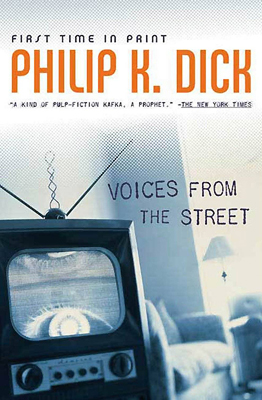
Here’s a visit with a favorite author who hasn’t made a BookBin appearance since I reviewed his novel Flow My Tears, The Policeman Said back in 2009. Anyone who knows me knows that I love Philip K. Dick. While I haven’t read a lot of his works, I have always regarded the ones that I have read as top-shelf contributions to the science fiction genre. One of my ongoing frustrations with our local library (which for all intents and purposes, is quite lovely in almost every regard) is that the only one of Dick’s novels that they’ve had in a very long time is Do Androids Dream of Electric Sheep?

Own it. Love it. Want something new.

So when I did a random database search on a whim and discovered that they were hiding one of Dick’s books somewhere other than the science fiction section, I could barely keep from running to the location. Seems that one of his earliest rejected manuscripts, penned sometime in the 1950s, finally made it into print in 2007. Surprisingly, Voices from the Street is not a science fiction book. It’s as grounded in present-day reality (for the time it was written) as anything could possibly be.

The story centers on Stuart Hadley, a young handsome lad with a pretty wife, a new baby boy, and a dull but promising job selling televisions. He’s also coddled, disaffected, and temperamental, with a constant sense that he was meant for more than the confines of his “normal” life. He wants to be an artiste, bohemian, spiritual, separate. He seeks fulfillment through various means and…well, in the end, it’s truly a Philip K. Dick novel, even without the electric sheep.

In this novel, Dick captures several personality layers through an array of complex and disparate characters…the damage of disconnectedness left by war, the ennui of privilege, the false witness of spirituality, the emptiness of having, the futility of wanting. His prose is dark, direct, never afraid to keep plummeting down the rabbit hole, never feeling the need to hold back on anything. His dialogue is vicious at times as his characters hold conversations reserved either for the closest of friends or the people one deems unworthy of censorship. Characters are blas

BookBin2013: A Curious Man: The Strange and Brilliant Life of Robert “Believe It Or Not!” Ripley

curiousman

Two of my all-time favorite things when I was a kid were as follows: watching episodes of Ripley’s Believe It Or Not! on Sunday evenings before bed, and getting to visit the Ripley’s museum whenever we made it to Myrtle Beach. I have always had a love affair with the bizarre or mysterious or just plain gross or scary, so these two treats fed right into my fascinations…it wasn’t until I was much older that I started to understand the exploitative implications of a lot of the people the Ripley museum “showcased.”

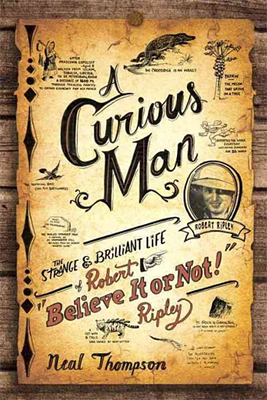
It also wasn’t until I was much older that I realized that the “Ripley” of Ripley’s fame was an actual person. What? I never claimed to be 100-percent on the ball all the time, denizens. Needless to say, it’s no surprise that I hardly knew anything about LeRoy Robert Ripley beyond the obvious fact that he had a penchant for peculiarities. From this approach, then, I found the details of Neal Thompson’s Ripley biography A Curious Man both fascinating and at times, yes, unbelievable.

Mostly, I think I find it unbelievable how much money cartoonists once made, how like rock stars they were treated by their employers and readers alike. I suppose it should make more sense to me than the celebrity status we so willingly award to the most undeserving of crassness today (“reality” television is a poisonous thing, indeed). Those early comic strip pioneers, including Ripley, at least contributed something to the pantheon of creativity…something more substantial than the stain of fake tan smeared across our collective conscience.

Besides, this was a time before cable television and multiplex theaters. It was a time before world travel was an acceptable option and we dared envision connecting with anyone beyond the boundaries of our ZIP code or even the parameters of our humble little neighborhoods. To experience the wonders and terrors that the world had to offer required a contact, a willing conduit to allow the flow of information from the farthest regions down into Main Street, USA. Someone like Ripley, who gladly would uproot and take to the skies, the seas, the snows, the sun-drenched jungles…wherever he had not yet journeyed, had not yet taken his readers.

Thompson’s biography provides all this information and more on Ripley, from his early days through his rise to fame, his comics, his museums, his radio shows…perhaps even beyond that. Sadly, I ran out of time and had to return this to the library before I could finish it. However, what I did read of this book was quite fascinating, not just in regard to the man but also to where he grew up, where he lived, and where he traveled. Thompson does quite a lovely job of making his biography well-researched, well-rounded, and well-received by readers, including me.

Final Verdict: I would like to check this one back out of the library at some point, so that I can finish the few chapters I had left, and perhaps I’ll add it to my wish list for future buying. Believe it…or not!

BookBin2013: Batgirl Volume 2: Knightfall Descends

knightfalldescends

Finally back to my own collection…although, admittedly, this is a recent purchase and not one of those myriad books languishing in the literary limbo of my own devising. Still, this collection and the other two that I recently purchased are stories that I have been waiting to continue for quite a while now. I simply can’t wait to read these.

It’s been since January of this year that I paid a visit to Gotham City to see what’s new with two of my favorite members of the Order Chiroptera. I’ll be talking more about my visit with the Lady Kane soon enough, but this is about the Knightfall Descending upon the lovely Barbara Gordon.

Writer Gail Simone continues to spin quite a yarn for Gordon as she re-acclimates herself with her role as Batgirl. There’s a nice bit of back story in the beginning, a bit of “top of the world for a moment or two” as we see her fighting alongside Batman and Robin, followed by a decision to leave the darkness of fighting the criminal world to live a normal life…only to realize that, as the first issue of this collection points out on its last page, “Sometimes, the darkness finds you.

That darkness is, of course, what Gordon continues to struggle with as she tries once more to regain the full prowess of her role as Batgirl. There is other darkness as well throughout this novel, both within the fortress of Gordon’s personal life as well as throughout the expanses of her home turf. Quite a bit, actually. Gotham’s sinister underside spills into the lives of its heroes, painting every corner with blood and menace, revenge and desperation all the shades of the grimmest spectrum.

Overall, the stories within this novel were interesting enough to keep me reading. I also believe that they are putting into place some elements that will set the stage for even more interesting storytelling to come with Batgirl’s upcoming third collection, Death of the Family.

[Loba Tangent: I have already pre-ordered this collection, which apparently ties in with several other Gotham-related graphic novels that all share the same title, and am counting down the days until its October 29 release. The cover art alone makes me want to get my hands on this one!]

Speaking of art, Ardian Syaf is still doing the bulk of the penciling for Batgirl, and is still doing an admirable job. I’m not really all that fond of the cover of this particular collection (done by artist Stanley Lau). I feel like that cover is all about one thing: “Hey, look, it’s Batgirl’s crotch!” However, Syaf’s still treating Batgirl as if she’s more than crotch shots, butt shots, and boobs. I wish they drew Batwoman a little more like Syaf draws Batgirl.

Speaking of Batwoman (which I like to do quite often, thank you), she makes a crossover appearance toward the end of this collection! And answers that most important question: Who would win in a fight between Batwoman and Batgirl? (Guess you’ll just have to read the novel to learn the answer.) Even though I still think that Batwoman artist J.H. Williams III is the stronger artist, I really liked Syaf’s treatment of Batwoman. He made her a little sportier looking as well, while still giving her the rather…generous proportions that Williams bestows upon her in her own comics. Syaf might be a good choice to take over Batwoman’s world as well, now that…

…but that’s a conversation for another post.

Final Verdict: I liked this collection. I found some of the revelations to be interesting and titillating enough (especially the ones involving Gordon’s family members). I do feel that this was a bit of a “bridge” collection…stories that are not necessarily the greatest, but that are setting us up for something that might transcend greatness in the telling. For that reason alone, I’m glad I picked back up with Barbara Gordon and her Batgirl journeys.

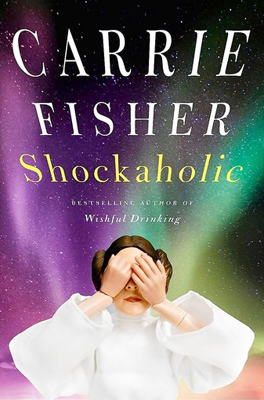
BookBin2013: Shockaholic

It’s a shame, really, that Carrie Fisher decided to follow up her wildly successful memoir Wishful Drinking (which I have read, adored, and reviewed) with this book. It was like following up a Rembrandt retrospective with finger-paintings from the local kindergarten. Sure, the parents are proud, but everyone else is immensely disappointed at the mediocrity.

(I wonder, though, if Debbie Reynolds could even be proud of this book…)

I mentioned in my review of Wishful Drinking that Fisher had undergone electroshock therapy (ECT), which helped with her severe bipolar disorder, but also left her with rather gaping holes in her memory. Shockaholic was her attempt to document some of the moments in her life that have already been whittled away by the ECT in spits and spurts, before the memories are completely eradicated.

To be honest, a lot of the memories she decided to write about aren’t really ones worth salvaging…or at least not worth putting down in a book you intend to sell people. It’s a lot of “Hey, here’s another half-remembered moment that shows how awesome I think I am” or “Here’s a snippet of memory about some of the cool people I’ve interacted with” or “Hey, I remember spending time with Michael Jackson, so I’m going to exploit that memory while it’s still here.”

Not only was this a painful exercise in self-aggrandizement, but it also completely lacked the glorious humor and wit that I have so often loved about Fisher’s writings and performances. If these are further victims of her ongoing ECT sessions, it’s a sad, sad day, indeed.

Final Verdict: The only reasons I finished this book were: A) The font was massive, so it was a really quick read; and B) I kept hoping, hoping, hoping that it would get better (instead, it got worse…SPOILERS!). Back to the library. No chance of adding this to my personal collection.

BookBin2013: N0S4A2

n0s4a2

I suppose it was inevitable that I would finally encounter a work from my latest literary heart-throb that simply didn’t enrapture me in the same ways as his other works. I just wasn’t expecting that moment to come so quickly in our relationship. Yet so it went with Joe Hill’s latest offering N0S4A2.

In this particular world of Hill’s devising, there are people who are able to create conduits to other places, either real or fictional, through the power of their minds. For young Victoria “Vic” McQueen, she learns that she can find missing items for people by using her ability to create conduits thanks to her Raleigh Tuff Burner bike and the “ghost” of the Shorter Way Bridge that once stood in ruins near her house. On the flip side, there are people like Charlie Manx, who uses his ability to create a conduit through his connection to his Rolls Royce Wraith (a rather possessive possessed car, if you ask me, Christine) to steal children away to “Christmasland,” a place of his own devising that allows him to drain the children of their life rather vampiristically (in a metaphorical sense) while letting them live in what he considers to be the perfect childhood utopia…a place where it is always Christmas, always happy, always festive. Of course, McQueen and Manx cross paths early in the novel (it only makes sense since one is a stealer and one is a finder), and cross paths again years later, to settle the score from the previous encounter.

Hilarity…well, you know the drill.

I’m not really certain what exactly didn’t click with me with this newest tale from Hill. I enjoyed the fact that the protagonist was a strong-willed girl with a wicked imagination and a pretty fascinating secret ability…and who would grow up into a flawed but still likeable, still imaginative young woman, damaged by that ability and seeking respite from the scars of that damage.

The supporting characters were also quite interesting and multifaceted, for the most part. I think, though, that the ultimate failing of this book, for me, was in both the story and its antagonist. First, I’m kind of through with vampires. And while this book isn’t exactly a vampire tale, the invocation of vampirism through the slightly-too-cute-for-its-own-good title forces me to envision Charlie Manx’s draining of life from the children he kidnaps as akin to the actions of that fabled creature of the night. Plus, there’s the hook teeth and the only traveling after dark that really hit it home.

Really, though, more than vampires, Charlie Manx slowly began to evolve into one particular character in my mind, based on descriptions of his physical appearance, his age, his mannerisms, his olden-days slang…halfway through the book, I realized that I was picturing Manx as an even more ill-tempered C. Montgomery Burns.

I’m willing to bet that Hill would not think this was excellent at all.

Of course, I then began to imagine Manx’s latest henchman, Bing Partridge, as a cross between Smithers and Barney. I even started picturing Vic McQueen as sort of like Lisa Simpson. Unfortunately, I also started to picture her lover as Comic Book Guy (for reasons that are quite obvious if you read this book). Again, all this was not helping at all with the horror element.

Worst. Comparisons. Ever.

Plus, there’s the fact that Hill crammed as many in-jokes as possible into this book, both in reference to his own previous books and most definitely in reference to his father’s works. N0S4A2 contains a panoply of Kingian references and allusions, which I admit both amused and irritated me. I’m glad that Hill is starting to be a little less tetchy about people knowing he is King’s son. However, a few times his “wink-wink” throwbacks to some of his father’s greatest hits (Cujo, Pet Sematary, Christine) teetered very, very close to too cute. I don’t want “cute” in a horror novel.

It wasn’t until after I read the book that I learned that I probably should have looked for the audio version instead. The entire book was read by none other than Kate Mulgrew. You have no idea how intriguing and frightening this is to me. I feel like I need to experience this story as narrated by Captain Janeway. I will absorb her powers and make a nice Kiev (and if you get that joke, Red’s got a place on her kitchen staff just for you).

Final Verdict: I’m still very much enamored of Hill as a writer, but I definitely did not consider this to be one of his better offerings. Still, if I can get my hands on a copy of Kate Mulgrew reading it? You bet your sweet Cujo I’m gonna give that a whirl.
BookBin2013: Locke & Key 2

I can’t believe that it’s been more than a year since Joe Hill welcomed me to Lovecraft. More than a year since I first encountered the Locke family as they began their long emotional journey back from the brutal home invasion in their San Francisco home that left their father murdered and their mother broken in many ways.

It’s been too long. It’s time to catch up on old times, denizens.

lak2-4

That’s right, I recently succumbed to my need to enter a library and binge on whatever I could find of interest…and part of what I found were the next three graphic novels from Joe Hill and Gabriel Rodriguez’s Locke & Key series: Volume 2: Head Games; Volume 3: Crown of Shadows; and Volume 4: Keys to the Kingdom.

More revelations about the truth behind Rendell Locke’s murder as well as his life in Lovecraft. More keys. More secrets. More discoveries. More darkness.

This is a seriously dark story. I would expect nothing less from Hill

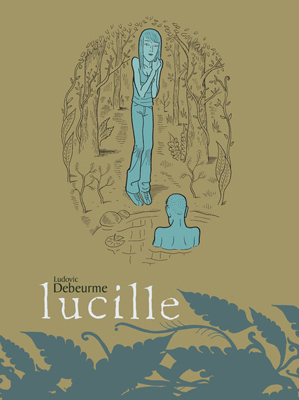
BookBin2013: Lucille

lucille

You might just want to skip this review, denizens, because I’m going to let you know right now: It’s going to be short and unsatisfying.

And, yes, that’s what she said. [ba-dum-tssh]

Ludovic Debeurme’s rather large graphic novel Lucille (I do believe it’s slightly more than 500 pages) is the story of two troubled teenagers

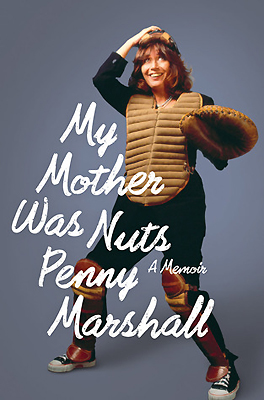
BookBin2013: My Mother Was Nuts

mmwn

I’ve written before about how certain shows from my youth have stuck with me while certain others leave me feeling not the least bit disturbed that there was a point in which I could stand more than 5 minutes of them without wanting to defenestrate the television. One of the shows that I think still falls in the former category is Laverne & Shirley. Looking back on the show now, I think that it was the characters’ blue collar appeal that initially drew me in, even as a child. I watched the regular antics of these two working-class women and recognized in their struggles with work and money the same struggles that my own family sometimes faced.

With less Booboo Kitty, of course.

In fact, I think it’s safe to say that I consider Laverne DeFazio and Shirley Feeney just as much part of the pantheon of female role models from my youth as Beverly Crusher, Jaime Sommers, Diana Prince, Bonnie Barstow, Jo Polniaczek, and Terry Dolittle, just to name a few.

I’ll get back to that last one in a minute.

I liked them both, but Laverne was my favorite. She always seemed less concerned about etiquette or appearances, a little less genteel, a little more crass, a little quirkier, a little more likely to tell the dirtier jokes and share the better stories over a pizza and a pitcher of beer. Plus, she embroidered all her tops with a giant cursive “L” and drank Pepsi Milk.

Yes, Pepsi Milk. It was a mixture of milk and Pepsi-Cola. I remember drinking these with my grandmother one summer. I don’t know why this sticks in my mind, but it always makes me smile whenever I think of it.

So, what does all this have to do with my latest BookBin entry? My Mother Was Nuts is the autobiography of none other than She Who Was Laverne.

What can I say? If you liked Penny Marshall as Laverne or if you have liked her continued Hollywood career as a director, I would recommend this book to you. It’s funny, straightforward, and incredibly interesting. Suffice it to say, she has led quite a life. Also, Marshall has a wonderful way of being honest without being catty or vindictive. She tells things plainly, saying only what’s important in a refreshingly objective way, and then moves on. She doesn’t try to tear anyone down and she doesn’t try to build herself up…even though, she could if she wanted to.

After all, Marshall was the first woman director to break $100 million at the box office…on only her second directorial outing (not counting those episodes of Laverne & Shirley she directed). She broke the boundary with Big and she repeated this feat with A League of Their Own, one of my absolute favorite movies ever made.

As for my earlier mention of Terry Dolittle, this was Whoopie Goldberg’s character from Marshall’s directorial debut, Jumpin’ Jack Flash, which was one of my earliest Flashback Friday posts. Yes, it was horribly inappropriate for 10-year-old me, but it also showed me that someone quirky and strange and just a little left of center could be awesome. In fact, this is what I wrote of Dolittle:

More than just making me laugh, though, I think at some point in my impressionable young mind, I made the choice that, when I grew up and got a

BookBin2013: Ether

ether

My final read from our recent journey was Ben Ehrenreich’s Ether, another City Lights acquisition. Here, first, is the description from the back cover:

A bearded man in a badly soiled suit known only as The Stranger wanders an apocalyptic landscape on the fringes of a dying metropolis, looking for a way to “get back on top.” Thwarted and rejected at every turn by old friends and strangers alike

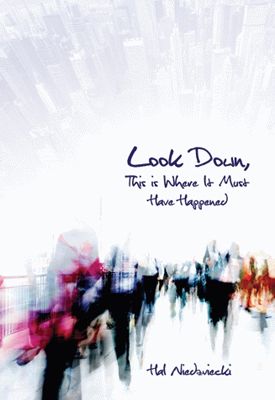
BookBin2013: Look Down, This Is Where It Must Have Happened

ldtiwimhh

Continuing with the books I finished during those long flights to and from Hawaii, I decided that I also wanted to whittle away a bit at the collection of books I have picked up from City Lights Bookstore the last two times I’ve been to San Francisco (ironically, we had a long enough layover in San Francisco during our journey to the islands that I could have gone back to City Lights for some more perusing…but then we wouldn’t have gotten to do anything else. Because bookstores require HOURS.).

I admit that I chose Hal Niedzviecki’s short story collection Look Down, This Is Where It Must Have Happened because it’s a nice slim paperback that fit nicely into my backpack, in between my DSLR bag and my Kindle. I also admit that sadly one of the first things I noticed about this book was the fact that the Table of Contents listed the wrong pages for every single story (at least in my copy). For someone who spends a soul-crushing amount of time QCing minutia just like this, I was not happy to find such a glaring error during my leisure time. To me, this speaks to a lack of quality in the preparation that could have indicated a lack of quality in the product.

Luckily, this was not the case. Niedzviecki’s stories are captivating oddities, populated by strange and slightly indecipherable (and sometimes utterly unnerving) characters. His language is sparse and understated. His concepts are quirky and often complex…or at the very least complicated. One could imagine his characters populating a world conceived by Charlie Kaufman or perhaps even Robert Altman…actually, I detected a bit of Raymond Carver in these stories (Carver’s collection What We Talk About When We Talk About Love was the inspiration for Altman’s 1993 film Short Cuts). Niedzviecki isn’t quite as intensely restrained in his prose as Carver was, but he wields a similar precision in the selection of words to convey his tales. He also embraces the ambiguity of open endings that I sometimes really enjoy.

Final Verdict: I enjoy having short story collections on call into which I can dive quickly for a tale or two, so I do believe I shall be keeping this one.