50BC09: Book Number 31

cfwishfuldrinking

Brett Butler, one of my all-time favorite comedians, after a particularly…vivid story about her adolescence, looked into the audience, smiled that devilish, dimpled smile of hers, and stated, “I’ve lived quite a life, haven’t I?” For all intents and purposes, that line could have doubled as the subtitle to Carrie Fisher’s memoir, Wishful Drinking (consequently, Fisher gets bonus points for the clever twist of a title).

The book also earns extra points for the cover design. Look at it! The way Fisher’s name and the book title are tilted in a style reminiscent of the scroll at the beginning of all the Star Wars movies. And look at Princess Leia, with her empty martini glass and pile of blue pills. See? Neo was right to take the red pill after all.

The really great thing is that the inside of the book is just as clever and just as humorous as the outside. Fisher is quite honest about the mess that is her life, about the mistakes she’s made, and the path that she continues to carve for herself. She’s also honest about the fact that her path is now one of confusion and self-discovery ever since electroshock therapy muddled her mind and shorted out a lot of her memories.

I’ll give you a moment to mull over that last bit…

Like I said, she’s quite honest. I know that Fisher has had a lot of problems throughout her life, including severe depression and addiction problems. The fact that she is so straightforward about all of this and doesn’t try to make excuses or pass blame is refreshing. Besides, she’s Princess Leia Organa. She fought the dark side in a metal bikini and made out with her brother. How could that not complicate anyone’s life?

Final score: 3.5/5. Another quick, funny beach read that will help pass the time between low and high tide.
50BC09: Book Number 30

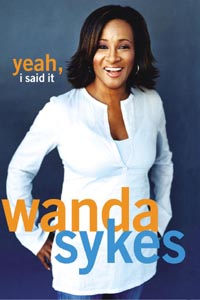
ws_yeahsaid

Did she really just say that? Yeah, she did. That’s the kind of woman Wanda Sykes is. What did she say, you might ask? Just about anything you can imagine…and some stuff you can’t believe.

Wanda Sykes is so completely off the chain in an uproariously provocative way. And while her language might be a bit blue at times, she’s always funny, always thoughtful, and always honest. I think that’s what helps her not only stay in the stand-up game, but stay relatively at the top. Not an easy feat if you think about it, especially considering how far stand-up comedy has fallen from its halcyon days of popularity in the mid-90s.

True to form for a lot of books written by stand-up comics, Yeah, I Said It contains a lot of things that later found their way into some of Sykes’s routines, especially her HBO special, Sick and Tired. But the familiar sections are scattered throughout and significantly built upon, so even if you think you know where she’s heading, she’ll usually take you that little bit farther…or in a completely new direction that’s just as enjoyable as the road you thought you were heading down.

Final score: 3.5/5. This was perfect beach material: Quick, funny, not too deep, but still will get you thinking.

50BC09: Book Number 29

avatar2

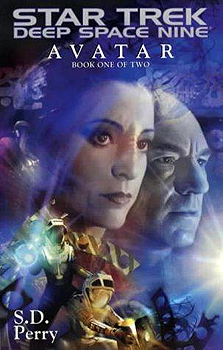
I know that I have only read two of her books (and technically, they were two parts of the same story, so it was really just one BIG book), but I’m going to have to say that I think S.D. Perry might have actually given Peter David a run for his money as being the author I would trust the most with my precious Star Trek characters. She’s definitely now among my top Trek authors, to be sure, after pulling off an amazing debut for the “eighth season” of Deep Space Nine with the conclusion of Avatar, Book Two of Two.

I was highly impressed by both of these books, and not simply because of the various storylines taking place and intersecting and combining oh so beautifully. It was also how Perry handled each of these characters, both established and new, with a care and precision that in many ways surpassed the attention lavished upon them by the show’s writers. Most impressive was her handling of the character Ezri Dax. I had a huge problem with the fact that Ezri Dax was stationed to DS9 after Jadzia Dax was killed. It just felt wrong. But since it was going to happen regardless of what I thought, I decided that what I’d like most is to see a deeper exploration of the whole concept of being a Trill, especially for a host who never really planned on being a host.

Needless to say, the show never really met my expectations in this regard. They only had one season to work with Ezri, so I guess they did as best as they could. Still, I wanted more. And Perry delivered in this book. She deftly explores the inner intricacies of what it’s like to carry around so many memories and lives in ways that provided amazing insight into both the Dax symbiont and the latest host to carry it within her.

This alone made these two books enjoyable. Add onto this the fact that Perry also actually pulls off the reintroduction of Ro Laren to the Trek universe in a wonderful way (minus my complaint regarding the somewhat of a stretch in storyline from the first book). Indeed, there was a bit of an “encounter” between the TNG crew and DS9’s new chief of security, but only in regard to two brief interactions between Picard and Ro, which were contained and well-played. It is Jean-Luc Picard, after all. Plus, Perry gives us glimpses of the TNG crew interacting with DS9 crew in ways that I had always wanted to see during crossover episodes of the shows. There’s even a great scene in which Dr. Crusher is called upon to temporarily take over as DS9’s CMO. It’s a short snippet in the book, but it’s wonderfully executed and a delight to read.

I think that’s a perfect summary for both of these books: They were a delight to read. I haven’t been this happy with a Trek book in a very long time. Avatar kicks off the continuation of the DS9 saga in high style. Perry shows Colonel Kira to be a competent and pragmatic commander of the station. She also takes Kira down a path that leads to quite a change for the normally spiritual Nerys. The end result is one that I have to admit left me with a profound sadness for Kira. Another sign of an excellent writer. I can only hope that the path that Colonel Kira now finds herself on is one that she is prepared to walk, but I can say this: I’m prepared to follow her, Lieutenant Ro, Dr. Bashir, Commander Dax, and all the others wherever their journeys take them next. I only hope that the next author responsible for continuing this story arc can live up to the high standards that S.D. Perry has now set.

Final score: 5/5. The law of averages has demanded that I give this entire two-parter a solid 5. Highly enjoyable, and totally believable continuation of the DS9 saga. I can’t wait to read the next book!

50BC09: Book Number 28

avatar1

FINALLY! Oh thank the Prophets, I have found a Star Trek book worth reading! I’ve temporarily abandoned hope regarding finding a decent TNG novel from the post-Nemesis flotsam, and I’ve now switched over to the “eighth season” DS9 books. First on the agenda is Avatar, Book One of Two, by S.D. Perry.

This was a brilliant way to continue the DS9 story. I take special joy in this idea since I was so disappointed in how the writers ended DS9 by scattering all those characters across the Alpha and Gamma Quadrants so unceremoniously. I get the fact that life often behaves in such a fashion, pulling apart friends and lovers in similar ways, but the fact that they did it to so many characters all at once…it was just too painful an ending for a show that I daresay often gave TNG a run for being my favorite series.

Plus, the added bonus to this book (and I’m assuming the second part, which I have already started reading) is that it brings in the TNG cast as well. So far, there’s a parallel story taking place on the Enterprise-E that is going to end up bringing the crew to DS9. I suspect the doo will hit the fan in some way then, since the new security chief on DS9 is none other than Ro Laren.

Okay, here’s where my biggest complaint about this book comes into play: Ro Laren? Really? I get that Ro was originally supposed to be the liaison between the Bajorans and the Federation on DS9, but Michelle Forbes kaboshed that idea because she didn’t want to be shackled to a television show. So what better way to finally put Ro where she belongs than in the books! But…she was Maquis. According to Voyager, the Dominion killed all the remaining Maquis in the Alpha Quadrant. But Ro Laren survived…to become DS9’s security chief.

Yeah. Perry does an admirable job of trying to make this make sense, but it’s about as much of a stretch as the elastic in Rush Limbaugh’s Fruit of the Looms after Thanksgiving dinner. Still, it’s so great to have Ro Laren back in the fold…even though Peter David, Michael Jan Friedman, and Robert Greenberger already brought Ro and Kira together once before, in their DS9 novel collaboration, The Wrath of the Prophets. Of course, we all know that the novels are not considered canon at all…if they were, Peter David’s Vendetta would have been a prime argument against Seven of Nine ever being more post-Borg than full-blown catatonic.

Oh noes, I’ve gone hardcore geek now, eh? Needless to say, even with as “coincidental” as Ro Laren’s resurfacing is, Perry does an admirable job of making it as believable as possible. Plus, Perry juggles several major plot lines beautifully, including a murder on the space station that becomes Ro’s first major way to prove herself to Kira, the surfacing of an ancient Bajoran text that speaks of frightful events to transpire, the discovery of the Orb of Memory, the plight of Jake Sisko, plus a boatload of new characters to help round out the story and push it along. She does a beautiful job of keeping everything racing along at a wonderfully engaging pace, and I can’t wait to keep plowing through the second half of the story.

Final score: 4.5/5. I’m deducting half a point because the Ro Laren stretch is still something that I found difficult to completely believe…but not quite as bad as who is currently wooing the good lieutenant. I won’t say who, but I’m sure there’s a Rule of Acquisition somewhere that might be able to explain it to you a bit better than I could.

Here’s hoping that the second half is even half as good as the first!

50BC09: Book Number 27

manindark

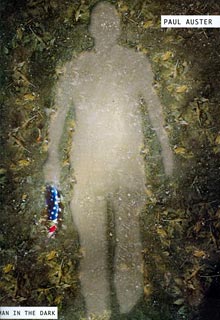
That last book riled me up so much that it took me a bit longer before I was ready to wade back into the literary waters. Well, that and the fact that this whole month has left me feeling like I’ve gone 10 rounds of Velocity with a former Borg drone (come on, you know you’ve got to keep up with my geek references…or at the very least, tolerate them).

I know that I’ve mentioned Paul Auster before and how I discovered him by way of one of his books having a dog on its cover. Thank goodness I’m a softie like that. I believe Paul Auster is a brilliant writer, one of the best in the modern literary game today. Every time I read one of his novels, I’m transported to places and ideas and imaginings of the most wonderful varieties.

Man In the Dark is no exception to this rule. In fact, I daresay that this particular novel might be one of my favorite Auster offerings so far, as it resonates with me on a particularly intimate level. The main character, August Brill, weaves a tale for us through reality and imagination, seeking truth and comfort in the small hours of night, as he lies awake in the darkness of his room…lost in the stories he constructs within his mind (sounds familiar, no?).

A large portion of this book, in fact, takes place in these stories that Brill creates to keep himself entertained and distracted as he awaits sleep’s arrival. I love how deftly Auster is able to craft this scenario, shifting us from Brill’s imagination to his reality with effortless certitude. That’s what it means to be a master of your craft.

If you have never read Paul Auster before, I urge you to give him a try. His works are surreal, but not complicatedly so. This is an excellent place to start. So is Timbuktu…you know, the book with the dog on the cover.

Final score: 5/5. More than likely I’m biased, but there wasn’t one part of this book that failed to hold me rapt and ready for more. I may even have to add this one to my personal collection.

50BC09: Book Number 26

twilightbook

I’m so very angry at this book.

I’ve actually wanted to read Twilight for a while now (sorry, I’m not going to link to any page that will allow any of you to buy this one; I just won’t). Even though it’s from a “young people” series, I figured what the hell? I so thoroughly enjoyed diving into Harry Potter’s world that I didn’t see anything too odd about trying out another young adult fictional world.

I’m so very angry.

I don’t have children, but if I did

50BC09: Book Number 25

thereader

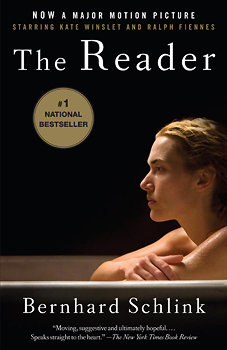
I’ve yet to see the movie version of Bernhard Schlink’s The Reader. I usually prefer the books to the movies based on them anyway, so I don’t feel short-changed at all.

I’m not really sure what I can say about this book, though, as saying too much will ruin the story, but saying too little will do it undeserved injustice. The prose is simple and straightforward, which I have often found to be the case with books that have been translated from another language into English. Is this a reflection on the translator? Or are writers from other countries just more direct in their language?

Whatever the case, I love the clean feel of the prose. As much of a word nerd as I am, I appreciate how a sparse take on language allows the reader to focus more on the story being told rather than on how it is being told. There are few linguistic dalliances in this story, but that in no way stops Schlink from plumbing some very complex depths. I also find information on World War II as told from a German perspective to be highly intriguing. Anyone who has seen Der Untergang knows already what I mean.

Of course, this gives away the fact that this story deals head-on with actions committed during WWII as well as their long-term consequences. However, the primary story can also be seen as an allegory for a Post-WWII Germany and how its youth must deal with its older and oftentimes guilty predecessors. The relationship shared by Hanna and Michael, the two protagonists, is beautiful, frightening, and complicated in its own right, but when superimposed over the mental and emotional landscape of this post-war country, it takes on multifarious meanings, least of which are compulsory questions about loving someone/something guilty of horrific crimes. The only “flaw” that comes to mind at the moment is that the reason behind the title was almost a bit anti-climactic for me. It just didn’t resonate as loudly with me as I believe Schlink was hoping it would with his readers. Perhaps I should give it some time to sink in.

Final score: 4.5/5. This book is good enough that I forgive it for being an Oprah Book Club selection. I also think I might check out some of Schlink’s other works.

And now, because I promised, here’s a round-up of the first 25 books that I have read so far:

  1. 10 Most Beautiful Experiments, by George Johnson (3.5/5)
  2. The Dumbest Generation, by Mark Bauerlein (3/5)
  3. The Memory of Running, by Ron McLarty (4.5/5)
  4. Gene Roddenberry: The Last Conversation, by Yvonne Fern (4.5/5)
  5. Stardust, by Neil Gaiman (4.5/5)
  6. The Eyes of the Beholders, by A.C. Crispin (3.5/5)
  7. Watchmen, by Alan Moore and Dave Gibbons (2.5/5)
  8. Nightmare at 20,000 Feet: Horror Stories by Richard Matheson (4.5/5)
  9. Comic Wars, by Dan Raviv (3/5)
  10. It Ain’t All About the Cookin’, by Paula Deen (3/5)
  11. Calculating God, by Robert J. Sawyer (4.5/5)
  12. Walking in Circles Before Lying Down, by Merrill Markoe (3.5/5)
  13. The Anglo Files: A Field Guide to the British, by Sarah Lyall (4/5)
  14. The Almost Moon, by Alice Sebold (4/5 for prose; 3/5 for story)
  15. Captivity, by Debbie Lee Wesselmann (2.5/5)
  16. Resistance, by J.M. Dillard (1.5/5)
  17. The Island of Dr. Moreau, by H.G. Wells (4/5)
  18. The Last Lecture, by Dr. Randy Pausch (5/5)
  19. One on One, by Tabitha King (2/5)
  20. Good Omens, by Neil Gaiman and Terry Pratchett (4.5/5)
  21. Golf Monster, by Alice Cooper (4.5/5)
  22. The Stars Like Dust, by Isaac Asimov (2.5/5)
  23. Rapture for the Geeks: When AI Outsmarts IQ, by Richard Dooling (2.5/5)
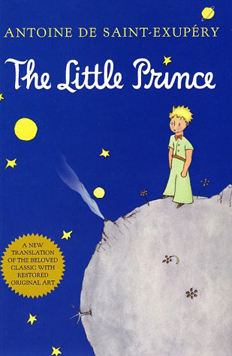
  24. The Little Prince, by Antoine de Saint-Exup

50BC09: Book Number 23

geekrapture

I feel as though I may have been Jedi-mind-tricked by Richard Dooling. Mr. Dooling is the author of my latest read, Rapture for the Geeks: When AI Outsmarts IQ. For the life of me, though, I can’t come up with much to say about this book. It’s like my mind has already been wiped: “These are not the droids you’re looking for…and this is not the book you just read.”

The book started out with a wonderful bang: It was funny, engaging, captivating. Then it started to stray from the path of interesting and entertaining

50BC09: Book Number 22

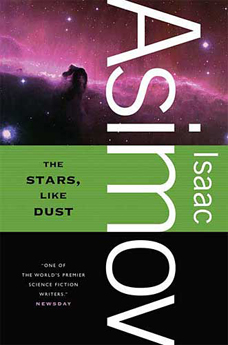
asimovsld

I’m about to commit what some might call tantamount to geek treason. I’m about to trash an Isaac Asimov book.

First, though, I’m going to make a somewhat shocking confession: Prior to now, I have never actually read an Isaac Asimov novel.

Okay, I’ll wait while you all digest that.

Yes, I did just admit that I was an Asimov virgin until now. Well, not completely. You can’t be a geek, especially a TNG geek, without knowing Asimov. After all, our favorite android possessed a “Soong-type positronic brain.” Positronic brains came straight from the brain of one Mr. Isaac Asimov, father of the three laws of robotics:

  1. A robot may not injure a human being or, through inaction, allow a human being to come to harm.
  2. A robot must obey any orders given to it by human beings, except where such orders would conflict with the First Law.
  3. A robot must protect its own existence as long as such protection does not conflict with the First or Second Law.

This is all moot, however, since none of this relates to the Asimov book I did read, The Stars, Like Dust. Apparently, this is a recent re-release. It was positioned on the New Arrivals shelf at the library, all sparkly new and, strangely enough, without a protective plastic cover. I quickly snatched it up, taking its presence as a sign that it was time I delved into something Asimovian.

I should have gone to find I, Robot instead. This was not at all what I was expecting