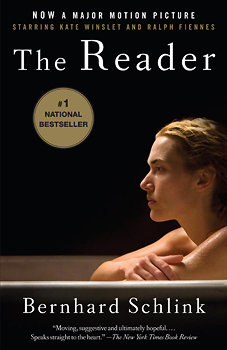
I’ve yet to see the movie version of Bernhard Schlink’s The Reader. I usually prefer the books to the movies based on them anyway, so I don’t feel short-changed at all.
I’m not really sure what I can say about this book, though, as saying too much will ruin the story, but saying too little will do it undeserved injustice. The prose is simple and straightforward, which I have often found to be the case with books that have been translated from another language into English. Is this a reflection on the translator? Or are writers from other countries just more direct in their language?
Whatever the case, I love the clean feel of the prose. As much of a word nerd as I am, I appreciate how a sparse take on language allows the reader to focus more on the story being told rather than on how it is being told. There are few linguistic dalliances in this story, but that in no way stops Schlink from plumbing some very complex depths. I also find information on World War II as told from a German perspective to be highly intriguing. Anyone who has seen Der Untergang knows already what I mean.
Of course, this gives away the fact that this story deals head-on with actions committed during WWII as well as their long-term consequences. However, the primary story can also be seen as an allegory for a Post-WWII Germany and how its youth must deal with its older and oftentimes guilty predecessors. The relationship shared by Hanna and Michael, the two protagonists, is beautiful, frightening, and complicated in its own right, but when superimposed over the mental and emotional landscape of this post-war country, it takes on multifarious meanings, least of which are compulsory questions about loving someone/something guilty of horrific crimes. The only “flaw” that comes to mind at the moment is that the reason behind the title was almost a bit anti-climactic for me. It just didn’t resonate as loudly with me as I believe Schlink was hoping it would with his readers. Perhaps I should give it some time to sink in.
Final score: 4.5/5. This book is good enough that I forgive it for being an Oprah Book Club selection. I also think I might check out some of Schlink’s other works.
And now, because I promised, here’s a round-up of the first 25 books that I have read so far:
- 10 Most Beautiful Experiments, by George Johnson (3.5/5)
- The Dumbest Generation, by Mark Bauerlein (3/5)
- The Memory of Running, by Ron McLarty (4.5/5)
- Gene Roddenberry: The Last Conversation, by Yvonne Fern (4.5/5)
- Stardust, by Neil Gaiman (4.5/5)
- The Eyes of the Beholders, by A.C. Crispin (3.5/5)
- Watchmen, by Alan Moore and Dave Gibbons (2.5/5)
- Nightmare at 20,000 Feet: Horror Stories by Richard Matheson (4.5/5)
- Comic Wars, by Dan Raviv (3/5)
- It Ain’t All About the Cookin’, by Paula Deen (3/5)
- Calculating God, by Robert J. Sawyer (4.5/5)
- Walking in Circles Before Lying Down, by Merrill Markoe (3.5/5)
- The Anglo Files: A Field Guide to the British, by Sarah Lyall (4/5)
- The Almost Moon, by Alice Sebold (4/5 for prose; 3/5 for story)
- Captivity, by Debbie Lee Wesselmann (2.5/5)
- Resistance, by J.M. Dillard (1.5/5)
- The Island of Dr. Moreau, by H.G. Wells (4/5)
- The Last Lecture, by Dr. Randy Pausch (5/5)
- One on One, by Tabitha King (2/5)
- Good Omens, by Neil Gaiman and Terry Pratchett (4.5/5)
- Golf Monster, by Alice Cooper (4.5/5)
- The Stars Like Dust, by Isaac Asimov (2.5/5)
- Rapture for the Geeks: When AI Outsmarts IQ, by Richard Dooling (2.5/5)
- The Little Prince, by Antoine de Saint-Exup
