50BC09: Book Number 21

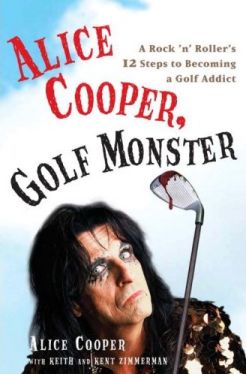
golfmonster

Gather round, kiddies, for this fiendish tale spun for you from the depths of your Uncle Alice’s darkest nightmares!

Okay, maybe not. The book is called Golf Monster after all. You know Alice is a huge golf junkie now, right? That was the whole “Fairway to Heaven” reference in my last BC entry. He used to be a drunk, and then he replaced his alcohol addiction with a HUGE golf jones. Seriously. He plays at least 18 holes almost every day, no matter where he happens to be.

Of course, I love Alice Cooper. I love his music. I love his camp. I love his snakes (real snakes, you dirty buggers!). I love his speech about Milwaukee in Wayne’s World. He is teh awesome. Therefore, take my review of his book with that caveat as an ap

50BC09: Book Number 20

goodomens

The irony of my final statement from my Book 19 review about how my next book had better be “good” is that I honestly hadn’t made my next choice at that point. Just made this selection all the more serendipitous, I suppose.

Whatever the universal alignment that led to my latest selection (which really boils down to the fact that this was at the top of the closest stack of my unread books), Neil Gaiman and Terry Pratchett’s joint effort, Good Omens: The Nice and Accurate Prophecies of Agnes Nutter, Witch, was more than simply “good”; it was astonishingly enjoyable.

What would happen if the Antichrist is born but then accidentally misplaced by Satanic Nurses (who are not quite as awesome as Satanic Mechanics, but who would rock the soft-core porn parody of Satanic Verses)? How would he grow up to be a right proper universe-ending bad ass without guidance from his netherworld family? How can Aziraphale the Angel and Crowley the Demon battle over the instruction of the young Bringer of Armageddon if they don’t know where he is? Even better, how can they stop it all from happening anyway since they do fancy living among the mortals? Would it surprise anyone to know that the Four Horsemen of the Apocalypse aren’t all men…and have traded in their horses for Harleys? How did Agnes Nutter end up predicting that all this would eventually happen even though she died (rather spectacularly) centuries prior? Are there really people named Nutter? Can I please shake one loose from my family tree?

For the answers to all these questions and more, you simply must read Good Omens! (Well, okay, they won’t answer the last two questions…but you’re good on all the others.)

If you’re familiar with Gaiman or Pratchett, then this book will be a delightful pairing of two grand talents of the sci-fi/fantasy literary world. If you’re not familiar with either of them, then this is a wonderful introduction. It’s witty, funny, and cheeky in equal doses, and once you start it, you really won’t want to put it down (except maybe you should try to put it down when doing things like driving, chopping vegetables, or mowing your lawn, especially if you own a cat or a small dog).

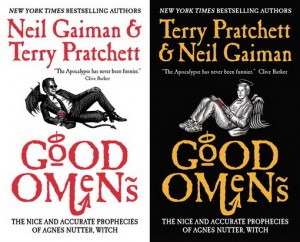
Also, the most recent printing of the paperback came with two different covers, as you can see in my accompanying photo. I am pleased to say that my parents, when they purchased this book for me for Christmas, chose the white cover with the Demon Crowley on the cover. They know me well, little devil that I am.

Final score: 4.5/5. Like Mary Poppins, this book was practically perfect in every way, but did begin to drag on a bit too long toward the end.

I was thinking about doing a quick listing of all the books I’ve read so far and their scores now that I’m at the 20 mark, but I think I’ll hold off until the halfway mark. Sound good? Good. And I’m once again loaded up with library selections and have already chosen my next read (and it really is going to be my next read; I’m not going to wimp out like I did with the Saramago book I had a while ago). It’s a shock rocker autobiography of sorts. I shan’t say more than this: Think “Fairway to Heaven.”

‘Nuff said.

50BC09: Book Number 18

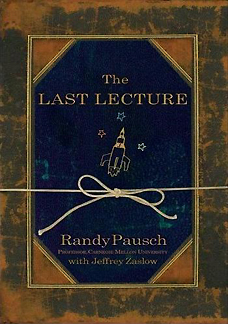
lastlecture

Unbeknown to me, Dr. Randy Pausch has been a silent hero in my life for many years. A professor of computer science at Carnegie Mellon University, Dr. Pausch helped train some of the most brilliant, innovative minds to hit the programming world…students who, through his honest and inspirational guidance, went on to become video game programmers, CGI designers for major Hollywood studios, Disney Imagineers. He, along with students and fellow computer geeks, designed Alice, a free program that teaches anyone how to design in a 3-D environment, all the while teaching them the fundamentals of several programming languages. As a geek, these things are my bread and butter.

Dr. Pausch also qualifies as a geek idol because of his own intrinsic geekiness. His wish list of childhood dreams included being in zero gravity; being a Disney Imagineer; authoring an article in the World Book encyclopedia; and being Captain Kirk.

With the exception of the last dream, he captured all these dreams. As for that last wish…well, he came pretty damn close. Not only did he befriend William Shatner in real life, but he served as a bridge officer on the U.S.S. Kelvin alongside George Kirk, father of the future James Tiberius. Yes, look very closely at those opening scenes in the new Star Trek movie and you will see Dr. Pausch. He was the officer who declared, “Captain, we have a visual!” This also means that Dr. Pausch has achieved the immortality of now being listed on Memory Alpha, the greatest Trek database ever.

In 2007, Dr. Pausch participated in Carnegie Mellon’s “Last Lecture” series, a program in which various professors are invited to imagine what they would want to give as a final message in light of an imagined imminent death.

The difference for Dr. Pausch was that he was, in fact, dying. He had been diagnosed with pancreatic cancer the year before, and it had metastasized. A month before his last lecture, doctors had given him a prognosis of 3-6 months to live.

How would you cope with such a prognosis? I daresay I don’t know if I could do it with the strength, grace, or humor that Dr. Pausch exhibited. This was a man who lived more positively in his final months of life than most of us live in our entire existence on this third rock from the sun.

Randy Pausch died on July 24, 2008, nearly one year after his grim prognosis. One of his final messages, given to Carnegie Mellon’s graduating class a little more than 2 months before he died, was this:

We don’t beat the Reaper by living longer. We beat the Reaper by living well and living fully. For the Reaper will come for all of us. The question is what do we do between the time we’re born and the time he shows up.

Sometimes it seems that there is so little in this life to give us hope or inspiration. Sometimes it seems like we’re just spiraling ever deeper into disdain and despair. Look at yesterday’s incident at the Holocaust Museum and how the malignancy of hatred slowly consumed a man throughout his entire life. And now his legacy will be one of death and violence and hate.

Yet here was Dr. Pausch, consumed within by a real malignancy, unstoppable and unmerciful. And what is his legacy? Hope. Courage. Strength. When William Shatner learned of Dr. Pausch’s diagnosis and prognosis, he sent a photo of Captain Kirk on which he wrote, “I don’t believe in the no-win scenario.” Cancer may have been Dr. Pausch’s Kobayashi Maru, but it did not defeat his soul. It was never his no-win scenario.

Yes, I’ve chosen to take the schmaltz road in discussing this book. I don’t care. Dr. Pausch is now in my pantheon of geek idols. He was an amazing individual. I urge you all, if you don’t want to read this book, then watch his last lecture. His was an amazing spirit and I’m so grateful for what he has left for us all to discover within ourselves, if we just take the time to look.

Final score: 5/5

[youtube http://www.youtube.com/watch?v=ji5_MqicxSo&hl=en&fs=1&color1=0x006699&color2=0x54abd6&border=1]
50BC09: Book Number 17

moreau

No, I wasn’t reading a biography on Everlast when I said in my last post, “His is the House of Pain.” The original Keeper of the House of Pain, my friends, was Dr. Moreau.

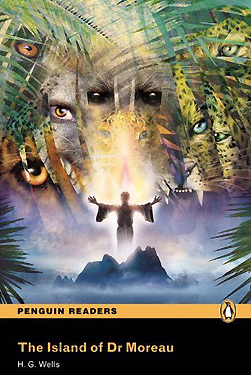
I’ve been a fan of H.G. Wells since my English major days, but this is the first time I’ve read The Island of Dr. Moreau. I love Wells’s simple, clean prose and how easily you fall right into the unnervingly controlled cadence of Moreau’s vivisected insanity. This was also ostensibly a very Wellsian view of man’s changing roles in science and nature, thanks I’m sure in part to all that Darwin dropped on the scientific community fewer than 50 years prior to this novella’s release. It was also disturbingly accurate in regard to how far science could go if left unchecked (see Nazi Germany for experiments far worse than even Wells could have envisioned).

The copy of this novella that I own is one I picked up at my favorite used book store. It’s a Signet version that was released in conjunction with the 1996 Marlon Brando/Val Kilmer movie. I can only imagine that whoever originally purchased this book must have been so frightened/repulsed/disgusted/angered by seeing the movie that they just got rid of the book without even reading it. That’s honestly the only reason I can imagine for ever parting with a copy of this story (but maybe that’s just me).

Okay, pardon my tangential yelling for a moment, but OHMYGODWHATHAFU?!?! What in the bloody, blooming hell is going on in this movie other than whole buckets full of fetid crazy? There are just so many things wrong with this movie. So many terrible, horrible things. And I dare not even imagine the horrors Fairuza Balk must have witnessed while trapped there with the dueling creepiness of Val Kilmer and Marlon Brando. At least, though, we now know from where Remus Lupin really comes (that’s for all you loyal HP/David Thewlis fans).

Ugh. Seriously, I could have gone the rest of my life without witnessing this atrocity. I’ve seen the 1932 version, Island of Lost Souls. I’ve even seen bits and pieces of the 1977 Charlton Heston version. After subjecting myself to the Brando Moreau and his MuMus of Terror, I think I might have to watch the entire Heston version, to cleanse my palate.

Anyway, back to the book. I point out the version of my copy simply because I wanted to note one of the most delightful typographical errors (or perhaps a bored proofreader with a wicked sense of humor) that I have encountered in a while. Rather than discussing the “feline Beast People,” at one point Montgomery tells Prendick about the “feline Breast People.”

Hmm. That’s a whole different part of the island…

Final novella score: 4/5
Final Brando crazy score: Solid 5/5 psycho MuMus.

50BC09: Book Number 16

resistance

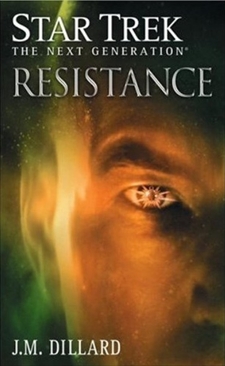
Yeah, I was trying to set up a clue or just a really bad pun at the end of my last 50BC09 post regarding the next book that I was going to read…but then I got side-tracked by my latest purchase, J.M. Dillard’s TNG novel, Resistance. I wasn’t really feeling all that well on Friday afternoon when I got home, so I had no plans to exercise. And there this little book sat, waving at at me from atop one of the many piles of unread novels I have strategically positioned throughout the house. So I thought, what the hell. I might as well see what it’s all about.

Let’s start with the most blindingly, glaringly, irritatingly obvious fallacy of this book (to me, at least): Beverly Crusher does not have green eyes.

You want to write a TNG novel and you can’t even get this very basic fact correct? You’re already in the red zone with me. Besides this fact, there are just so many things wrong with the newer TNG novels. This one, just like its predecessor, Michael Jan Friedman’s Death in Winter, takes place after Nemesis. So Data’s dead, Riker and Troi are on the Titan, and all is not right in the TNG world. You don’t want them to be this scattered or this scarred by such a dud of a Trek movie as Nemesis.

I will say this about the post-Nemesis TNG books I’ve read so far: Beverly Crusher gets far more attention now, even if it is by authors who can’t be bothered to invest the two seconds it would take to look at a photo of Gates McFadden and her very blue eyes. Death In Winter, in fact, was all about Dr. Crusher, and Captain Picard’s efforts to save her. In Resistance, Crusher and Picard are now lovers. Sadly, I must confess to a tiny sliver of puerile joy over this fact. I very rarely give a razzy rat’s romp about “shippers” or “shipping” or whatever the hell they call it. But this…this makes me happy.

Ick. I feel dirty making that confession.

As for this book’s main story? It gets a full-blown meh. The Enterprise must battle the Borg. Again. Picard must defeat the Borg Queen. Again. It was tired and trite, with smatterings of sad reminders that this is not the crew I love so dearly. Riker? Replaced by Worf. Troi? Replaced by a Vulcan counselor who hates Worf. Worf now owns Spot and the biggest scene in the book to feature Geordi LaForge is the one right at the beginning of Chapter One in which he deactivates and disassembles B-4 for shipment to the Daystrom Institute.

Am I giving too much away? Nah. I’m saving you from wasting your time on this lame Trek novel. True, it’s not a time-consuming read; I started Friday afternoon and finished yesterday evening. Is it worth it, though? I don’t know. If you’re really jonesin’ for some TNG reading, sure, give this a try. Or Death In Winter, which was better than this one, but still not that spectacular. Or go back to the early TNG novels, hunt down something by Peter David, and settle in for a really good journey with a still-intact crew of the NCC-1701-D.

Final score: 1.5/5.

I’ve already started my next book. It’s still not the one I was setting up the last time. I will say only this: His is the House of Pain.

50BC09: Book Number 15

captivity

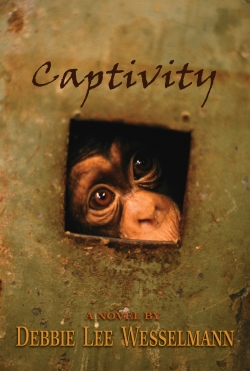
Okay, so I wasn’t completely honest when I said that I didn’t know what first drew me to Captivity by Debbie Lee Wesselmann. It was the spot varnish on the cover.

Sadly, I’m not kidding. I’m quite the sucker for well-placed spot varnish, and so I was instantly hooked by the spot-varnished chimpanzee eyes that caught the library’s fluorescent lighting so playfully as I passed by the New Release shelf.

For the most part, I’m glad that I let my soft spot for spot varnish dictate this pick. I also am a sucker for animal stories. I think I’ve already shown this by my propensity to pick up a book because it has a dog on the cover. SUCKER.

Anyway, this was a bit of an odd story, centering on the machinations of a make-believe primate sanctuary and its director. Wrapped up in the sanctuary’s mix of political and collegiate intrigue are the director’s personal issues, secrets, and wounds, all coming to surface in this perfect chimp-related storm.

I don’t necessarily think this one’s going to be for everyone. In fact, there’s only one person of whom I immediately thought in regard to recommending this book, and that’s because she works in a field similar to the one presented in this book, only with a different endangered species. The primary story is engaging enough, and there are several subplots that unfold along the way…but it really is all about chimps. Chimps at the sanctuary. Chimps from the director’s past. Chimps in laboratories. Chimps, chimps, chimps.

I’m not a big fan of chimps, so admittedly I felt my interest wane here and there. However, toward the end, I couldn’t put down the book (either because the story finally took me over or because I just wanted to be finished and moving along in my challenge). I feel a bit badly for not giving Captivity a more positive review because it’s really not a bad book. It’s just not going to be everyone’s cup of tea (not everyone likes banana-flavored tea, do they?).

Final score: 2.5/5.

I’ve got a bit of book blindness regarding my next read. Guess I’ll just have to wait to see what I’m seeing next in my scope…

50BC09: Book Number 14

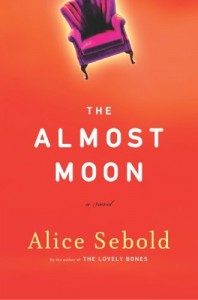
am-as

I’m going to spoil this book for you with the very first sentence of the novel:

When all is said and done, killing my mother came easily.

And thus begins Alice Sebold’s The Almost Moon. Why did I ruin this for you? I didn’t really. That’s like saying that I would ruin Sebold’s first novel, The Lovely Bones, by telling you that it starts with the protagonist being assaulted and murdered. With Sebold, the violence is the catalyst from which the true story ignites and sears itself into your brain and your soul.

I think, however, that many people probably had difficulty with this novel because of the fact that this time the protagonist is not the victim, but the perpetrator. This time we are expected to come to the other side of the coin, accept and possibly even sympathize with the one who has committed this story’s prime crime. It’s a hard sell, indeed.

The prose is gorgeous, as Sebold’s writing tends to be. And I suppose if Sebold’s ultimate goal was simply to present this tale as an open-ended account of the initial act, she has succeeded, especially considering the very open-ended way in which the story ends. I won’t give any more away than I already have. I will simply say that I think Sebold only partially succeeded in this story. It drew me in as quickly and wholly as The Lovely Bones did; however, I felt none of the satisfaction or emotion that I felt upon finishing the former novel.

Final score: 4/5 for prose; 3/5 for story. I don’t think I will be adding this book to my collection, but I’m glad that I didn’t let all the negative reviews sway me from reading it.

Book number 15 has already been selected from the library’s New Arrivals shelf: Captivity by Debbie Lee Wesselmann. I’m not really sure what drew me to this one, but I’m hoping that it will be enjoyable.

50BC09: Book Number 13

anglofiles

A “field guide to the British”? Never mind that it does make one imagine that the British are some kind of endangered species to be observed from a respectable distance, I must say that Sarah Lyall’s The Anglo Files: A Field Guide to the British was an entertaining and informative read.

Ms. Lyall is the stereotypical “Yankee in Queen Elizabeth’s Court,” a displaced American trying to make her way among our more refined but strangely similar cousins. The focus of her narrative is somewhat limited to the more commonly known “British” topics that we fail to understand here in the “practice colonies” but still find titillating: the royals, the tabloids, the food, the “stiff upper lip” mentality, cricket (the game, not the insect, you git), the politics of Parliament…and, yes, the teeth.

As the wife of an Englishman and the mother of two daughters split between the two worlds, Ms. Lyall can lay claim to a deeper understanding than most armchair Anglophiles (myself included). I do believe that she succeeds at helping her American compatriots understand a bit better what takes place on the other side of the pond, and the why of it all. Whether or not she got the why of it all as accurate as she should have is another question. If there are any British visitors to the lair who have read this book and would like to make any corrections, please click the link to my e-mail address, provided in the column to your right. I would very much enjoy hearing from you.

Final score: 4/5. All in all a thoroughly enjoyable read that provided this Anglophile with a deeper view of British life than I could ever glean from my quick hops to the Big Smoke. It has definitely earned its place on my bookshelf.

Now on to Alice Sebold’s The Almost Moon. I’m a bit worried as I have read nothing but negative reviews of this book. Are they based on the fact that nothing short of something dictated by God him/her/itself could thrive in the shadow of greatness cast by The Lovely Bones? Or is the criticism warranted?

We shall soon find out…

50BC09: Book Number 12

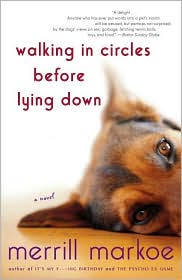
circles

I’m a bit ambivalent about my latest read, Merrill Markoe’s Walking in Circles Before Lying Down.

These damned books with dogs on the covers. True, I mentioned Paul Auster’s Timbuktu as being one of these books that I really enjoyed. But they’re not all like Timbuktu. In fact, I think the publishing industry has figured out the perfect way to get someone like me to start reading a literature genre that I typically avoid like the plague: slap a dog photo on the cover.

What genre might this be? “Chick Lit.” To be fair, I think this book might qualify as Chick Lit Lite. It’s by no means on par with The Devil Wears Prada, but it definitely does more than just dip its big toe into those estrogen-heavy waters.

All that being said, I’m a sucker for talking dog stories. I was, after all, the only adult willingly in attendance at the Scooby Doo 2: Monsters Unleashed matinee a few years ago. So a story about a woman who suddenly finds herself able to hear every dog around her definitely has a certain appeal. And even though Dawn, the canine-conversing character in question, does things throughout the novel that I found frustratingly boiler-plate for this particular genre, it was still an entertaining read. However, I do have to say that I found the slightly glib use of Scott Peterson and the BTK Killer as ways of moving along one part of the story to be a bit off-putting.

Final score: 3.5/5. Another quick and fluffy-fun beach read to keep in mind this summer.

I’d give you a sneak peek at book number 13, but I’m not really sure what that book is just yet. Sadly, I have such a glut of unread books that I could probably do this 50 Book Challenge for the next 2 years and still have books left untouched. I really need to stay away from bookstores…