50BC09: Book Number 41

foundation1

So here is the moment in which I finally fulfill my promise to read another Isaac Asimov novel. Regular denizens may remember that I wasn’t very thrilled with my first exposure to the sci-fi god that is Asimov. One denizen in particular found my displeasure disquieting and so provided me with the opening trilogy of Asimov’s Foundation series, which in whole won the the one-time Hugo Award for “Best All-Time Series” in 1966. Thank you, Tony.

As I believe I’ve already established with my review of The Road, however, prestigious awards do not always signify something great. On the other hand, the award was given in 1966, which is the year that the original Star Trek hit the airwaves in full force.

I do have a soft spot in my heart for the number 66.

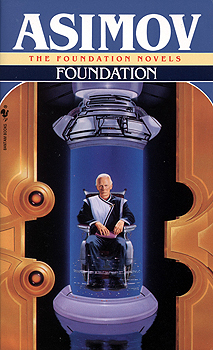
What? Oh yes, my review. First, I’d like to point out the cover. Though this isn’t the exact cover that’s on my copy, both share the fact that the primary design element is an old dude in a wheelchair. I love this fact more than I think I can properly express. The first book of the “Best All-Time Series” has chosen to showcase on its cover an old dude in a wheelchair. This is not going to be your typical “blasters at the ready” sci-fi pulp novel, is it?

So, the old dude in question is Hari Seldon. He kicks off the first Foundation novel with his psychohistorical calculations that the Empire is about to take quite the tumble, which will lead to 30,000 years of snuffy-dumplings. Don’t try to Google what that means, by the way. I just made it up. He has, however, announced that he has figured out a way of minimizing the snuffy-dumplings down to only 1,000 years. Sounds much more appealing, no?

This is quite a complex story that spans a significant time period (almost 200 years, I believe?) and introduces an array of characters along the way in addition to Mr. Seldon. Do I think everyone should read this book? No. Do I think that every science-fiction fan should read this book? Oh, very much so. I think that reading this book will determine whether you are indeed a fan of the science fiction genre…or if you are more of a “sci-fi” fan.

What in Seldon is the difference, you might be wondering. BIG difference, my friends. Such a big difference that some of the greatest minds from the genre have debated it. (Oh, and anyone interested in the Newsweek piece that Harlan Ellison references during this debate can read it here.)

What Asimov did in this first book (and I’m assuming with the entire series) is take us on a journey through the history of what has never been. And it’s brilliant. This will never be a summer blockbuster shoot-em-up (at least I hope not). And that makes it even more brilliant. It instead taps into the logical…some might say, “Vulcan” part of our minds, expects us to think, to reason, to at the very least be willing to follow along through intricacies that don’t involve phasers and quantum torpedoes. It’s instead about politics, religion, socioeconomic status, the deeper, darker machinations behind the wars…topics that expect us to think along with the story, not just lean back and watch all the pretty colors firing away on the screen.

This is the type of story that requires one to “be in the mood” for it. Admittedly, there were evenings in which my brain simply didn’t want to be stimulated by such a story. Sometimes, I want to take the easy road. This road leads you through a craggy land of intellectual climbs and tumbles. It is not a quiet stroll through the Enterprise-D’s arboretum. It was a struggle at times, but one I’m glad I endured. Because it made me better understand both what makes “science fiction” great, and what made Isaac Asimov a master of this great genre.

One of the major complaints that I had about my first exposure to Asimov’s work is how misogynistic it was. That element, though not completely absent from the first Foundation novel, was quite diminished. Of course, that’s because there were almost no appearances by female characters in this book. I’m actually grateful for that. I said it in my review of Watchmen, but it bears repeating here: “If you aren
50BC09: Book Number 40

shatnerquake

I’m actually in the process of reading another book, but last week I read on Wil Wheaton’s blog (and you didn’t think I was serious about actually reading his blog regularly) about an offer that I simply couldn’t refuse.

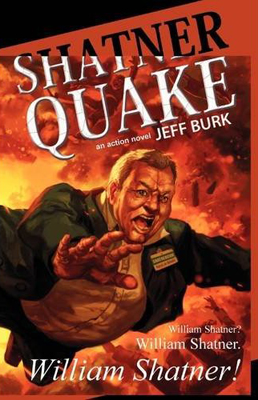
For one day only, author Jeff Burk was giving away electronic copies of his kooky, crazy tome to the toupee-tasty greatness that is William Shatner, Shatnerquake. All he asked was that those who accepted his 24-hour bout of generosity, read and review his book…on Amazon, on GoodReads, on our own blogs, with friends, wherever. Just that we get word out about this story.

So here I am, living up to my end of this bargain. Overall, this was a delightfully twisted premise. What would happen if a fiction bomb planted by Campbellians (worshippers of the Chin Known As Bruce) at ShatnerCon backfired, and instead of obliterating the existence of Shatner’s contributions to television and film, it brought them all to life? And the real William Shatner was the only man able to fight back against the rise of the real Captain Kirk, TJ Hooker, Denny Crane, Rescue 911 Shatner, the SNL “Get a Life” Shatner, and the rest of the Shat-tastic army?

Throw in a look-a-like Shatner fan, the intimate details of convention life, and a whole passel of stereotypical sci-fi conventioneers, and you’ve got yourself one freakin’ bizarro tale, which, at fewer than 100 pages, zips by at a crazy-fast and oftentimes furiously funny pace. Burk has a very strange sense of humor, but it is rooted in a seemingly intimate knowledge of just what goes down at these crazy things called sci-fi conventions. Perfect example comes from this line, which appeared during a fight scene between Captain Kirk and William Shatner, inside the dealers’ room:

Kirk moved toward Shatner twirling the lightsaber from side to side, the blade instantly devaluing collectibles and severing limbs.

Know what I love most about that line? That mention of the collectible damage came before the corporeal damage. Collectibles first, my friends. Each and every time. That’s how we roll in the dealers’ room, byatches.

The downside of this story is that it is in severe need of clean-up. I stand by my life mantra, “Everybody needs an editor.” Burk definitely needed one for this story. Misspellings abound. Turborlift? Dr. McKoy? WTF, man. WTF. Plus, a substantive edit would really help sharpen its satirical blade and tighten up the story to raise it from the appearance of being nothing more than hastily penned fan fiction.

Final score: 2.5/5. Yeah, this gets the same score as a Pulitzer winner. See, when I rate these books, I rate them based on the context of their existence. My last read, for example, tries to exist on a plane higher than it deserves, and thus should be rated accordingly. This, however, was a surprisingly enjoyable find from a literary arena that I have come to accept as producing severely hit-or-miss stories. This was a hit that has the potential of becoming even better with the right treatment. Of course, however, it runs the risk of losing its rough-edged whimsy if it is polished up for public consumption. So maybe it’s better to leave it just as it is, McKoy and all.

50BC09: Book Number 39

theroad

My first warning about Cormac McCarthy’s The Road should have been the fact that Oprah raved about it. Every time I pick up a book that has one of her stupid book club stickers on it, I inevitably hate it. I’m not talking about the already established canonical favorites of literature nerds. I’m talking about new releases she latches onto with her trademark joie de Oprah.

But this book won not just her questionable praise. It also won a Pulitzer Prize for Fiction. I’ve loved several novels that can also claim such a win, including Harper Lee’s To Kill a Mockingbird, which I consider one of the most perfect novels ever written. So I thought this fact might help to balance out the taint of Oprah praise.

Not so.

Perhaps it is because I love a genre that has done post-apocalyptic tales in multiple (and, dare I say it, better) ways. So the idea was not new to me. The concepts were not new. The behaviors were not new. The story was not new. The style was not new. I recognize the beauty of McCarthy’s sparse, restrained prose. But it, too, is not something new or unique to him. Book nerds will recognize in his style myriad other writers from disparate genres: Kerouac. Kesey. Carver. Sarmago.

Actually, Jos

50BC09: Book Number 38

wake

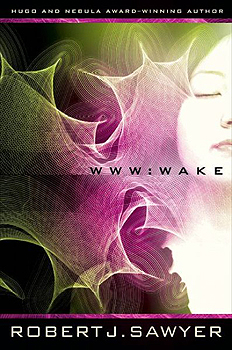
I’m very glad that I didn’t immediately post about my latest book right after finishing it. I’m glad that I looked into the back story a bit more, because I learned that Robert J. Sawyer’s latest novel, WWW:Wake, is the first in a planned trilogy of books. That makes things a lot more understandable. Well, okay, it doesn’t really. But it does at least explain why so many story threads in this novel were left dangling in front of me in such an irritating way that I wanted to reach out and rip them to shreds like Blondie told me to a long, long time ago.

I’ve read Sawyer once before during this year’s challenge and I very much enjoyed what I read. I didn’t enjoy this book quite as much, but it’s still an interesting read. The fact that it’s only part of a proposed series is something that they might want to mention in the first novel. It makes all the difference between thinking that Sawyer got really lazy toward the end and knowing that Sawyer is simply laying groundwork for future portions of the story. Also, it took a bit of doing to get used to Sawyer writing as a 15-year-old girl. I have to admit that I started imagining Sawyer going into chat rooms and pretending to actually be a 15-year-old girl, in an effort to perfect his cadence and grasp of all the hip young people slang. That by itself was really creepy and disconcerting.

Anyway, basic plot outline: Caitlin Decter, the young protagonist in question, was born blind. Her blindness, however, is due to Tomasevic’s syndrome, “which was marked by reversed pupil dilation: instead of contracting in bright light and expanding in dim light, her pupils did the opposite,” according to the novel. A Japanese scientist, Dr. Kuroda, has developed a signal-processing device that can be attached to her optic nerve with the hope that it can correct the syndrome and begin to correctly process visual input and allow her to see. She goes through with the surgery to have this device implanted…and things proceed to get very sci-fi weird from there.

Caitlin can’t see “normally” at first. Instead, she starts to see what everyone soon determines is a visual representation of the World Wide Web. They deduce that it’s because she grew up as a child of the online revolution and she spent so many hours in front of a computer (never mind that she was blind and staring at a monitor usually in the “off” position). Things may or may not sort themselves out properly. I’m not saying…you’ll have to read the story yourself.

There are also parallel stories about a videoconferencing chimpanzee hybrid named HoBo and a Chinese dissident blogger as well as a disturbing Chinese cover-up, but none of these stories is resolved in this book. Neither, really, is Caitlin’s story.

I think the book was intriguing enough that if I see the sequels pop up at my library, I’ll probably check them out. But I don’t think this was captivating enough that I would purposely seek out the sequels. I apparently am that fickle a fan.

Final score: 3/5. Not a bad read (and very quick), but I definitely enjoyed Sawyer’s Calculating God much more.

50BC09: Book Number 37

agahc

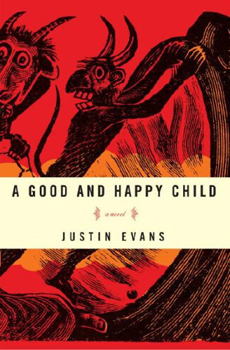
Poor George Davies. He’s got a big problem…and I’m not talking about the fictional one described within the pages of my latest read. No, little Georgie has a bigger problem than that. He’s got the problem of the inevitable comparison to Regan MacNeil. You all know Regan, right? Little girl who lives over in Georgetown with her mom? Green pallor? Bit of a chiropractic challenge? Doesn’t like split pea soup, but really likes crucifixes? Yeah…kind of a hard act to follow on amateur night, that’s for sure.

Truthfully, though, it’s not completely fair to compare Justin Evans’s debut novel, A Good and Happy Child, to William Peter Blatty’s unnerving horror masterpiece, The Exorcist. Hell, it isn’t even really all that fair to have a link to Blatty’s book embedded in this review of Evans’s novel. But it is what it is.

The Exorcist happens to be one of my favorite horror novels. It’s also one of the few novels that I’ve actually had to put down while reading, because the overload it was causing to my way-too-active imagination was more than I could stand. It’s also become my own diamond standard for any possession novel I have read since (before you even ask, no, I haven’t read that many…I’m not that demented). So it was with A Good and Happy Child.

While Evans’s novel is nowhere near as atmospheric or frightening as Blatty’s, it holds its own fairly capably. The novel becomes even more impressive when you learn that this is Evans’s debut book. Not bad for his first time at bat. Plus, it’s not quite as straightforward as you might at first assume. There aren’t many sharp-edged twists, but rather slow, sloping curves that obfuscate your view of what’s ahead just enough to make the reveal around the bend delightfully unnerving.

Admittedly, I was hoping for something a bit more frightening since All Hallow’s Eve doth approach, and I do loves me some scariness. Also, there were several moments throughout the story in which I could sense that certain events and revelations were coming simply from the setup. I think that’s less the fault of the author and more the result of a lifetime of gorging myself on Stephen King and Nightmare Theater. All that being said, as its own story, separate from the inevitable comparisons to Blatty and others from its genre, A Good and Happy Child was a mostly satisfying read that will keep you awake at night if only because you want to keep reading to find out what happens next.

Final score: 3/5. I give Evans an extra half point for coming out of the gate with a strong, entertaining first try. It won’t chill you to the marrow like Blatty’s story can, but it’s a great start to his literary career.

50BC09: Book Number 36

siasl

You know the neighborhood restaurant that’s been around for a really long time? The one that you pass every morning on your way to the Metro and you think you should try it sometime, but “sometime” never seems to come around? Then you have a couple of friends tell you how good the place is and how it’s one of their favorite places to eat and that you’d really enjoy it, so you decide finally to go for dinner. You find that the meal is okay even though the service is a little slow and clumsy, and you start thinking halfway through that it’s a satisfactory enough place that you might come back for another meal…and then it happens.

You find a hair in your food. It’s wound up with your pasta, dangling uncomfortably close to your agape mouth, the color indicating that it could in no way be your own hair. Your stomach clenches a little and whatever enjoyment you might have found instantly drains away. You immediately put down your fork and stare at your partially finished dinner, contemplating how to best handle the situation, but knowing that there’s no way in hell you’re finishing that food.

Robert Heinlein’s Stranger in a Strange Land was this meal for me. Heralded as “the most famous science fiction novel ever written,” I’ve known for a while that it fits the bill of must-read literature for my sci-fi tastes. Plus, I’ve had a few people in my life say how much they love this book. Good enough for me.

I picked up the unabridged, restored version, which at 438 tiny-font-filled pages, was more like a sci-fi smorgasbord than a light repast. But I dove in, hoping to savor the flavors that so many have enjoyed before me. After a while, though, it started to feel more like a force feeding rather than enjoyment. Heinlein is WORDY.

But the story embedded in all those words was an intriguing one, about a Human, Valentine Michael Smith, born on Mars and raised by Martians, who is then brought back to Earth to learn how to be among “his kind.” It’s an interesting twist on the Mowgli tale, even if Heinlein never really explains a lot of the things that Martian Mike is able to do beyond stating that he was “raised by Martians.” You’d think, with all the words he crammed into this book, he could have explained something to the effect of the Martians taught Mike how to use portions of his brain that Humans had yet to tap into, which is why he was able to alter his appearance or make people and things disappear. To simply glaze over all of Mike’s powers with the fact that he was raised by Martians is, to quote Captain Picard, “Not good enough, dammit! Not good enough!”

Then came the discovery of the glaringly disgusting hair: Gillian Boardman, one of the main female protagonists, says to Martian Mike at one point, “Nine times out of ten, if a girl gets raped, it’s partly her fault.”

STOP.

WTF did she just say?

Up to this point (which didn’t arrive until page 304), I had been trying to view the women in this book through the eyes of the times in which this novel was published. Treatment and views of women in 1961 were still quite pandering and stereotypical all across the board. Plus, early science fiction is not a realm in which women are held in any higher regard than they were in current presentations, never mind that the stories were supposed to be taking place in the future. Heinlein is no exception here, with his women appearing in traditional caregiver roles or as strippers. There are a few women in the story who break the mold, but they are outnumbered significantly in this book…plus, two die “off-stage” as it were, while a third joins the sexy orgy party that is the end of this book (yeah, I’m spoiling, I suppose…get Jubal Harshaw to sue me).

But this line…this line was so fucking jarring that I stopped reading the book for several days and debated during this time about whether I even wanted to finish the book. Sexism aside, this was ignorance of the purest and darkest variety. I continued to read the book until the end, deciding that I wanted to find out if this statement would be revisited and corrected. It never was. But there was lots of polyamory and nekkid time to distract us later, so who cares about the discovery of this nauseating hair?

Obviously, I did. Still do.

I guess what bothers me the most (beyond the obvious) is that this is another reminder that science fiction remains a genre that, while not exclusively a boys’ club, isn’t all that amenable to female fans. I’ve already mentioned my disappointment in the female character from my first Asimov adventure (note to Tony: I swear on my Gates McFadden-signed hypospray that I am going to give him another try thanks to your generosity), but this one line from this HUGE tome of what New York Times critic Orville Prescott described as a “disastrous mishmash of science fiction, laborious humor, dreary social satire and cheap eroticism” plunges my despair even deeper regarding women’s status in the sci-fi universe. That this could be embedded among lesser but still degrading commentary toward women in what is heralded as the most famous sci-fi novel ever written disheartens me to my very marrow.

Final score: 1/5. I guess I didn’t grok this book after all.

I’ve got three more books from the library that I need to finish, and then I’m declaring a moratorium on borrowed books. This challenge was supposed to help me get through all the books that I own and have yet to read. The time to focus on those books is now!

50BC09: Book Number 35

patientzero

I have several ImagiFriendsTM who are really into zombies. Into them to the point that they’ve thought about the zombie apocalypse…and they have game plans for how to deal with said event.

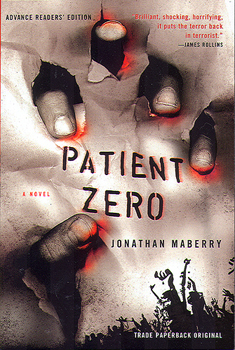
I dig zombies, too, although maybe not quite as much. So it was with mostly equal parts joy and trepidation that I dove into Jonathan Maberry’s novel Patient Zero. The trepidation stemmed from the fact that I’m usually not drawn to good guy/bad guy shoot-em-up novels all that much. Unless the weapons are phasers. Then I’m cool.

I was happily surprised for the most part. Maberry sets a quick, solid pace and lays down a story that is both captivating and highly unsettling. The latter might be a mostly subjective reaction that stems from the hooks he sinks into the realism of a post-9/11 world. Granted, zombie warfare is a bit far-fetched, but shadows of biological warfare and further terrorist attacks on American soil tap into a wellspring of real fear that, for me, does not make for pleasant reading.

However, Maberry spins a tale that is enough of a m

50BC09: Book Number 34

fmttps

I love Dick.

What? Why are you giggling? There’s nothing wrong with expressing my love for Philip K. Dick! He is very near the top of my list of favorite authors. Hell, I even like most of the movies that Hollywood has churned out based on his stories. Blade Runner, in fact, is one of my all-time favorite films ever.

[On a tangentially nerdy track, I always wanted someone to ask Lieutenant Commander Data, “Do androids dream of electric sheep?” Sadly, no one ever did.]

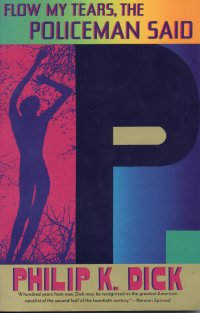
For these reasons, I was quite excited to read Flow My Tears, The Policeman Said. In this story, singer and celebrity Jason Taverner goes from being one of the most popular stars on television to being completely unknown overnight. Literally. No one recognizes him, his wallet is empty of all identification…his birth certificate isn’t even on record. He is no one, which is highly dangerous in the dystopian future in which Taverner lives. To be “no one” means that the pols (police in this book) can do with you whatever they wish, which usually means labor camps or other forms of class-based detention and abuse.

This, of course, would not do for Taverner, who as a “Six,” a genetically enhanced class of Human, is used to having his every whim met. Now, he can’t even find one person from his past who recognizes who he is…or rather, was.

For a book written in 1974, this story was quite on-target regarding the inescapable surveillance that we now find ourselves surrounded by on a daily basis. Like Orwell before him, Dick had a frightening grasp of how technology could impinge upon our lives in Big Brother-esque ways, and of how socio-economic status would become an insurmountable obstacle that would wall in the poor and lock them away from the “better” parts of society.

Out of curiosity, I went to IMDb to see what’s next on tap for Dick’s stories, and this is one of the books they’re turning into a movie. Strangely, they’re also remaking Total Recall, which was inspired by Dick’s story “We Can Remember It for You Wholesale.” Depending on who they cast in the movie version of this book, it could very well be a decent film, especially since it is so very action-oriented. Of course, we are talking about Hollywood. They’ll cast Justin Timberlake as Jason Taverner and Megan Fox as Heather Hart…and my inner geek will shed bitter tears for the horror of it all.

Final score: 4/5. I’m going to take away a point for the creepiness of a plot twist that unraveled toward the end of the book, but that’s just my own silliness. Also, the ending was a bit too abrupt and tidy. Otherwise, this was yet another amazing Dick experience. Do with that whatever you will.

And thus ends my catch-up posts from all the books I read at the beach. I only hope this boost will be enough to keep me on-target for my 50 book goal. Keep your fingers crossed, denizens!

50BC09: Book Number 33

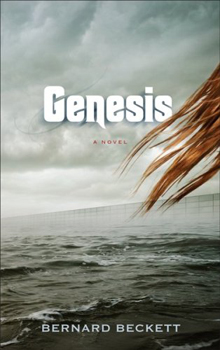
genesis

No, not the first book of the Bible. This Genesis comes from the mind of Kiwi sci-fi author Bernard Beckett.

It’s a quick tale that I read in pretty much one sitting. The premise is that we are watching in as the main character, Anaximander, is taking the equivalent of her board entrance exam for admission to the Academy. So we get to hear not only her presentation on one of her people’s greatest historical figures, but we are also made privy to her internal conflicts, worries, and pride regarding said presentation.

Doesn’t that sound like fun reading?

I’m probably not doing it proper justice, but I can’t really say much about this one. It has a bit of a twist to it, which I’d rather not give away. It’s a bit of a cliched twist for the science fiction world, but Beckett handles it well enough to keep it fresh and entertaining. Plus, like I already said, this was an incredibly fast read, so you don’t feel like you’ve wasted any time in reading it.

Whether or not you feel as though you’ve gained anything from it once you are finished is more than likely dependent upon how much science fiction you’ve read previously. If not a lot, then this might be new for you. And if you’re an old hand at devouring sci-fi stories, this still might be an enjoyable diversion.

Final score: 2.5/5. Nice, middle-of-the-road storytelling, and a pleasant diversion for a rainy day.

50BC09: Book Number 32

VForVendetta

Alan Moore always hates the movies based on his graphic novels, so much so that he refuses to be listed in the credits anymore. I can’t say I blame him. The last time he was credited was on the movie version of League of Extraordinary Gentlemen. That would have been enough to get me to protest Hollywood using my name.

Moore was so disgusted by the movie version of V for Vendetta that he refused to accept any money from it. I think he received money from Watchmen, but I’m not certain.

All that being said, I must admit that I know I am very much in the minority with what I’m about to say: I loved the movie version of V for Vendetta. I’ve seen it about seven times, and I love it more with each viewing. It’s not necessarily that I love the acting, although I do loves me some Hugo Weaving. I didn’t mind Natalie Portman, but I do think that if it’s a movie taking place in England, you might want to spring for at least one English actor for the leads (although Weaving just gets under the wire by being awesomely Aussie).

What I love most about the movie are the ideas and concepts