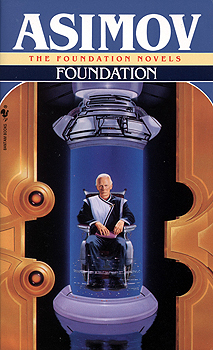
So here is the moment in which I finally fulfill my promise to read another Isaac Asimov novel. Regular denizens may remember that I wasn’t very thrilled with my first exposure to the sci-fi god that is Asimov. One denizen in particular found my displeasure disquieting and so provided me with the opening trilogy of Asimov’s Foundation series, which in whole won the the one-time Hugo Award for “Best All-Time Series” in 1966. Thank you, Tony.
As I believe I’ve already established with my review of The Road, however, prestigious awards do not always signify something great. On the other hand, the award was given in 1966, which is the year that the original Star Trek hit the airwaves in full force.
I do have a soft spot in my heart for the number 66.
What? Oh yes, my review. First, I’d like to point out the cover. Though this isn’t the exact cover that’s on my copy, both share the fact that the primary design element is an old dude in a wheelchair. I love this fact more than I think I can properly express. The first book of the “Best All-Time Series” has chosen to showcase on its cover an old dude in a wheelchair. This is not going to be your typical “blasters at the ready” sci-fi pulp novel, is it?
So, the old dude in question is Hari Seldon. He kicks off the first Foundation novel with his psychohistorical calculations that the Empire is about to take quite the tumble, which will lead to 30,000 years of snuffy-dumplings. Don’t try to Google what that means, by the way. I just made it up. He has, however, announced that he has figured out a way of minimizing the snuffy-dumplings down to only 1,000 years. Sounds much more appealing, no?
This is quite a complex story that spans a significant time period (almost 200 years, I believe?) and introduces an array of characters along the way in addition to Mr. Seldon. Do I think everyone should read this book? No. Do I think that every science-fiction fan should read this book? Oh, very much so. I think that reading this book will determine whether you are indeed a fan of the science fiction genre…or if you are more of a “sci-fi” fan.
What in Seldon is the difference, you might be wondering. BIG difference, my friends. Such a big difference that some of the greatest minds from the genre have debated it. (Oh, and anyone interested in the Newsweek piece that Harlan Ellison references during this debate can read it here.)
What Asimov did in this first book (and I’m assuming with the entire series) is take us on a journey through the history of what has never been. And it’s brilliant. This will never be a summer blockbuster shoot-em-up (at least I hope not). And that makes it even more brilliant. It instead taps into the logical…some might say, “Vulcan” part of our minds, expects us to think, to reason, to at the very least be willing to follow along through intricacies that don’t involve phasers and quantum torpedoes. It’s instead about politics, religion, socioeconomic status, the deeper, darker machinations behind the wars…topics that expect us to think along with the story, not just lean back and watch all the pretty colors firing away on the screen.
This is the type of story that requires one to “be in the mood” for it. Admittedly, there were evenings in which my brain simply didn’t want to be stimulated by such a story. Sometimes, I want to take the easy road. This road leads you through a craggy land of intellectual climbs and tumbles. It is not a quiet stroll through the Enterprise-D’s arboretum. It was a struggle at times, but one I’m glad I endured. Because it made me better understand both what makes “science fiction” great, and what made Isaac Asimov a master of this great genre.
One of the major complaints that I had about my first exposure to Asimov’s work is how misogynistic it was. That element, though not completely absent from the first Foundation novel, was quite diminished. Of course, that’s because there were almost no appearances by female characters in this book. I’m actually grateful for that. I said it in my review of Watchmen, but it bears repeating here: “If you aren
