BookBin2012: Fangland

Apparently, I’m on a bit of a vampire kick at the moment, eh? The truth of the matter is that I had planned the back-to-back vamp-a-thon I just completed, but I had no intention of reading anything else. Then, during a recent stroll through the local library, I stumbled across John Marks’ Fangland. I’d never heard of it before but the cover art was sparse and striking and…well, yeah, I’m in a bit of a bloodsucking mindset right now.

Do with that statement whatever you will, denizens.

I admittedly had trepidation when I first started reading this novel. I’m still feeling the rush of rage through my veins that yet another book has besmirched the darkness of the original Dracula. The fact that it was Stoker’s own kin makes the rage that much brighter. Was this going to be yet another book that devolved into ridiculous notions of vampire romanticism and eroticism? Or would we finally get this bloody bullet train back on track?

Oh, denizens. This story is dark…dark as tumbling untethered and unlit into the Mariana Trench. In some ways, I think this might actually be a darker story than even Bram Stoker imagined for our vicious immortals. Marks is deliciously diabolical as he spins a tale that is both respectful of the original novel and more than ready to push beyond the limits of the original’s boundaries. He also shows a level of deference to the original text that delighted me immensely. His story unfolds in a modern update to Stoker’s epistolary telling, through e-mails, diaries, newspaper clippings, and various other first-person accounts. Just as with Stoker’s story, this approach is almost purely subjective, leaving us with that same sense of uncertainty regarding whether what we are reading is to be believed or filed away as some form of communally shared mental breakdown.

Plus, he named his heroine Evangeline Harker, which I admit was what ultimately convinced me to check out this book after the cover first hooked me. Once I dove into the novel, I found other characters who obviously fed upon the legacy of predecessors such as Van Helsing, Lucy Westenra, and Renfield in different and familiar ways.

I’m not going to state here that this is a perfect tale. There are admittedly several aspects that I either found uninteresting or unpleasant. I’m still not all that comfortable with the events of September 11, 2001, being used as a means of propelling along fictional storylines. However, Marks uses the memory of that and other modern and historical atrocities to great effect and in such a way that works to strengthen the impact of his tale. It’s also part of the revelation of who and what Marks’ vampire is, and is ultimately the moment in which I felt that Marks surpassed Stoker in dark imaginings.

For full disclosure, Marks does use sex in this novel, but in its basest, darkest form. These characters wield sex with bleak precision for sinister purposes. There is no sparkly sexeh time here. There is, however, evisceration, immolation, desecration, mutilation, exsanguination, exploitation, and a whole lot of mental deterioration all across the board.

This story is a hot, crazy mess, denizens, and it drags you bleeding and sore over its twisted remains at discomfiting speeds. You might not like where it takes you, but it’s one hell of a ride.

An interesting side note that I discovered while looking for a cover image is that, apparently, John Carpenter was slated to direct the movie version of this novel back in 2007. There was even talk of Hilary Swank being cast as Evangeline Harker. I’m not sure what happened, although it looks like the writer strike that year derailed these plans. Neither Carpenter nor Swank is still attached to the project; rumor now has it that Wes Craven might be directing it. I’m on board for that. I’d rather see his take on this tale than watch him waste his time on another Scream.

Final Verdict: If you prefer sinister vampire mythology over sparkly treacle, then you might be in the market for just this novel. I’ve returned the library copy I had, but I do believe I will be adding this to my wish list for future acquisition.
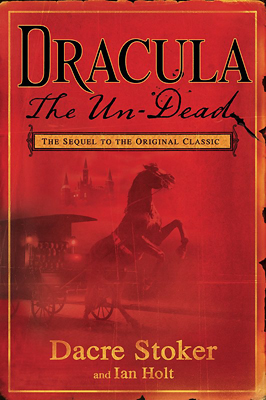
BookBin2012: Dracula: The Un-Dead

No, denizens, this isn’t a reprint of my previous BookBin entry. See, there was a reason why I chose to re-read a book that I knew I had no intention of giving away. I wanted to refresh my memory and prepare myself for my first reading of the “official” sequel to Stoker’s classic.

First, a little bit of history. Bram Stoker’s orginal Dracula is considered to be part of the public domain here in the United States. It’s fallen under this classification since 1899. Why? Because apparently Stoker failed to comply with one requirement from the U.S. copyright office and…POOF. No more U.S. copyright. Open season was pretty much declared on the Dracula story by all interested American parties at that point, each knowing that they would never have to consult with any member of the Stoker family and each in turn slowly whittling away the dignity of the Dark Prince.

Swoop ahead 200 sparkling years later to the 2009 release of Dracula: The Un-Dead. Touted as “The Sequel to the Original Classic,” this is the Stoker family’s attempt to reclaim the rights to their ancestor’s legacy. The book is co-written by Dracula historian Ian Holt and Dacre Stoker, Bram’s great-grandnephew.

I’m not going to lie: Seeing a new Dracula book with the Stoker name on the cover? Gave me little chills and tingles, denizens. With all the insipid and uninspired nonsense that has come down the pipeline in recent years regarding the vampire mythology, I was elated to see that someone might actually want to put things right once more.

Yeah.

Where to begin. Were this in no way associated with the names Stoker or Dracula…if it were presented as its own original story…I might actually have nice things to say about it. It’s a decent enough story with characters that, if they were original to this tale, would be an intriguing (though decidedly miserable) melange of personalities, characteristics, and attributes. I would still have problems with certain aspects of the story, but not nearly as many as I have with it as the “official” sequel to Stoker’s novel.

As the official sequel, Dracula: The Un-Dead is a murky mash-up in which the real and the fictional mingle in oftentimes disturbingly meta ways (including interactions between Bram Stoker himself and his characters), and which ultimately devolves into a disappointing concession to the years of bastardization that our dear Dark Prince has suffered at the hands of far less talented writers than Stoker.

The real Stoker, that is.

At first, I thought that my only major issue with Dracula: The Un-Dead would be the “character” of Countess Elizabeth B

BookBin2012: Dracula

See? I told you that I would make the Dark Prince mine once and for all. Electronically, that is. One of the first truly squeelicious moments I had with my Kindle was when I discovered that Bram Stoker’s Dracula was part of Amazon’s free library. I already own a printed copy, but I decided that one can never own too many copies of a horror classic, especially when the cost is non-existent.

It seems a bit trite for me to review this novel, since I’m willing to bet that there are very few people who are not aware of the Dracula legend. In fact, that was one of the things that I found myself regretting as I re-read this novel: I regret that I was never able to experience this story from a fresh perspective, without the baggage of the myriad popular culture translations, references, revisions, and blatant butchery of the vampire mythology as introduced by Stoker.

Anyone who is a horror fan knows that Stoker’s tale is one of the cornerstones of the genre. You cannot be even a passing fan without knowing something about our favorite Transylvanian acupuncturist. But what must it have been like to have experienced this novel for the very first time? Truly the first time, rather than how most of us have experienced it: through the lens of predetermined knowledge forged by Bela, Buffy, Barnabus, Blacula, Blade, Louis and Lestat (couldn’t go on forever with Bs, could I?), Selene, Vampire Hunter D, and the sugary sickness imposed upon the mythology by She Who Does Not Deserve Naming Alongside Stoker?

Actually, now that I think about it, it’s for all these reasons that we should revisit the original. Or, better yet, visit it for the first time. After all, how many Dracula fans have never actually read the original novel? I daresay there are quite a few, which is admittedly their loss. There has yet to be a definitive cinematic interpretation of the original Stoker tale, and this most assuredly includes Francis Ford Coppola’s attempt back in 1992.

[Loba Tangent: I recently re-watched this movie (realizing as I did that I have not watched it in its entirety since its original VHS release). First, I was depressed to realize that this movie was released 20 years ago this year. Second, I was even more depressed to realize that time has severely blurred my memory of what I saw 20 years ago. In my re-watching, I came to the conclusion that this movie is actually quite terrible for many reasons, including an offensive reinterpretation of the relationship between Mina and Dracula, more of which I shall discuss…later.]

If you have never read Stoker’s novel, I implore you to do so. Try your best to forget all that you have seen and instead allow yourself to embrace the darkness of Dracula’s true literary form. It is not the quickly paced sensory overload that Hollywood has turned it into. It is also decidedly not a love story. Not the kind that TPTB would have you believe, anyway. Instead, it is a slow boil of terror and triumph, told from multiple perspectives, giving you a full and unsettling view of events that will transport you from Transylvania to England and back (with multiple disturbing stops along the way). I can only imagine the response of those reading this novel upon its original 1897 release. It must have been scandalous for its shocking depictions and descriptions. Even now, more than 100 years later, it’s still deliciously unsettling. Go ahead, take a taste…

Final Verdict: I’ve got my print copy stored with the rest of my horror classics, and now I’ve got my electronic copy saved on my Kindle. I will say this, though: While reading this electronic copy of the novel, I came across several typographical errors, which brought to mind another possible reason for my hang-up with the concept of e-Readers. I have a strong feeling (at least with the free copies of books) that a lot of these digital conversions do not go through the same level of editing that printed books go through. There isn’t the same level of quality control, and I find that highly distracting. Why? I’m a editr. That’z wye.

BookBin2012: Epileptic

Not wanting the “Public Library” portion of my BookBin2012 widget to go unloved, and because I simply cannot stay out of a library as gorgeous as our neighborhood library, I bring you my latest discovery from the graphic novel section: Epileptic by David B. (or David Beauchard).

Originally released as a six-volume series under its French title, L’Ascension du Haut Mal (which translates as “The Rise of the High Evil”; also, “haut mal” is the French equivalent of the English term “grand mal” in reference to epileptic seizures), Epileptic is Beauchard’s retelling of his family’s journey through the sudden onset of his older brother’s epilepsy when his brother was 11.

Beauchard’s choice to approach his family’s story from his younger version’s perspective brings the narrative to a less convoluted, more accessible level. A story dealing with such a serious medical condition runs the risk of becoming overburdened by medical jargon; telling the tale from the perspective of the little brother who must process all these changes and ordeals as they are happening gave Beauchard permission to simplify his narrative without watering it down.

He balances the various family dynamics and reactions to his brother’s worsening condition, demonstrating not only the extraordinary measures to which family is willing to go in order to save their own, but also the disconnectedness and solitary confinement each member experiences, even in the face of familial cohesion in pursuit of a cure. Though they are together in family experimental journeys into alternative medicinal treatments and alternative religions, Beauchard explores well the varied and separate emotional responses he and his family experience.

Beauchard is not an overly sentimental writer, which I believe serves his story well. He is, however, a phenomenal artist. Just as I praised Craig Thompson for the artistry of his novel, Blankets, I believe that Beauchard is another whose artistic prowess has raised my opinion of graphic novels to an even higher plateau of respect. The inky intricacy of his oftentimes nightmarish tableaux roll over you in swells of beauty, horror, desperation, promise, resentment, and resignation. His artwork is unsettling, reflecting at times the disturbing aesthetic of a Grand Guignol influence.

[Or perhaps I merely think this because they’re both French. This is sometimes how my brain works.]

Admittedly, the artwork is bold and distinct enough that it was a bit overwhelming at first. I pressed through my initial discomfort and soon found myself enraptured by the dark details of Beauchard’s beautiful black and white panels. His view of the world, both the real one and that of his exquisite imagination, is rich and complex and full of the fury and impotence with which so many families are familiar when faced with an intractable disease. At times I found myself lingering over a page long after finishing the text, simply trying to take in the layers hidden beneath the words…layers that provided a deeper narrative unhindered by the boundaries of letters.

Final Verdict: I hope that this novel has already found its way into another’s book basket at our library. Definitely another one for the Amazon wish list.

BookBin2012: The Best of Cemetery Dance, Volume 1

I’m feeling a bit peckish for horror this year, denizens. I recently reorganized some of my library and discovered that I have amassed quite a few horror-related novels throughout the years, including a rather impressive list of Stephen King novels never once cracked open in all their years of taking up a lot of room on my shelves.

Horror has been my favorite branch of the speculative fiction triumvirate since I was just knee-high to a corpse (I’d rank them horror, sci-fi, and fantasy a solid and very distant last), so I’ve decided that I need to focus a bit more on this part of my library.

First on my list? The Best of Cemetery Dance, Volume 1, a collection of short stories that I bought at a used book sale slightly more than a decade ago (at the same sale that I bought many of my King novels as well as this previous BookBin entry).

For those not familiar with horror-focused literature, Cemetery Dance is…well, allow them to explain themselves:

Cemetery Dance is the World Fantasy Award-winning magazine of horror, dark mystery, and suspense. Each issue is packed with 100 to 140 pages of short stories, articles, columns, interviews, news, and reviews! Plus stunning full-color covers and striking interior artwork! Covering the entire horror field

BookBin2012: Secret Identity

I promise, this will be the last book review for a while. It will also be much shorter than my last two reviews. I don’t want to overload you.

I’m now finished with the stack of CSI graphic novels that I purchased last year, with the fifth in the series, Secret Identity. I thought this was the last one illustrated by Gabriel Rodriguez, but it looks like there might be one more, although it doesn’t seem to be part of the longer serial novels. I think it might be a one-shot novella done back when Ashley Wood was still doing the abstract artwork. More investigating is required.

For Secret Identity, Rodriguez again paired with Steven Perkins on the abstract art. Steven Grant took over from Kris Oprisko as the writer of this story. It’s a shame that this was the last novel Rodriguez and Perkins worked on together, because I believe this is the best of the bunch. Not only did these two artists’ divergent styles merge beautifully for this novel, Rodriguez really came into his own for the main artwork. He invests a great deal of care and creativity into exploring the space of each page, each panel, bringing a sense of grace and artistry to what is also the darkest, and in my opinion, best written story from this batch of five novels.

Steven Grant did a tremendous job writing this story, giving readers something that not only can compete with a television script, but might in some ways surpass what we’ve seen from the show (especially in recent years). It’s refreshing to see such a cumulatively extraordinary effort put toward a medium that, when done in such a mass market style as comic book tie-ins to television series, typically tends to suffer from mediocrity and apathy from all involved. Case in point? Go flip through a stack of hastily written/drawn/published Trek comics and tell me what you think…you know, after you finish peroxide-washing your brain and eyes.

The coloring is again superb, drawing from a palette of soothing to passion-infused, and enhancing the almost cinematic-quality angles of Rodriguez’s cleverly drawn panels. Also, IDW Publishing returned to the standard size for this graphic novel (although it looks like they also offered it in the smaller “New Format” size; avoid this one at all cost), which means larger space for artwork that truly deserves every inch and more.

Final Verdict: Definitely a keeper. I’d vote this the best of the first five CSI graphic novels, hands down. If you’re at all interested in seeing what the comics can offer you, this would be my top recommendation.

BookBin2011: CSI Graphic Novels

No, that isn’t a mistake, denizens. This will be the final book entry for my 2011 reading endeavors. Even though I was in the process of reading several other books (my attention span seemed to shrink significantly toward the end of last year), I decided I wanted to end the year on a fluffy note. Therefore, the stack of CSI graphic novels that I picked up from Amazon Marketplace a while ago seemed like a great place to go. Besides, as I mentioned in my last post, there was road-tripping to be done this past weekend, and since I wasn’t driving, I chose to entertain myself with reading.

Okay, so here’s the deal: After reading the first CSI graphic novel, Serial, I decided that

BookBin2011: Blankets

I suppose it would be a bit naive of me to think that I can have an objective opinion of Craig Thompson’s illustrated novel (his rather concise term) Blankets. Even though I knew nothing about the novel when I hefted it from the library shelf and added it to my pile, it ended up being one of the most surprisingly accessible books I’ve picked up in a very long time.

Thompson, born one year before me, is a contemporary not only in age and pop culture references (his affinity for the grunge music scene is particularly well defined through mostly wordless background references that might slip past you if you’re not paying attention), but also in religious experiences. His autobiographical protagonist goes through many of the same ordeals that I went through as a student at a Christian high school. His questions, fears, conundrums, and ultimately, his deliverance from these spiritual quandaries are more often than not identical to my own experiences.

And there I’ve gone and given away the ending. But only if you know me well…

Thompson’s journey through his religious and familial morasses is much darker, much more complex than mine ever was, which adds a newness to a slightly recognizable story and provides greater opportunity to develop a sense of empathy for our hero. His experiences with the ostracizing impact of adolescence and fumbling attempts at first love ultimately make him more fallible and more endearing with each page. Also, Thompson’s artistic skills are enviable. Blankets is a perfect example of why the graphic medium is such a powerful contributor to the literary world. In fluid lines and simple shadowing, Thompson is able to convey the complexities of emotion and beauty that often defy description. His artwork is elegant, observational, reverent, and beguiling.

Final Verdict: Alas, I must return this copy to our library where, hopefully, many others will discover its subtle beauty and depth. I would love to have a copy of this book in my library. Dear Amazon.com Marketplace, make me an offer I can’t refuse…

BookBin2011: La Perdida

This was a last-minute impulse grab from the graphic novel section as I was trying to leave the library during my last visit. I’d already pulled a stack of books from this section (most of which I’ve already finished and written up here), but there was something so very…forsaken about this novel. It sat, separate from the other novels, missing its dust jacket, its hardback cover showing its title and author only on the spine. I don’t know why, but I have a bit of a soft spot for hardback books that have lost their jackets.

And thus I ended up adding Jessica Abel’s La Perdida to my stack of selections. Translated as “The Lost,” La Perdida leads us through a year-long look at life in Mexico City, as experienced by the novel’s protagonist, Carla Olivares. Born to an American mother and Mexican father, Carla spends most of her early life trying to distance herself from the Mexican half of her heritage. However, as she grows more disillusioned with her urbanal existence as a 20-something Chicagoan, she decides to leave everything behind to drop in on her ex-boyfriend Harry, a rather stereotypical “wealthy WASP” who has chosen to live in Mexico City because his literary hero, William S. Burroughs, lived there for a brief time (he fled to Mexico City to escape possible jail time in Louisiana only to end up in a Mexican jail after killing his wife during a drunken game of William Tell.)

[Loba Tangent: There is a part of me that was greatly amused by the serendipity of discovering so many references to Burroughs throughout this novel, considering my recent discovery and appreciation of Beat Generation literature.]

Harry soon tires of Carla’s presence and kicks her out. However, rather than return home, Carla chooses to remain in the country illegally, an expatriate desperate to not only experience “true Mexico” but to be accepted by a collection of locals with whom she has become friends since her arrival. These include Oscar, a winsome if somewhat witless drug dealer who dreams of one day touring the United States as a renowned DJ and with whom she falls into a rather indeterminate relationship; and Memo, a false prophet of