BookBin2015: Still Alice

stillalice

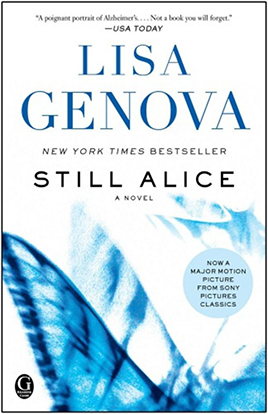
Remember in my last book review how I wrote that I was going to be writing again soon about a book that I enjoyed less than the movie? That would be Lisa Genova’s Still Alice.

Right off the bat, however, let me clarify some things about that statement. First, I think Genova’s story of well-respected linguistics professor Alice Howland’s decline from early onset Alzheimer’s disease is unflinching, devastating brilliance. I couldn’t put down the novel, no matter how haunting or painful it was to continue. As I’ve mentioned here before, Alzheimer’s took my grandmother from us slice by brutal slice, so this story was particularly upsetting at points. However, it also bore a message of determination and survival as well as a plea that we not shut out those with Alzheimer’s as though they were no longer a worthy part of our lives or the world in general. They cannot halt what is happening to them, but they continue to need the same things we all do: interaction, acceptance, love, strength, kindness.

That all being said, I don’t necessarily think I would use the word “enjoyed” in reference to this book. It’s like saying you enjoyed Sophie’s Choice. You can appreciate the craftsmanship of the story, the power of the narrative, the thematic impact. But enjoy? I don’t know about that, although I suppose the somewhat open-ended conclusion of the book and movie provide a final bit of silver lining to Alice’s admittedly ever-darkening cloud.

Finally, I would place the movie version of this book higher than the book. Why? Two words: Julianne Moore. A sublime actress, Moore brings Alice to life in ways that will destroy you. Few have deserved an Oscar more than she did for this performance. I believe she also is the reason that I ultimately rate the movie higher than the book. She lifted this character from the page and pushed her into existence honestly, eloquently, and with purest humility. She released all inhibition and gave herself to the role in a way that few can truly and convincingly do. If for Moore only, I recommend the movie more than the book, although I’m all for tackling both and doing your own comparison.

Final Verdict: In both book and cinematic form, this is a story whose value I can acknowledge. It also is a story I don’t particularly ever want to revisit.
Cravenous: The Last House on the Left

It’s October, denizens. You know how much I love this month. Even though it’s cold and bound to get colder from this point on in the year, I can’t help it. I love Halloween. I love horror. And while I’m still struggling to find solid footing when it comes to my visits here to the lair, I had this idea this morning while driving to work and I’m going to try to make it so. See, I decided a little while ago that, for this October, I wanted to watch/re-watch every Wes Craven-directed movie that doesn’t include the word Nightmare or Scream in the title. We all know how I feel about those two franchises. But what about all the other films that Craven directed throughout his career?

I’ve already loaded up my Netflix queue with every Craven film they offer (and I’m seriously debating going ahead and buying a couple that aren’t offered but that I love enough to want to add them to my collection anyway). There are enough movies in my list that I know I’m not going to be able to finish watching them all this month, so this new feature will last a hot minute longer than until All Hallow’s Eve. Plus, I’ve got a lot on my plate work-wise and play-wise, so that will slow things down there as well. But, the good news is that I’m here now, and I’m…Cravenous in my horror hunger.

Did you see it? What I did?

So let’s start with the beginning of it all, shall we?

tlhotl

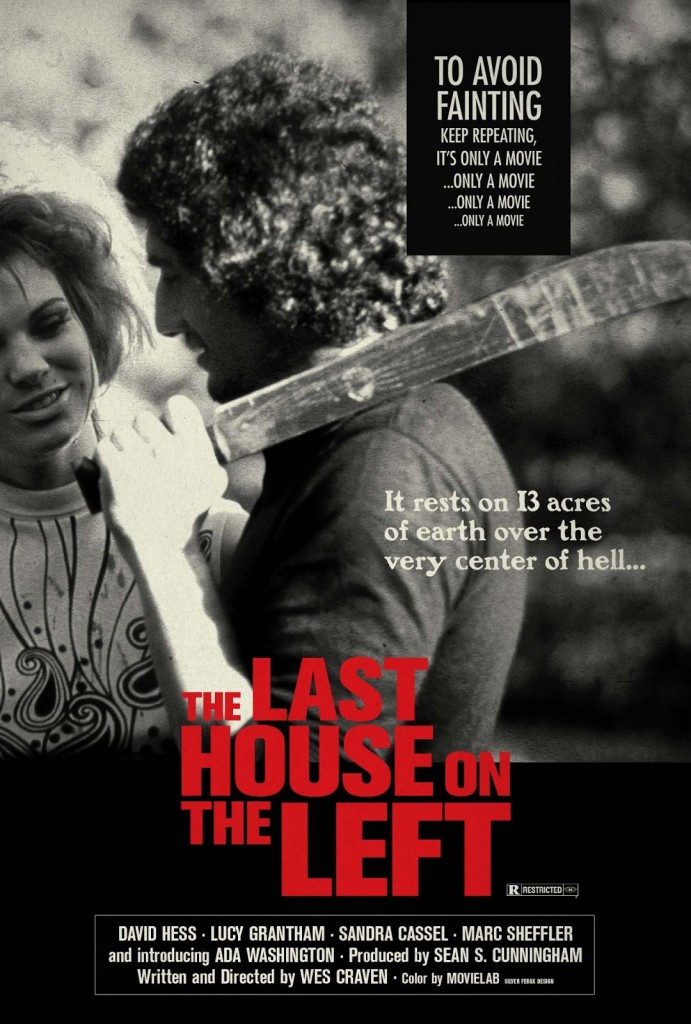
Admittedly, this is a very difficult place to start, especially for non-horror fans. I can’t recommend Craven’s first film The Last House on the Left. It falls soundly into that category of horror populated by realistically unsettling storytelling. Even if you do like horror but your preferences skew toward the scary yet implausible variety, then this is not the film for you.

Instead, this is Craven exploring the darkest of horror. Not the phantasmagorical. Not the supernatural. Not the paranormal. For Craven, we were the most frightening monsters to examine. Thus, when this film starts out with the warning that this story is based on true events, I view it less as a specific warning and more of a generic caution that what we’re about to see can be as true as we make it. As anyone who pays attention to the news even today (even? especially today), we can make this true…and we can make far worse true.

In horror lingo, you can boil the story down to two words, one genre trope: rape revenge. I don’t like rape revenge stories. I also don’t like this type of realistic horror. Again, I’m aware enough of what we do to each other in real life that when I want to be scared, I want it to come from a horror that cannot actually happen to me. Maybe that’s a cop-out. I don’t know. However, reality is a bludgeon enough even when it isn’t being horrific. A couple hours of escapism is a nice balm to a bludgeoned soul.

However, Craven felt the need to go to these darker depths of humanity, driven by the need to better understand the reality he and his peers were experiencing at that point in history. He said in many interviews regarding this movie that it was spurred into life by our increasingly violent culture. The images broadcast from the Vietnam War in particular brought violence into homes all along Main Street USA in visceral, unsettling ways, leaving all of our society

BookBin2015: Freakonomics: A Rogue Economist Explores the Hidden Side of Everything

freakonomics

I’m actually going to start this book review off with something that I rarely ever state (but also something that I’m going to be repeating in my next book review, so stay tuned!): I actually found the movie more interesting than the book. In this instance, I believe that the movie makes the information of economist Steven Levitt’s book Freakonomics a bit more approachable. While not completely boring, the book is a bit on the dry side. For a book with such a whimsical title, I suppose I was expecting a bit more…whimsy. I believe this is why I enjoyed the film version more. While not flippant at all, the film takes the text and livens it up, makes it pop a bit more.

I actually loathe that I’ve written all that. I typically defend books to the bitter end when it comes to the “which was better” debate. I think perhaps it also didn’t help that I trudged through this book while sitting on the beach. This is not beach reading. Bad choice on my part, to be honest.

After that rousing review, who doesn’t want to read this book now? To be fair, it actually is quite a fascinating study into the events that shape certain life paths for us as a society. It tackles statistical analysis in an approachable and provocative manner, inviting us to consider our own thoughts on Levitt’s well-supported arguments regarding things such as drugs, education, abortion, real estate, parenting, cheating…all presented in intelligent, witty, and freshly examined ways.

Final Verdict: I intend to check this out of the library again at some point. I don’t believe that I gave the book the fair shot it deserves to really capture me.

Photo Fun Friday: Wes Carpenter

First, the source of the inspiration:

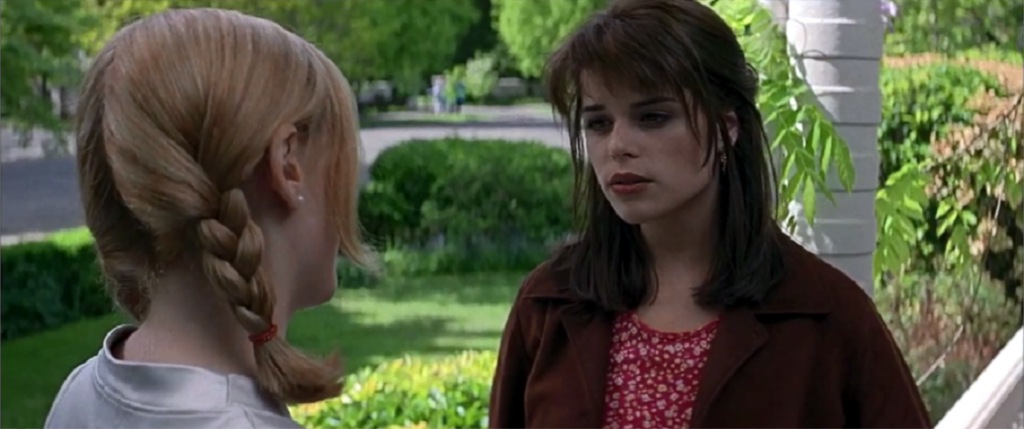
Sidney: You know, if I was wrong about Cotton Weary, then…the killer’s still out there.
Tatum: Don’t go there, Sid. You’re starting to sound like some Wes Carpenter flick or something.

sidneyandtatum

Second, a beautiful quote from John Carpenter and Sandy King in response to the passing of their friend, Wes Craven:

Wes Craven was a good friend. His passing took the world of cinema and his friends by surprise, which is probably how he would have liked it. Shock was his stock and trade.

He was a craftsman and a master storyteller who amused and thrilled audiences around the world with his films. He was a gentleman who leaves his friends missing his fellowship and generosity of spirit.

And now, the point of this post:

wescarpenter

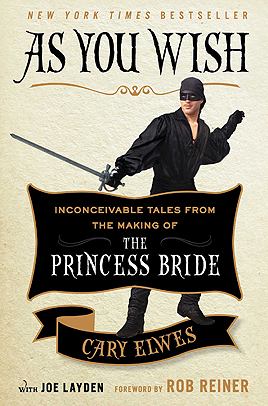
BookBin2015: As You Wish: Inconceivable Tales from the Making of The Princess Bride

asyouwish

I feel almost as if this were a cop-out review. I make no secret of the fact that I love The Princess Bride. It’s one of the funniest, sweetest, swash-bucklingiest, greatest modern fairy tales ever put to film, IMHO. Thankfully, I’m not alone in this opinion, as the movie continues to amuse and delight all age groups who see it. Simply put, it’s one of the most delightful films I own or I have ever seen. William Goldman, who both wrote the original novel and the screenplay for the movie, even stated that this is his favorite of all the things he has ever written. He loves the story so much that he was terrified of what might become of it in the hands of Hollywood.

Clearly, his worries ended up being totally and wondrously unfounded.

This entry isn’t about the original novel

BookBin2015: The Daylight Gate

daylightgate

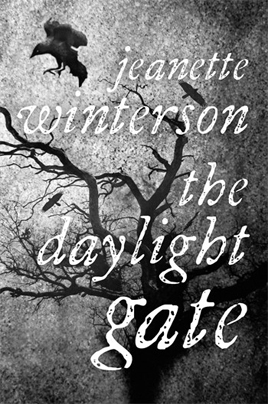
I feel a bit guilty, as this is going to be the second negative book review in a row (although I promise it won’t be quite as negative as my last one). I feel even more guilty because of the fact that I usually enjoy Jeanette Winterson’s writings a lot. However, for some reason, The Daylight Gate was not the Winterson book I was looking for this time.

I think one of the things that became the largest hurdle for me with this book was the fact that it was a fictionalized account of a true historical atrocity. It deals with the Pendle witch trials, which occurred in the early 1600s in England during the reign of James I. You know, the king under whom the only approved Bible for good fundamentalist Christians came into being. Never mind that it wasn’t an actual translation of the original texts, but a poor translation of a poor translation that was even further whittled down by random editing to help fit the Bible into all the square pegs James I wanted fitted. James I, of course, being the king who believed during his reign that Scottish witches were plotting against him.

But, again, I digress.

The Pendle witch trials were horrific enough in their facts. Truly, you don’t need to fictionalize anything about the trials to get a terrifying account of what occurred. It started as a decree from King James a year into his reign that all justices of the peace in Lancashire should provide lists of all within their jurisdiction who refused to attend church and take communion. By the end, 10 people had been hanged. Seems fair enough, right?

I don’t know why, but something about adding fictional elements to real horrors, or conversely, injecting real atrocities into fictional horror (see every season of American Horror Story for examples of that) has always bothered me. I don’t like history being trivialized. Call it the Cameron Effect, I guess. However, certain historical horrors should never have to have fictional elements added to make them compelling or important to know. The Pendle witch trial apparently fits into this category for me.

Final Verdict: I still very much like Winterson, and I even believe that this book is crafted well enough that, if you don’t have the same odd hangups that I apparently have when it comes to history and historical fiction, then you might enjoy it. I, however, shall bide my time until my next Winterson fix.

BookBin2015: Corked

corked

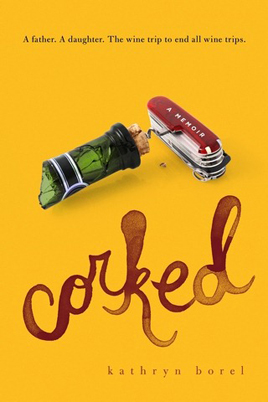
Y’all know that Loba likes a little bit of wine, right? Je voudrais un verre du vin rouge. Know what I’m saying? So I was definitely intrigued when I found Kathryn Borel’s memoir Corked and saw that it was about a special trip that she planned with her French father to visit wineries throughout the south of France and try to absorb from him some of the wine wisdom he possessed thanks to his career as a hotel manager. They were going to visit all the premiere wine-making regions, such as Alsace, Burgundy, Languedoc…places that, even without her father there to guide her, would have been extraordinary to visit, to describe, to share with readers.

That would have been a great book to read.

This book was, hands down, one of the biggest wastes of time I’ve encountered in a very long time. I honestly wish that I hadn’t finished it, but I’m still deep down disgustingly optimistic, especially when it comes to books. I kept hoping that the book would stop being all about Borel airing dirty laundry, whether it be hers or her father’s. I wanted to read about his knowledge of wine. I wanted to read about wineries and beautiful settings and tastings and learning. I did not want to know about Borel’s life or her problems or her obsessions or anything about her at all, really. I wanted to learn about wine. All I learned was that some people should never be allowed to write. Borel is one of those people.

Final Verdict: The term “corked” actually means that the wine has gone bad because of a cork failure, thus making the wine undrinkable. Once a wine is corked, all you can do is dump it. This memoir is most definitely corked.

BookBin2015: The Genius of Dogs: How Dogs are Smarter Than You Think

tgod
Honestly, anyone who has ever experienced the exquisite joy of owning a dog already knows inherently what this book tries to tell us empirically: Dogs are far more complicated and intelligent than we ever anticipate them being.

I write “tries to tell us” not because I thought Brian Hare and Vanessa Woods failed in any capacity with their book The Genius of Dogs: How Dogs are Smarter Than You Think. Instead, I think that it’s both an oversimplification to state something so obvious, but also that we are still great lengths away from understanding the depths of these creature’s intellect in any holistic capacity. While this book does take us deeper down the rabbit hole than most, I think the truth is that most people overlook the intellectual capacity of “man’s best friend” because we aren’t looking to them to be furry Einsteins. We want them to wag their tails, woof amiably, lick our faces, and generally just make us smile.

However, it takes a degree of intellectual and emotional depth to comprehend what is expected of them and to deliver in such compelling and completing ways. They come to know us in ways that we don’t quite know ourselves, and how they do it is one of the sweetest, most comforting mysteries of this universe. It’s something we might never fully understand, simply because how could they ever possibly explain it to us? However, this book provides some insights into the observable mental complexities of our canine companions. Again, though, it’s a fine line to walk between fact and supposition when contemplating certain elements of intellect in an animal that can neither confirm nor deny our assumptions. Yes, some things can been empirically proven. The things I want to know? Those are the beautiful mysteries that dogs keep to themselves.

Final Verdict: Interesting book, but not one I feel compelled to add to my library at the moment.

BookBin2015: Redshirts

redshirts
What to do on a cold, rainy Saturday? Read a little, drink a little coffee (or a lot of coffee), work out while watching part of a documentary on Harlan Ellison, and then write some book reviews. Finally. Why? What do you do on a cold, rainy Saturday?

I read John Scalzi’s Redshirts back in January of this year, yet it has stuck with me as one of those delightful surprises that I need to add to my sci-fi collection at some point in the future (look at that, already giving you the final verdict).

First off, if you are not a fan of the original Star Trek series, then the term “Redshirt” might not mean anything to you (of course, with the proliferation of geekery in the mainstream pop culture lexicon now, it’s kind of hard not to know the term, but I digress as usual). Quick summation: The term refers to the fact that the unknown, usually unnamed extra thrown into the landing party with Kirk, Spock, and McCoy always wore the security officer’s tunic, which was red on the original show (it later changed to gold on TNG, but the term remained). That officer rarely made it back to the ship, thus equating the red tunic with the survival short straw on any away mission. Because, really, did you think one of the Trek Triumvirate was going to bite it on that planet, Ensign Ricky?

Therefore, naming your novel after the unluckiest crew members of the original Enterprise guarantees you geek points right out of the gate. Of course, I instantly thought that it was going to be a Galaxy Quest-esque parody full of yucks and insider haha moments penned specifically to appeal to thoroughbred nerds.

I was not expecting it to take a wonderfully surprising sharp turn that would steer us all, character and reader alike, into a fantastical meta mixing of fantasy and reality that never once felt anything less than sincere to me as I went along willingly and happily for the ride.

Scalzi takes something so well-known among genre fans and twists it by giving it far more plausibility than the original show could ever afford it (why did the Redshirts always die on the original show? Because they weren’t Shatner, Nimoy, or Kelley…now stop asking stupid questions!) Instead, Scalzi takes the question seriously, examines it from more than the patently obvious answer, and provides a patently wonderful alternative response.

I could say more, but I don’t want to spoil this for anyone. It’s fun, it’s funny, it’s intriguing, and it’s far more than the parody I was expecting. It’s still whimsical and at times flat-out ridiculous, but Scalzi sells it in such a way that you willingly buy even the weirdest of the story’s elements.

Final Verdict: Seriously, were you not paying attention? I already told you, I’m adding the book to my collection…and you should add it to your reading list. If you love science fiction and Star Trek, then you, too, may love this book.

CSI: Catherine Still Incompetent?

Visitors to the lair know that when I’m devoted to a show, I’m in it to win it until the very end. I’ll even follow you into continued “seasons” in book form if I’m really into you (which reminds me: I need to finish the “eighth season” of Deep Space Nine before I completely forget the first three books from the run). It’s no surprise, then, that I have continued to watch the original CSI: Crime Scene Investigation through every bump and dip the show has seen in recent years. And, even though I confess to no surprise from the announcement earlier this year that CBS had cancelled the series after 15 years, I still felt a pang of loss. This show has meant a great deal to me for myriad reasons