Photo Fun Friday: Community Coffee House

Other than being re-sized for posting, this photo is completely unaltered in any way:

A rarity, indeed, denizens. Typically, I always do something to my photos before posting them, whether it be something simple like cropping it in a certain way or tweaking the color levels, or something…a bit more dramatic.

I can’t help myself. I am a PhotoShop devotee, to the very depth of my CMYK/RGB soul.

That being said, the moment I saw this photo, I loved it just as it was, without one plea. We’d gone out walking early on Sunday morning, our last full day in New Orleans (in case you were wondering, that’s part of the reason I barely made it to the lair in April…prep work followed by onsite support for a conference in the Big Easy, after which I played tourist for a few days).

It was already in the mid-70s and the sun was just reaching the point where it could cast its light down into the magnificent maze of the French Quarter. We were already heading to a place for breakfast, but I couldn’t resist stopping and filling my lungs with the scent of coffee wafting from this corner Community Coffee House.

As I stood, watching the light cast shadows of street lamps and signage against the wall, I was struck by how so many of the aspects of New Orleans that I love were right there in front of me: the cast-iron quaintness of the lamp posts; the bilingual street signs, each pointing us deeper into the tangle of delights that the Quarter willingly offers up to everyone who wanders through; the local brew house, churning out yet another delicious aroma to cancel out Bourbon Street’s unseemlier smells; the strong glow of sunlight, pouring down on it all, bright and bounteous.

The entire tableau made me so happy that I couldn’t resist snapping a shot before moving along to our breakfast destination. I didn’t even review the shot after taking it…simply slung the camera back over my shoulder and ambled on down the Rue Royale, thoughts of coffee and fried green tomatoes and biscuits and gravy taking precedence once more.

Imagine my surprise when I finally saw the shot.

True, the longer I look at it, the more ideas flood my mind regarding what I could do with it in PhotoShop…age it, fade it, bolster the color, crack it, rip it…the temptation is engulfing. However, for this post, I give it to you in its simplest, truest form.

Everyone Needs an Editor: Cemetary

There are certain editorial errors that are like kryptonite to a word nerd. Every word nerd has something that affects them in a particularly nerve-scraping way, but, rest assured, denizens, we all have those niggling little pet peeves that simply drive us crazy.

Me? I have a few, but one of my definitive “wailing and gnashing of teeth” moments is this:

It’s probably because I am quite a morbid wolf, but I loathe seeing the word “cemetery” misspelled. There’s an episode of Scooby Doo that has it spelled this way, and I can promise you, it has always driven me a wee bit batty.

In other news, yes, I have returned. I’m appalled that April passed so quickly and left me with the lowest entry count I’ve ever had here at the lair (minus the first month of my revampitude). I can’t promise that I’ll be making daily entries…but I promise to strive to beat last month’s record. And look! I’m already halfway there! 😉

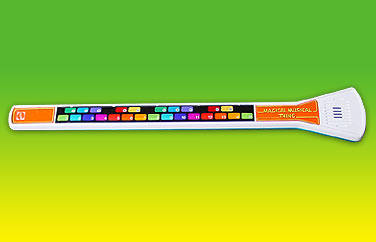
Flashback Friday: Magical Musical Thing

Stand back, denizens! It’s another one of those toys from the 80s loved by wacky suburban White kids!

Actually, the Magical Musical Thing hit the market in the late 1970s. It was, quite possibly, one of the silliest things I can remember from my childhood…and that’s saying a lot since I did have Strolling Bowling (and willingly admit to still having it stored in my closet).

The Magical Musical Thing was a long plastic stick, Smurf blue and trimmed in white (at least mine was). Along the spine were rows of pressure-sensitive pads, little color-coded rounded rectangles whose coloring always reminded me of billiard balls. Maybe this was the root of my future fascination with that game…who’s to say, really.

I remember going through the little music book that was included with the Magical Musical Thing, tapping out stilted renditions of classics such as “Oh, Susanna!” or “I’ve Been Working on the Railroad” for a little while before growing bored and rubbing the Magical Musical Thing against the top of my head to make it make a noise not dissimilar to someone trying to cram a synthesizer up an android’s bum.

I had mad skillz when it came to the Magical Musical Thing, denizens.

[youtube http://www.youtube.com/watch?v=ywz7vN0GF_Y&w=640&h=480]

BookBin2012: Sin City: Hell and Back

This is an addendum of sorts to my last book review. Really, though, it’s not even going to be a review.

I have nothing to say about Frank Miller’s final Sin City entry, Hell and Back. I didn’t like it. I didn’t like the story. Didn’t like the writing. Didn’t like the artwork.

Just didn’t like it.

I wish I had more to say about this book, but I really have nothing else I want to say. My response was decisive and persistent the entire time I read this book; to be honest, I actually dreaded this particular review because of my keen lack of interest or investment. I suppose it’s my fault for picking up the final volume in the series without having read any of the others. However, I also didn’t like the movie based on three other volumes from the series. I haven’t seen the film since it was at the theater, so I don’t remember specifics of why I didn’t like it. Of course, this speaks volumes, in my mind at least. If I can’t remember anything about it other than it left a lingering tang of disinterest on my palate, it’s obviously not going to be high on my list of re-watches.

Subsequently, this book isn’t going to be high on my list of re-reads. I’m also not in any particular hurry to track down any other volumes from the series. I can’t say I’m the least bit surprised by my reaction to this novel. I remember the hype surrounding Miller’s saga. In fact, this might be an early example of my hype deflector going into overload. The more I heard, the more marketing I witnessed, the more raging fanboy glee I watched, the less interested I became in this series. I’m sure there are earlier instances of simliar responses from me, but I can’t think of them right now.

Final Verdict: Meh.

BookBin2012: All-Star Batman & Robin, The Boy Wonder, Volume 1

Well, there’s a mouthful of a title, right?

Seems that I went on a bit of a binge the last time I hit the local library, especially when it came to graphic novels. This time, I was surprised to find a couple of selections from Frank Miller’s catalog. I’ve been looking for Miller’s work to show up for a while now; mostly, I’ve been waiting for his Batman work as well as 300. I got part of my wish with this selection.

Even though it wasn’t The Dark Knight Returns, which is what I was hoping would show up, I was more than willing to give All-Star Batman & Robin a go. With this series, we get Miller’s take on how Dick Grayson found himself under the protection and training of Batman after events left them sharing a defining moment involving their respective parents (how’s that for vague?).

Mainly, I was drawn in (ha) by the fact that Jim Lee was the artist for this collection. Lee was an integral force behind the artwork of the X-Men back in the late 80s and 90s. He pretty much helped establish the appearance of that merry band of mutants to which I was first introduced through the Saturday morning cartoon that I still love. Not only that, he helped Chris Claremont create the character of Gambit, who was always one of my favorites on the cartoon. Also? Anyone who gets a vote of confidence from Chris Claremont definitely gets my vote, too.

Obviously, at some point Lee shifted his talents from Marvel to DC, which led to his teaming up with Miller on this retelling of the Boy Wonder’s arrival in the Bat Cave.

Taken in its entirety, this is an amazing collection. Miller’s dark sensibilities work well in conjunction with the world of the Dark Knight. This is not the glowing realm of Metropolis, protected by their alien immortal in bright patriotic splashes of blue and red. This is seedy, gray Gotham, full of characters composed of gritty complexity. There are rarely clear delineations between good and evil, as intent and integrity blur into the deep shadows that Lee so eloquently elicits through his artwork. Kudos should also be given to Scott Williams and Alex Sinclair, who were responsible for inking and coloring, respectively.

Where the weakness of this collection shows is where the weakness of most comics appear: the depiction of female characters. Miller’s women are vapid, vituperative, and vindictive, not to mention extremely objectified through language and artistic renderings. We meet Vicki Vale in her very skimpy lingerie. Later, we see her preening in anticipation of getting close to Bruce Wayne and his huge bank account. The Black Canary is a busty, bawdy barmaid with indecent curves and impossible heels. Wonder Woman…she was the greatest disappointment of all. Apparently, in Miller’s Gotham, a woman of strength and independence by default must be an angry, violent man hater secretly harboring crippling lustful urges toward the primary target of her man-hating ways.

Right.

Miller’s depiction of all the women in this collection was infuriating, but no take was more insulting or offensive than his on the Amazon goddess.

Plus, there’s the added insult of the comic-standard ass angle in which we see nothing but the…butt of whatever woman happens to be in frame at the present moment. What a dull, tedious angle, lacking in any artistic integrity or imagination.

That being said, I did find certain other choices by Miller to be intriguing. I liked that his Batman was just the least bit, shall we say, unhinged. Sure, he’s the Dark Knight. Yes, he’s a crime-fighter. But he’s not a “hero.” He’s surly, unpredictable, uncooperative and just a tad bit…cracked. He refers to himself as “the goddamn Batman,” which made me think of the awesome Twitter feed of the same name every time I read it. I’m assuming this comic is also from where the idea for Christian Bale’s gravelly, growly Batman voice came? Interesting. Works better in print form.

Final Verdict: I’m not really sure I want to add this to my library. As much as I love Lee’s artwork as well as many aspects of Miller’s re-imagining of Gotham and its Dark Knight, I didn’t feel any particular desire to revisit. This might change. If it does, I’ll let you know.

BookBin2012: Deogratias

After stating in my last review that I find fictional uses of September 11 to be disconcerting, it’s a strange twist for me to then turn to a graphic novel recounting of the 1994 Rwandan genocide.

Truth is, the deeper down the graphic novel rabbit hole that I dive, the more blown away I am by the creativity and introspection shown by the amazing artists I’m discovering. When I saw Jean-Philippe Stassen’s Deogratias: A Tale of Rwanda, I didn’t think twice about grabbing it from the library shelf. David Beauchard and Craig Thompson have more than convinced me that this medium is not only capable of respectfully dealing with tough topics, but it is also in many ways more appropriate when dealing with things that escape the limits of language itself.

I should have been clued in by the expurgated length of this novel that it wasn’t going to be terribly provocative; however, the topic alone more than fulfills that expectation. Even nearly 20 years later, I still can’t wrap my brain around how the world sat by as so many lives were brutally snuffed from existence. Then again, most of the things that humanity does to itself elude my understanding. The one thing that humans will probably never truly understand is human nature.

Stassen tells a very carefully controlled story, centering on the titular character Deogratias (a Latin liturgy meaning “thanks be to God”). We experience the outbreak of violence through this teenaged boy’s view as he watches his Hutu kinsmen rise up against the local Tutsi. Interspersed are moments embedded 5 years after the fact, in which we see how the events have irrevocably altered him…alterations that Stassen conveys in a rather interesting visual choice.

In some ways, it feels almost disrespectful to have condensed the events of this genocide into such a short novel. Then again, I don’t necessarily think I would have been able to absorb a visual account any longer than this, considering how bleakly explicit Stassen’s artwork became at times. There are some things you simply don’t need to see to comprehend how awful they were.

An obvious comparison at this time would, of course, be Art Spiegelman’s Maus, not only for the graphic treatment of a graphic historical event, but also for shared allegorical elements. Spiegelman’s groundbreaking novels, however, are far more complicated than Stassen’s tale. Still, I believe that Stassen pays subtle but deserved obeisance to Spiegelman’s novels through certain choices in his storytelling.

Final Verdict: As an interlude to something more probing and holistic, this is worth the time to read; however, as a stand-alone, it falls short of the greatness to which it could have transpired.

Everyone Needs an Editor: Allen

Little known Poe fact: In addition to being the master of the macabre, the father of the modern detective novel, and one of my all-time favorite writers, he was also apparently the inventor of the Allen wrench:

I kid, of course. And yet my jaw still aches a little bit from the irritated teeth grinding to which I succumbed as I stared at this placard. I found it while strolling about the D.C. National Portrait Gallery this past weekend. Strangely enough, I’d never been to this particular Smithsonian museum. It’s quite beautiful and filled with an eclectic array of paintings, photographs, and sculptures that could easily consume the better part of a day if you’re so inclined to indulge in a serene saunter through the museum’s many halls.

Leave it to me to find the one editorial error that would be the fly backstroking along in my otherwise lovely soup. Beyond my own personal reasons for cringing whenever I see Edgar Allan Poe’s name misspelled in this way, I can’t help but feel an even greater level of offense for the one-two-three punch of it being misspelled in this particular location:

  1. Let’s start with the fact that this placard is hanging in a museum located in the heart of Poe country. Although he never called Washington, D.C., itself home, he lived and died in the confines of a circuitous path that ranged from Richmond to New York City, with frequent stops in Philadelphia and Baltimore, which became his final resting place. For all intents and purposes, Poe is a local literary hero. For that reason alone, we should know how to spell his name properly.
  2. His name is misspelled on a placard describing a photograph of Stephen King, the writer who is arguably the modern-day heir to Poe’s macabre legacy. It would be like placing a placard next to a portrait of Poe and referring to “Steven King.”
  3. Last, but certainly not least, this is a placard located in a museum. Maybe it’s just me, but I kind of expect a greater level of quality control involving materials associated with museums. After all, the very etymology of the word “museum” denotes a building dedicated to the “Muses” of study and art

BookBin2012: Dracula

See? I told you that I would make the Dark Prince mine once and for all. Electronically, that is. One of the first truly squeelicious moments I had with my Kindle was when I discovered that Bram Stoker’s Dracula was part of Amazon’s free library. I already own a printed copy, but I decided that one can never own too many copies of a horror classic, especially when the cost is non-existent.

It seems a bit trite for me to review this novel, since I’m willing to bet that there are very few people who are not aware of the Dracula legend. In fact, that was one of the things that I found myself regretting as I re-read this novel: I regret that I was never able to experience this story from a fresh perspective, without the baggage of the myriad popular culture translations, references, revisions, and blatant butchery of the vampire mythology as introduced by Stoker.

Anyone who is a horror fan knows that Stoker’s tale is one of the cornerstones of the genre. You cannot be even a passing fan without knowing something about our favorite Transylvanian acupuncturist. But what must it have been like to have experienced this novel for the very first time? Truly the first time, rather than how most of us have experienced it: through the lens of predetermined knowledge forged by Bela, Buffy, Barnabus, Blacula, Blade, Louis and Lestat (couldn’t go on forever with Bs, could I?), Selene, Vampire Hunter D, and the sugary sickness imposed upon the mythology by She Who Does Not Deserve Naming Alongside Stoker?

Actually, now that I think about it, it’s for all these reasons that we should revisit the original. Or, better yet, visit it for the first time. After all, how many Dracula fans have never actually read the original novel? I daresay there are quite a few, which is admittedly their loss. There has yet to be a definitive cinematic interpretation of the original Stoker tale, and this most assuredly includes Francis Ford Coppola’s attempt back in 1992.

[Loba Tangent: I recently re-watched this movie (realizing as I did that I have not watched it in its entirety since its original VHS release). First, I was depressed to realize that this movie was released 20 years ago this year. Second, I was even more depressed to realize that time has severely blurred my memory of what I saw 20 years ago. In my re-watching, I came to the conclusion that this movie is actually quite terrible for many reasons, including an offensive reinterpretation of the relationship between Mina and Dracula, more of which I shall discuss…later.]

If you have never read Stoker’s novel, I implore you to do so. Try your best to forget all that you have seen and instead allow yourself to embrace the darkness of Dracula’s true literary form. It is not the quickly paced sensory overload that Hollywood has turned it into. It is also decidedly not a love story. Not the kind that TPTB would have you believe, anyway. Instead, it is a slow boil of terror and triumph, told from multiple perspectives, giving you a full and unsettling view of events that will transport you from Transylvania to England and back (with multiple disturbing stops along the way). I can only imagine the response of those reading this novel upon its original 1897 release. It must have been scandalous for its shocking depictions and descriptions. Even now, more than 100 years later, it’s still deliciously unsettling. Go ahead, take a taste…

Final Verdict: I’ve got my print copy stored with the rest of my horror classics, and now I’ve got my electronic copy saved on my Kindle. I will say this, though: While reading this electronic copy of the novel, I came across several typographical errors, which brought to mind another possible reason for my hang-up with the concept of e-Readers. I have a strong feeling (at least with the free copies of books) that a lot of these digital conversions do not go through the same level of editing that printed books go through. There isn’t the same level of quality control, and I find that highly distracting. Why? I’m a editr. That’z wye.

I Don’t Give a Damn ‘Bout My Bad Doppelg

I warned you, denizens. There was a reason for my last Flashback Friday choice.

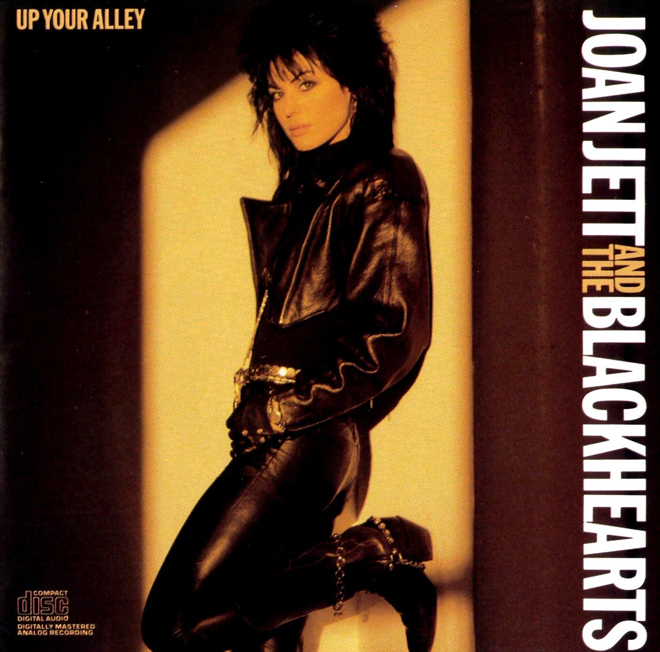
Truth be told, Joan Jett’s 1988 release Up Your Alley is my favorite album, holistically speaking. This probably stems from the fact that this was my first taste. However, I can find something enjoyable from all of her Blackhearts releases. I can even dip back into her Runaways years and find stuff to make those long commutes at least audibly enjoyable. All I have to do, though, is just see the cover art for Up Your Alley, and the Loba Happy-O-Meter is cranked to 11.

None more black, indeed.

This was quintessential Jett in many ways, especially in visual style: teased black rocker hair, black leather all around, kohled eyes, “come here if you dare” stare. However, I’ve always had a soft spot in my heart for the cover of her 1983 release, Album. Atrocious jaundiced background aside, this has always struck me as one of her most “fun” covers:

Nothing better than a Jett in flight, eh? I’ve always loved this pose…so much so that I’ve considered getting the silhouette on a T-shirt. Plus, she’s decked in her trademark black, including the leather pants, but she’s still holding onto her punkier Runaways style with her red Chucks, that bandanna thing she kept going for quite a while, and some badass black leather-studded accoutrements.

I love this version of Jett so much that this is the photo I chose as the inspiration for my own Joan Jett costume for a rock-themed party this weekend:

Close enough for government work, right? I was pretty pleased with the overall look (although I’m sure there was more makeup on my pasty face that night than on an episode of RuPaul’s Drag Race). I thought about taking my Guitar Hero controller with me for effect (after covering the Aerosmith logo, of course), but decided that I didn’t want to run the risk of spilling anything on it. And there was much to be spilled. Open bars make awesome parties.

Most people immediately twigged to who I was supposed to be. One couple, however, did ask if I was Jack White.

Damn young people. Learn your rock history!

Of course, I did have a disturbing epiphany when I finally stumbled back home that night and caught a quick glimpse of myself in the foyer mirror. With my mullety hair and my thickly lined blue eyes? I looked a little less like an 80s rock star and more like a motorcycle-riding graduate of Eastland Prep…

Loba as Joan Jett Totally Looks Like Nancy McKeon as Jo Polniaczek

Take the good. Take the bad. Take ’em both and there you have just a part of Mi Vida Loba…