Observational Randomness

The radio traffic reporter called me “honey bunny” this morning.

Okay, not me specifically. It was all part of her goofy on-air banter, her way of making her usually dismal news to us groggy Beltway commuters a little less soul-crushing. As much as I loathe my commute, I always love listening to her.

Truth is, the traffic report is pretty much all I can stand listening to anymore. Everything else sounds jumbled, confusing, off-key. Podcasts wash over me, the words trickling through the cracks in my concentration and flowing away without leaving any trace of their passing. Music? Dissonant and irritating, like pebbles stuck inside my shoes.

So I drive in silence most of the time, and I keep my brain from straying to places I’m not yet ready to go by watching the world as it zooms past Sammy’s windows. This morning it was all the joggers. Like the lovely older Asian man who jogs with the precision of Swiss watches. It’s not just his predictable punctuality but his movements as well. Strides perfectly measured, syncopated arm swings, even the towel always tucked around his neck seems to flop in pre-planned rhythm.

Or the gaggle of college girls crowding others to the side as they dominated the sidewalk, trotting along like sun-dappled mares with their upswept ponytails swinging in hypnotic unison.

It’s enough to make me wish once more that I jogged. Only problem is that my knees and back used to play softball in high school. I suppose the rest of me played as well…but my knees and back still remember those years the most. Still feel those years.

Sometimes I miss playing softball. I’d like to think I was good at it. I won a few awards from those years and when I was finished, I’d made it to shortstop, which I’ve been told is a pretty important position. Really, though, I played because it was in my blood. One of the first gifts I remember receiving was a whiffle ball and bat set and a little lefty glove from my three aunts, two of whom played on various softball teams for most of my childhood.

And then there were the hours that my mom and I spent playing catch. Even when there was very little else we could do together without tempers and tensions flaring, this was our oftentimes silent truce. I can still see our gloves in the hall closet, her full-sized righthander’s leather glove with my little pee-wee league lefty glove nestled inside it.

I remember how, for my birthday after the first year I made the school softball team, she had my dad drive her all over the place (this was well before the days of Sports Authority or Modell’s), trying to find a new lefty glove for me. She wanted to make sure I was ready for the next season, ready with a grown-up glove to finally replace the one I’d been using since 2nd grade.

I can still smell that clean, new leather, still feel the supple give of the grain as I slipped my hand into the glove for the first time. I stopped keeping my glove in the hall closet. Instead, it stayed in my room, usually with a softball tucked into it to keep its shape. I’d oil it regularly and often sit in my computer chair in the evenings, absentmindedly tossing a ball into the glove as I watched television. During softball season, I was very rarely without that glove on my hand.

It was around this point that my mom stopped wanting to play catch. My throws, even when I tried to moderate them, were too hard, too fast, and she was too proud to admit this. So she simply stopped playing.

I remember not long after I moved out, I was visiting my parents and needed to look for something in the hall closet. I happened to look down and there was my mom’s glove, still sitting at the top of the junk bucket, empty except for the dusting of cobwebs across the ball pocket. Too many years had passed by that point, but I still remember wishing that I’d had my glove with me, that we could go play catch once more.

I never saw her glove again after that. I’m not sure what happened to it after my parents moved a few years ago, although I strongly suspect that my dad might have tossed it during their pre-move cleanout. He views sports equipment with a special disdain usually reserved for politicians or fundamentalists (not hard to imagine I’m his daughter, eh?).

Perhaps I’ll ask him where her glove is next time I visit. Perhaps by then I’ll be back to listening to music and podcasts. Perhaps by then even innocent random observations won’t lead me down the very pathways I’d been trying to avoid through the observations. Perhaps.

When Words Fall Away

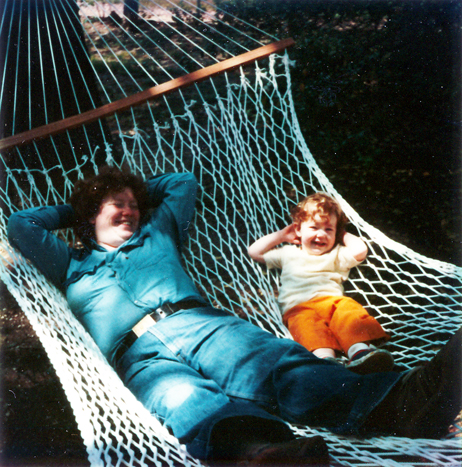
When words fall away, love must speak for us. I’ll always love you, Mom.

Till time shall cease:
Sleep that no pain shall wake;
Night that no morn shall break
Till joy shall overtake
Her perfect peace.

{ from Christina Rossetti

Country Music is So…Gay?

I’ve been keeping a secret from you, denizens, but now it’s time I come out.

I used to be a major country music fan.

I know, I know. That statement just sparks WTFery, right? I am the one, after all, who often reminisces quite fondly about my metal hair days and I even recently expressed my still-bright love for old school rap and go-go. But there was a period of time in my life when I traded in my metal cred and my go-go bounce for the love of a little slide guitar and fiddle.

How did this happen? Honestly, I’m not really sure. I know it involved patient but persistent prodding from a very good friend whose veins ran hot for country. It was her ultimate goal, I think, to convert as many of her friends as possible. And, for a brief moment in time, she succeeded in convincing me that country music was worth my time.

Then, however, came the Bush administration and all the

I’m Too Sexy for My Docs…

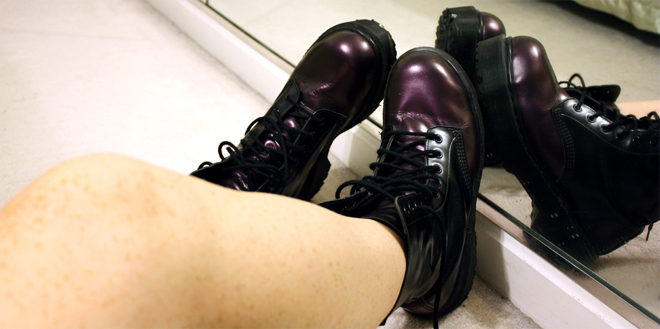
Okay, so that should probably be the other way around. These Docs are way too sexy for me. Even in a supremely over-saturated photo in which I effed with the colors like no one’s business, they’re still teh awesome. Also, doesn’t this shot scream that it belongs on the cover of some 90s indie alt-rock band’s CD? Makes me want to slip into my flannel and rock out to The Breeders or Pearl Jam. Want a better look at them?

This is more true to their original color (and mine, too…freckled knee and all!). They’re two-toned leather: black and metallic purple. Plus, they’ve got killer-high soles and steel toes. No other real point to these pics…or this post, for that matter. Was feeling slightly experimental with my camera this evening and wanted to give some love to a pair of my Docs that don’t really see much action anymore. Although they were great for clubbing, they look a tiny bit out of place when I wear them to work. Of course, that doesn’t stop me from wearing them anyway…

Snickers Makes Me Snicker, Actually

I’m usually not a fan of television commercials. I quite hate them, in fact. Sometimes, though, an advertising campaign is such pure brilliance that even this Commercial Grinch can’t help but fall in love.

So it is with Snickers. First came the Super Bowl commercial, with Betty White and Abe Vigoda:

I don’t think the line “That’s not what your girlfriend says” has ever been funnier. Or oogier.

Then there’s this one, the Diva Commercial:

I’m sure that I should feel some sort of consternation that these are both slightly misogynistic in nature (dudes unable to do their dudely deeds because their hunger has turned them into old women or divas…or Abe Vigoda), but there’s something so effing funny about both these commercials that my feminist sensibilities are appeased by the laughter they invoke. Especially that Betty White commercial. She’s so freaking funny. I’ve adored her ever since I first saw her as Rose Nylund, and I love how she continues to rule the funny block like the Comedy Diva she is.

Flashback Friday: Misfits of Science

Nothing too profound for this week’s Flashback, but I thought it might be bad form to miss another Friday without dropping something on you (sorry about last week…stupid work, keeping me from blogging!).

Whilst poking around on YouTube a while ago, I discovered that someone has been posting episodes from one of my earliest sci-fi obsessions. Yes, Loba is dipping all the way back into the year I was 9 for this one (although I thought I was younger than this…oh well), to bring you Misfits of Science.

Basic premise is that these two groovy California scientists, Billy Hayes and Elvin Lincoln (played respectively by Dean Paul Martin and Kevin Peter Hall), bring together these…well, misfits of science, to fight for truth, justice, and the right to dress in the most stereotypically gnarly 80s ways imaginable.

Billy is a “normie,” but Elvin creates and takes a super-secret potion that allows him to shrink from 7 feet down to, I think like 8 inches (thus becoming the first instance in history of a dude choosing shrinkage). The rest of the team is formed by “Johnny B” Bukowski (played by Mark Thomas Miller), a rad rocker dude with glowing eyes who can run super fast and blast lightning bolts from his fists thanks to being struck by lightning during one of his band’s concerts; Gloria Dinallo (played by Courteney Cox), a typically confused teen with typical teen issues…oh, and a pesky telekinesis problem; and Jane Miller (played by Jennifer Holmes), Gloria’s parole officer and Billy’s love interest. Throw in the dad from ALF and you’ve got your cast! Yeah. Oh, that I was clever enough to make that up.

This was a hot mess of pure 80s cheese all the way through. But I didn’t care. I loved this show. I tuned in to watch every episode that aired on NBC, and I remember being devastated when the show just disappeared. It was tough being a child of the pre-Internet information saturation, I tell ya! There was just something about the Misfits that I couldn’t get enough of. I’m not sure what it was though.

Oh, wait. It was Courteney Cox.

Even though I have a strong suspicion that she’s no longer completely biodegradable, I still adore her, and that all started with Misfits of Science. I was so happy when she re-appeared on NBC on Family Ties, totally related to her character on Friends (I, too, find it difficult to sleep if I know that there are still shoes lying out in the living room!), can’t get enough of Gale Weathers (okay, that’s somewhat of a lie…stop making Scream movies!!), and even own Masters of the Universe on DVD (Tom Paris and Gina Dinallo, w00ts!!1!). I even watched a few episodes of Dirt, but I can’t bring myself to watch Cougar Town. The thought of Courteney Cox being old enough to qualify as a “cougar” makes me feel old. Say it ain’t so!

[Loba Tangent: Seriously, Courteney, please stop with the plastic surgery. You’re beautiful as you are…but foreheads are supposed to actually move and your mouth isn’t supposed to stretch from one side of your face all the way to the other. Unless, you know, you’re going for that oh-so-sexy “New and Improved Joker Smile” look.]

Okay, back to the Misfits. It was a silly show, indeed, but it was fun silly. Well, I thought so at least. Of course, I was 9 at the time. What the hell do 9-year-olds know? At that age, I was running through mud puddles and wishing that Scooby Doo was real (I still regularly do one of these things, but I’m not telling which). But check it out for yourself if you don’t believe me. Just remember: If Johnny’s eyes are glowing, all your batteries are going to be dead and you’d probably better move out of the way of his fists…and if Gloria goes all negative colors, you’re about to either be hit by something or she’s about to fling you across the room. Don’t say I didn’t warn you either way…

BookBin2010: In the Woods

Haha, bet you thought I was finished with my book postings, didn’t you? I actually finished Tana French’s In the Woods before the last book I posted, but I held back. Why? Because this isn’t going to be a quick posting. I have a lot to say about this book. A lot.

[Loba Tangent: Ever notice how I always have so much more to say about the things that I don’t like than I do about the things I do like? Well, except for Star Trek. I can talk about that for hours. I think in another universe, I actually do.]

Wha?

Dammit, focus, Loba! Okay, so this is actually one of my books rather than another library book. Finally! I’ve been quite excited to read this one since I received it for Christmas 2 years ago (believe me when I say that getting to it within 2 years of receipt is proof of my excitement; some of my books have been waiting patiently for double that time or more).

I need to stop being excited for things, because my excitement is inevitably converted into bitter disappointment.

Okay, that was a bit hyperbolic. I was very excited to read this novel. And I wasn’t completely disappointed. French has an adept grasp of language that was a pleasure to read and that never faltered throughout the story. I love a skilled wordsmith more than any of you might truly understand, and I strongly believe that French is high-caliber in her writing style.

It’s the story that left me flat. It’s also the story that I’m about to ruin in some ways because of the nature of my gripes. So if you’re interested in reading this novel and would rather I not ruin it for you with my whiny hating, I recommend you stop here.

So, here’s the basic gist of the book: It’s a first-person account, told from the perspective of Detective Rob Ryan, from the Dublin Murder Squad. He and his partner, Cassie Maddox, are assigned to a child murder that takes place in the same place where two unsolved child disappearances took place several years before. Only one witness survived this earlier case: Detective Ryan, who has no memory of what happened and later changed his name and completely hid this event from almost everyone (he does tell his partner, however).

Of course, there’s overlap between the two cases in Ryan’s and Maddox’s mind, and they subsequently come at the new case from this and several other angles. In fact, this takes up a significant portion of the story. Are these cases linked? Is it a serial killer? Will they find the bodies of Ryan’s long-lost friends? How long can Ryan keep his secret from his superiors? Better yet, how long can he keep his secret from unraveling him completely? Will it consume him? Stop him from solving the current case? Destroy his relationships with his partner and other detectives? Destroy everything he’s fought so hard to achieve? Destroy him completely? How many more questions can I come up with before you scream ENOUGH!

Okay, enough.

So, here’s the thing that really ticked me off. The whole plot about Ryan’s forgotten traumatic event from his childhood (and, believe me, it’s definitely set up as traumatic right from the start) turns out to be nothing more than a red herring that I think French included to give her main character an excuse to be flawed. Why? This is just my theory, mind you, but I think it’s because she was writing from the perspective of a male character. I think she gave him this significant flaw so that if anyone questioned how he was behaving throughout the story, she’d have the fallback of being able to say, “Well of course he’s not going to behave like a typical guy. Look what he went through as a child!”

Again, this is completely my own theory, and probably a huge assumption on my part. However, there was just something so…wow, I hate what I’m about to write, but there was something so stereotypically female about many of Ryan’s actions, reactions, and behaviors throughout the novel that is served as quite a distraction from the real action. The way he behaved throughout a lot of this book, especially toward the end when the unraveling was becoming more prevalent, was erratic, irrational, and at times almost borderline hysterical (see why I hate writing this? I hate every single one of those behavior traits and how they’re always ascribed to women…and how, when they’re ascribed to a male character, they become distracting).

You know what it made me think of, actually? The line from Jack Nicholson’s character in As Good As It Gets. You know, when the woman asks him how he writes women so well, and he replies, “I think of a man, and I take away reason and accountability.” That’s terrible (and terribly funny in the context of this movie), but that’s precisely how I felt Ryan had been written.

Do I think that French made this decision as a way to cover for any failings she may have encountered in writing from the male perspective? Possibly. Maybe more than possibly. I totally understand if this was indeed her rationale for adding the childhood trauma angle. I was just so irritated as I approached the end of the novel and realized that this particular piece of the puzzle was going to remain unsolved. I don’t usually have a problem with things like that (some of my favorite episodes of CSI are the ones that are left unsolved for another day), but this really pissed me off. I guess I felt as though, I’ve stuck it out this long, I deserve a little closure, goddammit!

Ah well. Can’t always get what we want, right Mick?

Final Verdict: I haven’t come to a complete decision on this one, but I’m almost 100 percent positive that this book will not remain in my collection. The uncertainty stems from the fact that I’m intrigued enough by French’s other detective, Cassie Maddox that I’ve already borrowed from the library French’s followup novel, The Likeness, which is all about Maddox. It’s my next read, in fact (so much for reading my own books, eh?). If I like it enough to want it for my collection, there’s the slightest of possibilities that I might want to hang on to In the Woods as its companion piece. But that’s a very slight possibility, indeed. We’ll see. For now, though, I’m placing this one in my donation box. The thrift store is going to love me…

BookBin2010: The Guernsey Literary and Potato Peel Pie Society

I veered quite a distance from my last read, this time heading back in time to 1940s, post-WWII Europe to enjoy some time with The Guernsey Literary and Potato Peel Pie Society.

That’s a mouthful of a title, innit? This was a recommended read that I cracked open on Monday and finished last night. Very quick read, but also very interesting. Being the ever-clueless student of slightly America-centric history classes that I am, I was completely in the dark as to any Nazi occupation within the English Channel. I’m also actually kind of embarrassed to even write that. So to read a fictional account of people’s survival during such an occupation was both informative and, thanks to authors Mary Ann Shaffer and Annie Barrows, enjoyable.

The first thing that struck me about this novel is its epistolary format. Perhaps it’s because I tend to gravitate more toward literary genres that don’t rely on letter writing as a means of narration (we prefer to call them “Captain’s Logs,” thank you), but I have the distinct impression that this is a style of storytelling that is on the road to extinction. True, there are still epistolary novels coming out (Stephen Chbosky’s The Perks of Being a Wallflower and Harrison Solow’s upcoming Felicity and Barbara Pym immediately come to mind), but I suppose habit-forming pastimes like texting and Twitter are bringing to a halt even regular e-mail correspondence. It was wonderful, therefore, to find a throwback to this once popular literary style.

Anyway, so this particular novel is told from multiple perspectives, relayed to readers via a collection of letters and telegrams collected from all the major players and pieced together to give us a fuller view of the unfolding action. The primary voice, I suppose you could call her, is Juliet Ashton, a writer who receives a letter from someone who introduces himself as a member of the Guernsey Literary and Potato Peel Pie Society. As anyone would be expected to, Ashton immediately questions what precisely this society is…as well as what, pray tell, is a potato peel pie.

The answers she receives in return are the heart of the novel, as various members of the society write her to tell the tale of their survival during the occupation of Guernsey, thanks to a quick-witted and feisty resident named Elizabeth, whose lie “founded” the society. Ashton quickly grows quite fond of all the Guernsey residents who write her, as admittedly so did I, and soon she finds herself visiting them to learn even more. Shaffer and Barrows do a wonderful job of weaving a colorful and captivating tale from the myriad threads offered by society members, Ashton, and her friends. There were a few aspects of the story that I found a trifle uninteresting, but that’s because I’m not much for period-piece tales of wooing, which factors only slightly into the overall story.

How much of this book is rooted in truth I’m still discovering. I have started reading more about the occupation of the Channel islands (woots to my visitor from the island of Jersey, by the way!), and, again, am slightly embarrassed that I had no idea this even happened. So kudos to Shaffer and Barrows for introducing this silly American to a part of history to which I had been previously oblivious…and for doing it in such an engaging way.

Final Verdict: This was an enjoyable, informative, and incredibly quick read, but I don’t foresee adding this one to my collection any time soon. However, if you’re interested in a mini WWII history lesson presented by delightfully imaginary people, then you should check out this book.