Ladies of Horror May-hem: Jane Hudson

janehudson

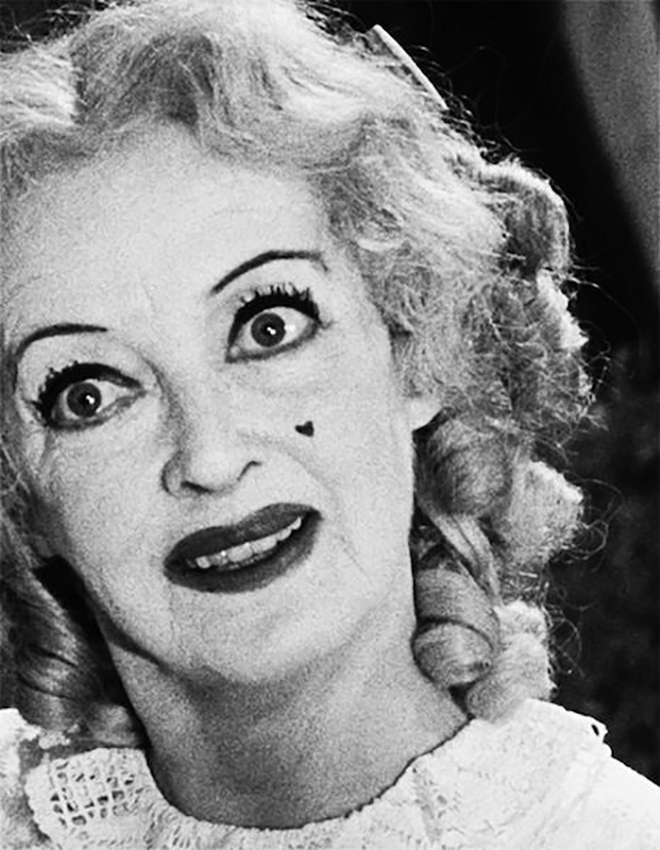
Remove the patina of camp that coats What Ever Happened to Baby Jane?, thanks in great part to the over-the-top onscreen performances by and even more over-the-top behind-the-scenes battles between leading ladies Joan Crawford and Bette Davis, and what you have is one of the most disturbing psychological breakdowns ever put to screen. You also have one of cinema’s most tragic characters in the form of “Baby” Jane Hudson.

I feel torn as to how much I want to write here about Jane. I’ve been a bit more lenient when it comes to revealing certain things about older movies, but to really get into the nitty gritty of why I think she deserves to be lauded as a Lady of Horror May-hem would require significant revelations about this movie, including one that I’m not that keen to give away here. I’d hate to deny anyone the joy of discovering this movie in all its twisted, tortuous glory.

Let it be known, though, that I think Jane Hudson’s downward spiraling is one of the most upsetting and heartbreaking cinematic presentations of mental instability. Baby Jane trumps even that “number one fan” for her inability to process reality in socially acceptable ways. Jane’s unhinged “care” of her sister Blanche, in fact, is quite the precursory permutation of Annie Wilkes’s treatment of Paul Sheldon. Jane believes that she cannot escape her past, either mentally or physically, thanks to the total dependence of Blanche upon her. Theirs is a codependency of chaotically epic proportions, and Jane’s resentment and guilt are equally palpable and poisonous to her already fragile mental state.

Watching Baby Jane’s story the first time might make you laugh. Okay, watching her story the first time will make you laugh. But watch her again. Watch her as you would watch a real person behaving in these ways. Watch her knowing how it all ends. Just watch her.
Ladies of Horror May-hem: Lana Winters

lanawinters

I briefly struggled with the fact that Lana Winters is not a horror movie heroine. However, I realized quickly that she was perfect for this month for precisely that reason. She instead made her mark as an amazing genre heroine from an equally amazing genre television show, of which there are not many options. She stands as proof that, if given the opportunity, a talented actress given a well-scripted role can bring horror to life in astonishing ways, regardless of the size of the screen.

[Loba Tangent: I also briefly struggled with the notion of combining Lana with her adversary, the stentorian Sister Jude, played to perfection by Jessica Lange. Both deserve to be included together for the fascinating interconnectedness they shared throughout their development. Plus, Lange’s performance as Jude is yet another in a series of high-quality performances from this grand dame of Hollywood elite. However, in the end, I chose Lana to stand alone as representative of this show, difficult though that decision ultimately proved to be.]

First, for full disclosure, I have only watched the second season of American Horror Story, dubbed “Asylum,” in its entirety. I tried to watch the first season, but I found it too tedious. Thankfully, each season of the series is a different story, with different characters telling the tale. Even more thankfully, the second season proved to be one of the best pieces of horror TV I’ve seen in a very long time. By taking the entire season to reveal its story, the show took its tortuously sweet time in creating a diabolical diaspora of evil intent and insufferable cruelty. I often don’t enjoy horror that showcases humanity’s penchant for violence and abuse against its own, but I can make allowances for those offerings that are done with care and precision. I can honestly say that I felt that AHS: Asylum executed both points quite well.

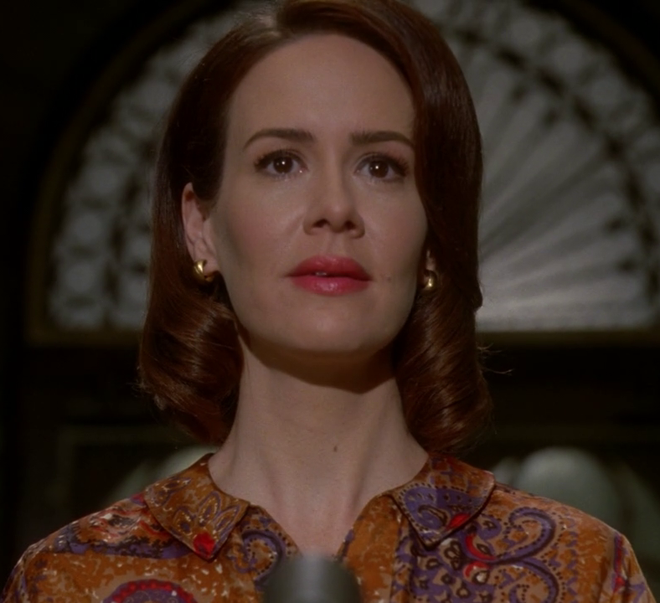
Another point well in the show’s favor was the wisdom in casting Sarah Paulson as Lana Winters, the “plucky” reporter with designs on fame for cracking open the truth behind Sister Jude and her Briarcliff Mental Institution. She could not have been a better selection to portray Lana and her almost preternatural survival reflex against the horrors in store for her. With chimeric grace, Paulson has repeatedly proven throughout her career that there has yet been a character outside the reach of her acting skills. She is one of my favorite parts of modern Hollywood, never disappointing me with her performances, even when cast in lesser roles in lesser projects. It’s taken a bit of time for the rest of Hollywood to see what I’ve seen for a while, and I couldn’t be more delighted.

Paulson’s performance acumen makes Lana such a compelling character that, even when the storyline delved into genre tropes that I rarely find tolerable let alone enjoyable, I continued along. I needed to see Lana’s story through to its completion. And, I have to say, her final moments on screen are deeply satisfying, something that quite often is not the case for horror endings. It’s admittedly much more of a commitment to discover the joy of Lana Winters as a horror heroine, but I believe that she will be well worth your time.

Ladies of Horror May-hem: Helen Lyle

helenlyle

There were a couple other names that would have been more appropriate picks for this particular holiday here in the States, but I vowed to go with whatever name I picked first. Abide by your rules, Loba. That’s my motto. And so I drew Helen Lyle, the intrepid grad student whose skepticism is no match for the Candyman.

[Loba Tangent: Again, I apologize for any spoilers I include here. I will try to be vague, but there are certain things I must include to provide a better understanding for Helen’s nomination. Do not let this dissuade you from watching this film. It’s wonderful.]

Helen was created by horror maven Clive Barker as the finder, foil, and finally believer in the history of Daniel Robitaille, a former slave who met a grisly end and found eternal resurrection as the urban legend known among the inhabitants of Cabrini Green as Candyman.

At first prone to humor and, yes, judge those whose unwavering belief in Candyman never quite convinces her, Helen continues to seek the truth behind the myth. Her curiosity is unquenchable to the point that, when she finds herself on the opposite side of laughter and judging from colleagues and mentors, she grows even more determined to root out the truth of Robitaille’s existence.

Helen is the curious cat. And we all know what curiosity does to cats.

Then again, we also learn what happens to those who become legendary. Legends never die.

Candyman has always been one of my favorite horror movies, thanks in great part to the unsettling chemistry shared between Helen and Candyman, played by Virgina Madsen and Tony Todd, respectively. In their roles as the myth and the detractor, each eager to prove their case at the expense of the other, they perform a beautifully synchronized cat-and-mouse game that you realize quite early on is not going to end well for the mouse, tenacious though she may be.

Madsen’s Helen is the detached interloper at first, separated from those who hold the key of understanding she seeks by her dismissal of their beliefs as well as the whiteness of her skin, a physical barrier for many reasons among the residents who keep Candyman’s legend alive. Barker’s counterpoint of Helen as “executioner” of the Candyman legend through her dismissal of its genuineness is poignant and, in many ways satisfying in its defeat. As a legend, Candyman can now face the threat that those like Helen once brought him…but her physical traits, which warn his believers away, draw him closer, push him to choose her, to cherish her.

“It was always you, Helen.”

In the end, Helen becomes what she seeks to disprove in a resolution that satisfies in unexpected ways. I’m not going to say anymore, even though I fear that I have already said too much. Just as long as I don’t say it four more times, I should be okay…

Ladies of Horror May-hem: Jess Bradford

jessbradford

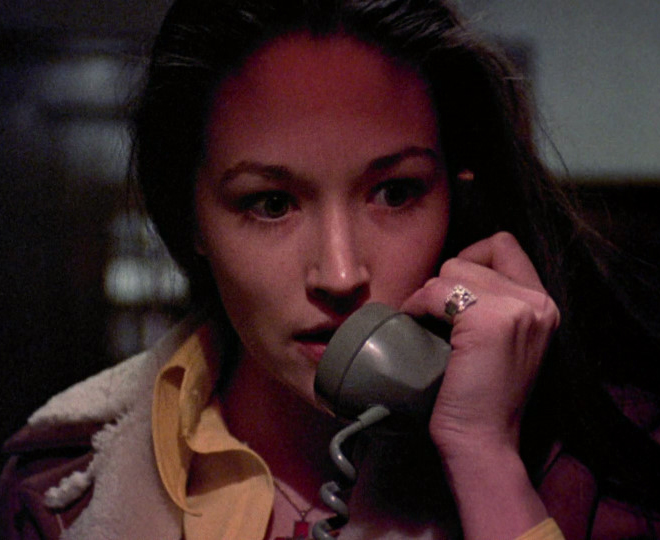
This might actually be another controversial choice, because a lot of what we see from Olivia Hussey’s character Jess Bradford in 1974’s Black Christmas is her reacting to the events transpiring around her…and her depending a lot on police to solve said events.

[Loba warning: It’s also going to spoil quite a bit from this film and a couple other films, for which I do apologize. It’s necessary to reveal certain things about this character, however, to justify my selection of her for this series. If you haven’t seen this film, then I would recommend stopping now and getting thee to the closest copy you can find.]

However, I believe that she earned her right to be a Lady of Horror May-hem for several reasons. First, (SPOILERZ) she is the originator of the slasher film “final girl” trope, proving her right to this crown by, der, surviving what many consider to be the first slasher film (blame Canada, eh?). For that reason alone, she stands at the pinnacle of horror movie greatness.

Jess does more than merely survive cinema’s very first slasher villain, however. She does so while contending with what were, at the time, several serious and controversial issues. Actually, one of them remains controversial and something that I can’t really tag as a point of stress for any other horror heroine (please feel free to correct me if I am wrong).

See, Jess has just learned that she is pregnant. Right out of the gate, she breaks the mold of “virginal survivor” that John Carpenter would cast fours years later with his final girl, Laurie Strode…a mold that wouldn’t be shattered completely until almost 20 years later by a wily young lass from Woodsboro High. As a college student looking forward to a future full of many things that do not require diaper change and feeding breaks, Jess decides to terminate this unplanned pregnancy. This does not set well with her boyfriend, who becomes a tad bit unhinged when she informs him of her decision (thus bringing him into contention as a potential suspect for the mysterious and increasingly disturbing obscene calls Jess and her sorority sisters keep receiving).

In that one paragraph, I’ve already identified three ways in which Jess stands apart as unique in the realm of horror heroines from that point in time. First, she’s obviously sexually active, thus proving that the quintessential final girl got her freak on and still survived. Then, she opts for, as I said, a still controversial decision, and she does so without first consulting with or seeking permission from her boyfriend. She stands as an early example of the evolving female identity, both in cinema and the real world. She is scared and a bit too trusting when it comes to authority (read: the expectations she has of the police actually coming through for her and her sisters), but she is also decisive, level-headed, and independent. In fact, she is one of the only sorority sisters to remain relatively grounded amidst the constant cacophonous swirl of activity surrounding her.

Hussey delivers a well-considered performance as Jess, oftentimes serving as the true house mother to her sisters (heavens knows Mrs. Mac isn’t providing much of a positive example). She comforts them, counsels them, chides them, and ultimately tries to protect them, all while contending with more stress and drama than the average college girl should ever have to deal with. Again, she is in many ways what that wily young lass from Woodsboro High will become. For all these reasons, Jess stands as the original example of what a final girl could be, in all her complex glory, if given the proper chance.

Ladies of Horror May-hem: Meg Penny

megpenny

Aw, this was the perfect draw for a Friday. I have had The Blob in mind as a potential Flashback Friday entry for a while. This remake was one of my favorite horror movies when I was a teen, for many reasons (which I might detail if I ever do add this movie to my Flashback Friday entries).

It’s also, IMHO, a perfect example of how to do a remake well. True, it has cheese galore when viewed through the prism of modern CGI capabilities (although I swear that practical effects still trump CGI any damn day). However, here are the four reasons that I think this was a successful remake: They waited a significant amount of time between the original and the remake (30 years is way more substantial than, say, the 10 years certain people waited to reboot the Spider-man franchise); during the time that passed in between the original and the remake, significant advances occurred in special effect capabilities (again, as opposed to the relative lack of advances made between 2002 and 2012); they freshened up the script so that it was the same idea but with different reasons and motivations that still worked within the parameters of the idea; and they twisted things up a bit by giving us a new hero…now a heroine in the form of Meg Penny.

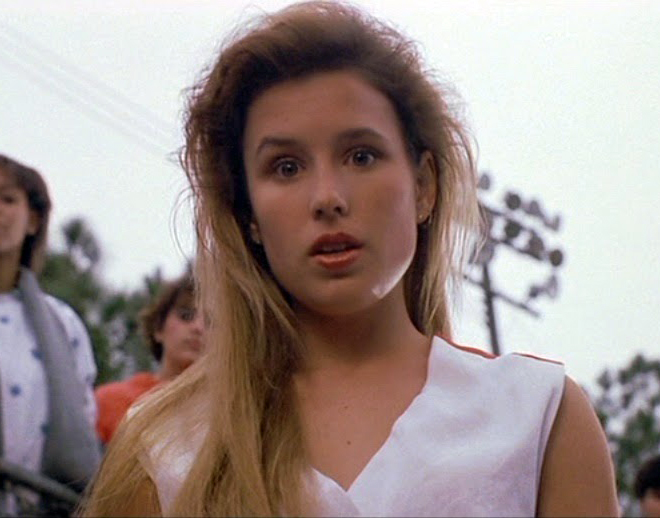
This is primarily why I have chosen Meg Penny as a Lady of Horror May-hem: She was an early example to me of how remakes can switch things up and turn earlier accepted norms upside down in the best possible ways. Rather than sticking with the original plot’s male hero, played by a “teenaged” Steve McQueen (who was nearly 30 when he made this movie and looked nearly 40), this time they chose an actual teenager! And a girl! Shawnee Smith was 17-18 years old at the time she played Meg. In a review of this movie I posted elsewhere, I wrote of Meg:

She was cute, she was sporty, she could rock pearls and a machine gun. Plus, she had this hair that was like the most awesome non-mullet mullet in the history of mulletdom. I have no idea what this hairstyle was supposed to be…but she somehow made it work.

Additionally, one of the things that has always cracked me up about Meg is that, while she has an uncanny ability to adapt to a series of increasingly bizarre and terrifying events transpiring in rapid fire, she never ever gets the chance to pull off the perfect “So, there!” exit from a situation. You know what I mean…that great exit that everyone always wants to get the chance to do at least once in their life, usually right after delivering the perfect verbal burn or rigging a charge to explode canisters of liquid nitrogen. You all know what I mean, right?

Seriously, poor Meg simply can’t catch a break when it comes to making a solid exit, and that gave her a relatable quality that I always enjoyed. She’s a horror movie heroine, but she bumbles along sometimes just like the rest of us. We won’t ever make a mullet look quite so fabulous, though. Natch.

Ladies of Horror May-hem: Asami Yamazaki

asami

Remember what I wrote about Annie Wilkes? Ramp that up by a million and you’ll enter the galaxy of Asami Yamazaki. But you still won’t quite be anywhere near her. Trust me when I say that’s a good thing.

Japanese director Takashi Miike’s Audition was one of the first movies I experienced at the rise in popularity of Asian horror here in the States. I’ve seen quite a few horror movies from places like Japan, China, Thailand, and South Korea since then, but Miike’s tale remains near the top of the list in terms of what has been seen can never be unseen.

Part of me feels guilty for adding Asami as a contender, because I can’t in good conscience recommend this movie for everyone. It’s one of those films I would only recommend to really serious horror fans. However, it’s for this very reason that I knew I couldn’t leave Asami out of the running, especially if I included Annie Wilkes (and I had to include Annie Wilkes). Both of these characters complement each other as prime examples of how the passage of time will inevitably lead to the “ramping up” of what we deem shocking or horrifying. You thought a hammer was bad? You’ve no idea.

Is this necessarily a good thing? I don’t really think I’m the right person to answer that question. My current personal horror preferences tend to lean toward those movies that introduce some kind of unexplainable (read: non-mortal-human) element into the storyline. I’ve learned that I don’t really enjoy movies that focus on the all-too-real ability of regular humans to be horrible to each other. I see what transpires in real life, and some of that makes horror movies look like Care Bear cartoons. We really are the disease, Agent Smith. Therefore, movies that depend upon the ramping up of realistic-looking violence as their sole source of “horror” aren’t really up my alley.

Why include Asami, then? Because, like Annie Wilkes, there’s a perverted logic to her behavior that makes her more than a pointlessly violent horror movie character. She has motivations that are understandable when examined through her warped view of reality (kind of like our lovely May from yesterday). I think this is one of the more interesting aspects of horror. When the story is told properly, even if you can’t imagine yourself responding in the same ways as these characters, you can understand them. Asami has obviously, to use layman’s vernacular, “seen some shit.” And whatever she’s gone through, be it internal or external, it’s seriously twisted her ability to behave in socially acceptable ways.

And that’s putting it mildly.

Also, Asami was definitely a “trial-by-fire” introduction to a new cultural perspective on the horror genre. She opened my eyes and sent me on my merrily terrified way, tearing through the foreign horror section on Netflix like a mouse loose in a cheese factory. For that, I hold a special place for her. A place far removed from my actual location. She does not need to know where I live.

Ladies of Horror May-hem: May Dove Canady

maycanady

Oh, I’ve been waiting to draw this name. After all, who better to represent the month of May-hem than that lovely, shy lass, May Canady?

Written and directed by Lucky McKee, May introduces us to this eponymous young woman, in all her lonely, socially inept glory. May’s a bit of a strange bird. She lacks any skill when it comes to interacting with others, whether it’s her overly friendly coworker Polly or hunky mechanic Adam. She’d like to connect with others, but she very obviously lacks any experience when it comes to relationships. She spent most of her life ostracized by a particularly difficult-to-manage lazy eye, which caused her to grow up practically friendless. In fact, her “best friend” Suzie is a doll her mother made for her with the explanation, “If you can’t find a friend, make one.”

Great advice, Mom. Too bad your little girl’s going to hold you to that when she grows up.

An optometrist finally helps fix May’s physical problem, but the emotional damage is already done. She does try to become more social and form normal bonds with others. She doesn’t really enjoy the entirety of others, though. She quickly realizes that people are holistically imperfect…but she is a believer that everyone has something to offer her. Something that can help make the perfect friend.

Bringing May to life was the Xenaean (yeah, I just made that up to take the place of “Herculean”; what of it?) task taken on by actress Angela Bettis. I’d never seen Bettis before this movie. Now, I can’t see her as anyone other than May at first blush. For all the terrible things that we watch May do, Bettis is able to convey those broken parts of May’s psyche in such a way that I can understand why she ends up doing the things she does. Not condone them…but understand them. Thanks to Bettis’s skill and obvious respect for this role, May’s denouement, though shocking and a little heave-inducing, makes sense when viewed through the lens of May’s shattered perspective on reality.

Ultimately, May exists as a reminder that looking solely at the exterior is never a good way to choose someone for friendship. Oh, and always be careful when giving advice to little kids. Prophets help you if they take everything you say literally…

Ladies of Horror May-hem: Mrs. Ganush

mrsganush

I love Sam Raimi. Whether directly or indirectly, he has brought so much joy into my geeky little world, be it in the form of horror or thriller or fantasy or radioactive spider. And Xena. Let’s not forget Xena. However, I love him most when he’s in his horror mode. Especially when said horror mode brings about wonder and grossness in the form of his most recent submission to the genre, 2009’s Drag Me to Hell.

The plot is pretty straight-forward: Loan officer Christine Brown refuses to grant elderly Mrs. Ganush a loan extension, thus paving the way for her to be evicted from her home, which is pretty horrific in a real-world, “you’re a bit of a douche” kind of way. What Brown doesn’t realize is that the woman she’s just evicted is not going to take this lightly. She’s also highly skilled at cursing, and not in the “drunken sailor” kind of way.

Hilarity? Oh, it doth ensue.

Mrs. Ganush is one of the most terrifyingly sympathetic characters to ever spring from the fertile depths of a mind as wonderfully warped as Raimi’s. She’s just a harmless old lady when we meet her, with her bad eye and questionable hygiene. But what transpires is a work of filthy, funky, frightening art. Raimi masterfully twists and turns the roles of protagonist and antagonist in unsettling yet ultimately fantastic ways, leaving us rooting for…well, maybe not even rooting for anyone…but loving the battle that takes place along the way. This movie reminded me how great he is at horror, and how I wish he’d do it more often.

Beyond Raimi’s influence is the miraculous casting of Lorna Raver as Mrs. Ganush. I love actresses who allow themselves to let go of all pretense and fully immerse themselves into a role, and, boy howdy, does she do just that. Raver will make sure that you do not forget Mrs. Ganush or her warped game of “Button, Button, Who’s Got the Button?” for a very long time.

I really don’t want to say anything else about Mrs. Ganush, because I really, desperately want you all to watch this movie. It’s disgusting as only a Sam Raimi horror movie can be, with body fluids galore…and a gumming. I just…there’s a gumming. And it’s So. Very. Awful.

Seriously, watch this. And brush your teeth. And bathe. And don’t take buttons from strangers. And don’t evict little old ladies from their homes. Those little old ladies will drag you down…

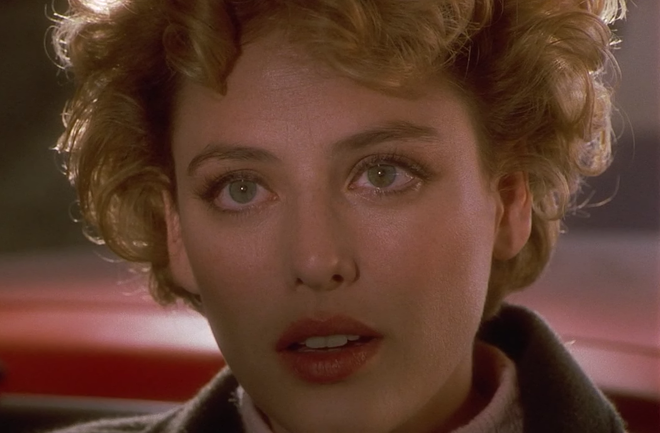
Ladies of Horror May-hem: Mary Henry

maryhenry

And finally, a regular here at the lair surfaces!

I have raved about the wonder that is Carnival of Souls for quite some time now, and yet I continue to hear it described by fellow horror hounds as “the best movie never seen.” As a full-on fan of this movie, I feel that it’s my duty to continue to sing its praises and encourage as many people as possible to see it.

That being said, I almost didn’t include Mary Henry as a possible Lady of Horror May-hem. She spends a large portion of the movie being reactive rather than proactive. However, because I’m a generous soul and because I really do love this movie so much, I allowed her to attend. After all, she is the one who sets into motion the entirety of this story thanks to her actions at the beginning. That counts! Also, she does it all by drag-racing a carload of hot-rodders. Drag-racing grrls, FTW.

Mary, as portrayed by Candace Hilligoss, also stands as the first bad-ass lady to go up against the modern cinema’s take on zombies (no, they aren’t really zombies…then again, most “zombies” we see in movies aren’t zombies either…they’re simply plays on this prototype). She stands at the pinnacle, even above George Romero’s Barbara from Night of the Living Dead. Romero even states that director Herk Harvey and writer John Clifford inspired his perennial zombie favorites.

Carnival of Souls is not your typical horror. It’s not burdened by special effects that would have aged in noticeably awkward ways. It’s streamlined and stunning, a firm and fit tale presented in the most delicious black and white shots imaginable. Harvey knew how to work that monochromatic palette. And Hilligoss’s portrayal of Mary’s downward spiral into terrified confusion is such that even when she tipples over into campiness, you never feel like she’s insincere. Just really overwhelmed by all that’s happening around her.

Another aspect that marks Mary as unique among early horror movie heroines is her unexpected hardened edge, especially regarding her take on religion. One assumes that a woman who has made church organist her profession would have a profound respect for the religion that employs her. Not so, Bob. She’s just in it for the Benjamins. In fact, she really doesn’t give much of a damn for anything other than her work and being left alone. Is this a side effect of the events of the movie, or is this her true personality? Regardless, it’s who we meet, who we observe, and who we ultimately follow to that penultimate dance that keeps luring her closer and closer as the dusk descends upon the carnival.

Ladies of Horror May-hem: Pazuzu

pazuzu

I think this might be my most controversial choice for this series. However, I stand by it 100 percent. See, for me, The Exorcist remains one of the greatest horror movies ever made. The reason stems from so many different sources, from original book to screenplay to direction to casting to practical effects to makeup to special effects…this movie had so many moving pieces that fell perfectly into place to make this well-oiled machine of a movie.

Two of the oft-overlooked but integral cogs in this wheel are the two women who helped to make the demon Pazuzu even more terrifying than a little head-spinning, naughty language, soup-puking, crucifixated little girl could by herself. First, however, I don’t wish to take away from Linda Blair’s performance as Regan MacNeil. I think she was amazing in this role, and her ability to make Regan sympathetic and believable as this vessel for the demon Pazuzu are two reasons why this movie remains as powerful as it is more than 40 years later. However, Regan as her own character does not fulfill my requirements for the Ladies of May-hem, because she is not the proactive central character. She is the receptacle for the proactive possession by Pazuzu.

Back to what I was saying. One of the creepiest recurring themes throughout the film is the split-second splash of luminescent white face we see throughout the movie (even more throughout the jazzed up re-release they did back for “the version you’ve never seen” DVD release). The flashes are so brief…just long enough for you to register that horrific visage and shiver as a result. That face was actress Eileen Dietz, see on the left:

dietz-mccambridge

The lady on the right is the one who ultimately makes Regan’s possession the most believable. Close your eyes. Now, imagine the sounds emanating from that possessed little girl. The wheezing breaths. The raspy moans. The guttural, vile, almost multi-voiced heaving and threatening and cursing and screaming and laughing…all of it, so terrible flowing from the mouth of a child.

Only it wasn’t really a child making all those noises. It was silver-screen star Mercedes McCambridge, who went uncredited for her vocal talents at first but later received the credit she most definitely deserved. McCambridge went through hell to provide those voice-overs for Regan, sometimes having the sound recorders tie her to her chair and leave her in the dark, to put her in the proper frame of mind. As if there were such a frame of mind for those sounds. Those awful, demonic, spine-shivering sounds.

Just thinking about them now is giving me a strong case of the NO.

Dietz and McCambridge actually both went uncredited for their parts in The Exorcist. However, they both helped give Pazuzu its true face and voice, thus solidifying the demonic presence even more and solidifying their places in horror history.